QUESTION IMAGE
Question
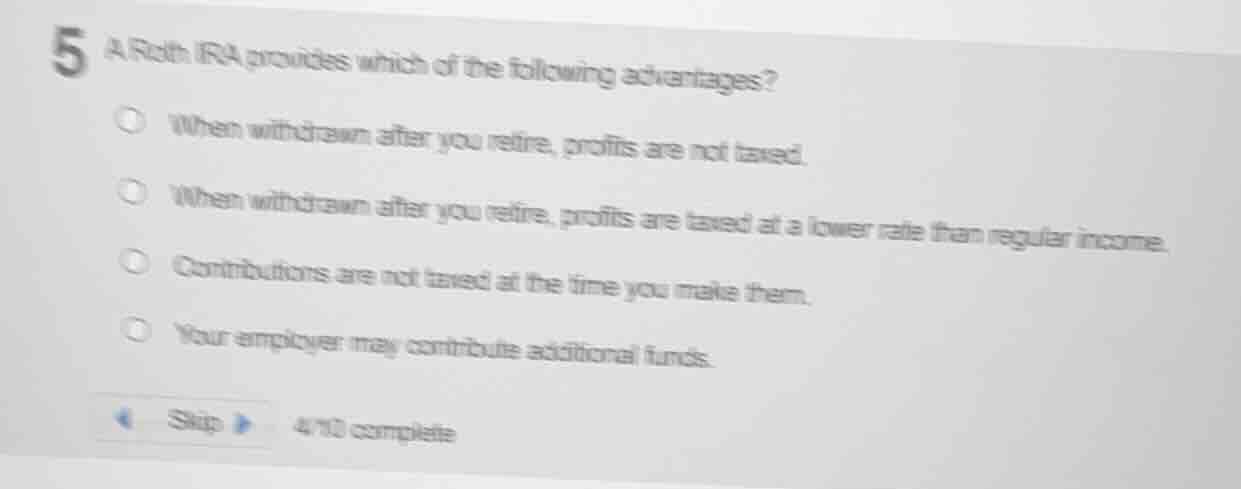
5 a roth ira provides which of the following advantages?
when withdrawn after you retire, profits are not taxed.
when withdrawn after you retire, profits are taxed at a lower rate than regular income.
contributions are not taxed at the time you make them.
your employer may contribute additional funds.
Understand the characteristics of a Roth IRA
A Roth IRA is an individual retirement account that is funded with after-tax dollars. Because contributions are made with money that has already been taxed, the primary advantage is that qualified withdrawals during retirement—including all accumulated investment earnings and profits—are completely tax-free.
Evaluate the given options
- Option 1: "When withdrawn after you retire, profits are not taxed." This is correct. Qualified distributions of earnings from a Roth IRA are tax-free.
- Option 2: "When withdrawn after you retire, profits are taxed at a lower rate than regular income." This is incorrect because qualified withdrawals are not taxed at all.
- Option 3: "Contributions are not taxed at the time you make them." This is incorrect. Roth IRA contributions are made with after-tax dollars (unlike a Traditional IRA, where contributions may be tax-deductible).
- Option 4: "Your employer may contribute additional funds." This is incorrect. IRAs are individual accounts; employer matching is a feature of employer-sponsored plans like 401(k)s.
Connect to retirement planning concepts
Using the Retirement Accounts and Retirement Planning knowledge points, we recognize that choosing between tax-deferred accounts (like Traditional IRAs) and tax-free growth accounts (like Roth IRAs) is a fundamental decision in long-term financial planning. The main benefit of a Roth IRA is the tax-free status of withdrawals in retirement.

Snap & solve any problem in the app
Get step-by-step solutions on Sovi AI
Photo-based solutions with guided steps
Explore more problems and detailed explanations
- (A) When withdrawn after you retire, profits are not taxed. (Correct answer)
- (B) When withdrawn after you retire, profits are taxed at a lower rate than regular income.
- (C) Contributions are not taxed at the time you make them.
- (D) Your employer may contribute additional funds.