QUESTION IMAGE
Question
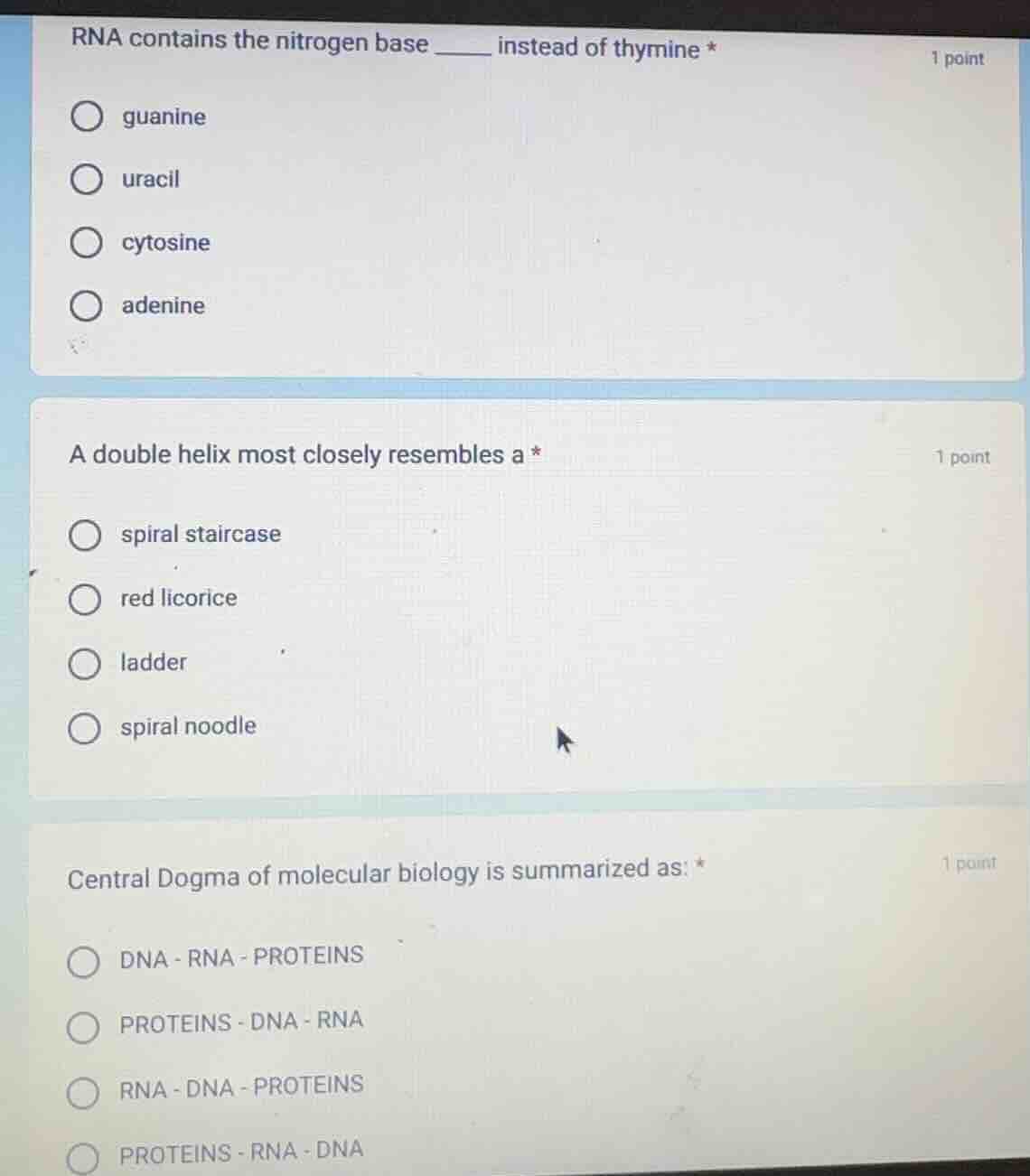
rna contains the nitrogen base ___ instead of thymine *
guanine
uracil
cytosine
adenine
a double helix most closely resembles a *
spiral staircase
red licorice
ladder
spiral noodle
central dogma of molecular biology is summarized as: *
dna - rna - proteins
proteins - dna - rna
rna - dna - proteins
proteins - rna - dna
<pre_analysis>
{
"quality": "clear",
"question_count": 3,
"skills_matched": [
"direct_cot",
"multiple_choice_formatter",
"explain_then_answer",
"quick"
],
"needs_drawing": false,
"concepts_used": [],
"new_concepts": [
"RNA Structure",
"DNA Double Helix",
"Central Dogma"
],
"current_concepts": [
"RNA Structure",
"DNA Double Helix",
"Central Dogma"
]
}
</pre_analysis>
<reasoning>
Identify the nitrogenous base unique to RNA
RNA contains adenine, cytosine, guanine, and uracil. Unlike DNA, which uses thymine, RNA uses uracil to pair with adenine.
Determine the physical analogy for a double helix
A double helix consists of two strands winding around a central axis. This structure is most commonly compared to a spiral staircase, where the handrails represent the sugar-phosphate backbones and the steps represent the base pairs.
Identify the flow of genetic information in the Central Dogma
The Central Dogma of molecular biology describes the two-step process, transcription and translation, by which the information in genes flows into proteins: DNA is transcribed into RNA, which is then translated into proteins.
</reasoning>
<answer>
Question 1
<mcq-option>guanine</mcq-option>
<mcq-correct>uracil</mcq-correct>
<mcq-option>cytosine</mcq-option>
<mcq-option>adenine</mcq-option>
Question 2
<mcq-correct>spiral staircase</mcq-correct>
<mcq-option>red licorice</mcq-option>
<mcq-option>ladder</mcq-option>
<mcq-option>spiral noodle</mcq-option>
Question 3
<mcq-correct>DNA - RNA - PROTEINS</mcq-correct>
<mcq-option>PROTEINS - DNA - RNA</mcq-option>
<mcq-option>RNA - DNA - PROTEINS</mcq-option>
<mcq-option>PROTEINS - RNA - DNA</mcq-option>
</answer>
<post_analysis>
{
"subject": "Natural Science",
"question_type": "Multiple Choice",
"knowledge_point": [
"Natural Science",
"Biology",
"Molecular Biology"
]
}
</post_analysis>
Snap & solve any problem in the app
Get step-by-step solutions on Sovi AI
Photo-based solutions with guided steps
Explore more problems and detailed explanations
<pre_analysis>
{
"quality": "clear",
"question_count": 3,
"skills_matched": [
"direct_cot",
"multiple_choice_formatter",
"explain_then_answer",
"quick"
],
"needs_drawing": false,
"concepts_used": [],
"new_concepts": [
"RNA Structure",
"DNA Double Helix",
"Central Dogma"
],
"current_concepts": [
"RNA Structure",
"DNA Double Helix",
"Central Dogma"
]
}
</pre_analysis>
<reasoning>
Identify the nitrogenous base unique to RNA
RNA contains adenine, cytosine, guanine, and uracil. Unlike DNA, which uses thymine, RNA uses uracil to pair with adenine.
Determine the physical analogy for a double helix
A double helix consists of two strands winding around a central axis. This structure is most commonly compared to a spiral staircase, where the handrails represent the sugar-phosphate backbones and the steps represent the base pairs.
Identify the flow of genetic information in the Central Dogma
The Central Dogma of molecular biology describes the two-step process, transcription and translation, by which the information in genes flows into proteins: DNA is transcribed into RNA, which is then translated into proteins.
</reasoning>
<answer>
Question 1
<mcq-option>guanine</mcq-option>
<mcq-correct>uracil</mcq-correct>
<mcq-option>cytosine</mcq-option>
<mcq-option>adenine</mcq-option>
Question 2
<mcq-correct>spiral staircase</mcq-correct>
<mcq-option>red licorice</mcq-option>
<mcq-option>ladder</mcq-option>
<mcq-option>spiral noodle</mcq-option>
Question 3
<mcq-correct>DNA - RNA - PROTEINS</mcq-correct>
<mcq-option>PROTEINS - DNA - RNA</mcq-option>
<mcq-option>RNA - DNA - PROTEINS</mcq-option>
<mcq-option>PROTEINS - RNA - DNA</mcq-option>
</answer>
<post_analysis>
{
"subject": "Natural Science",
"question_type": "Multiple Choice",
"knowledge_point": [
"Natural Science",
"Biology",
"Molecular Biology"
]
}
</post_analysis>