Sovi.AI - AI Math Tutor

Scan to solve math questions

QUESTION IMAGE

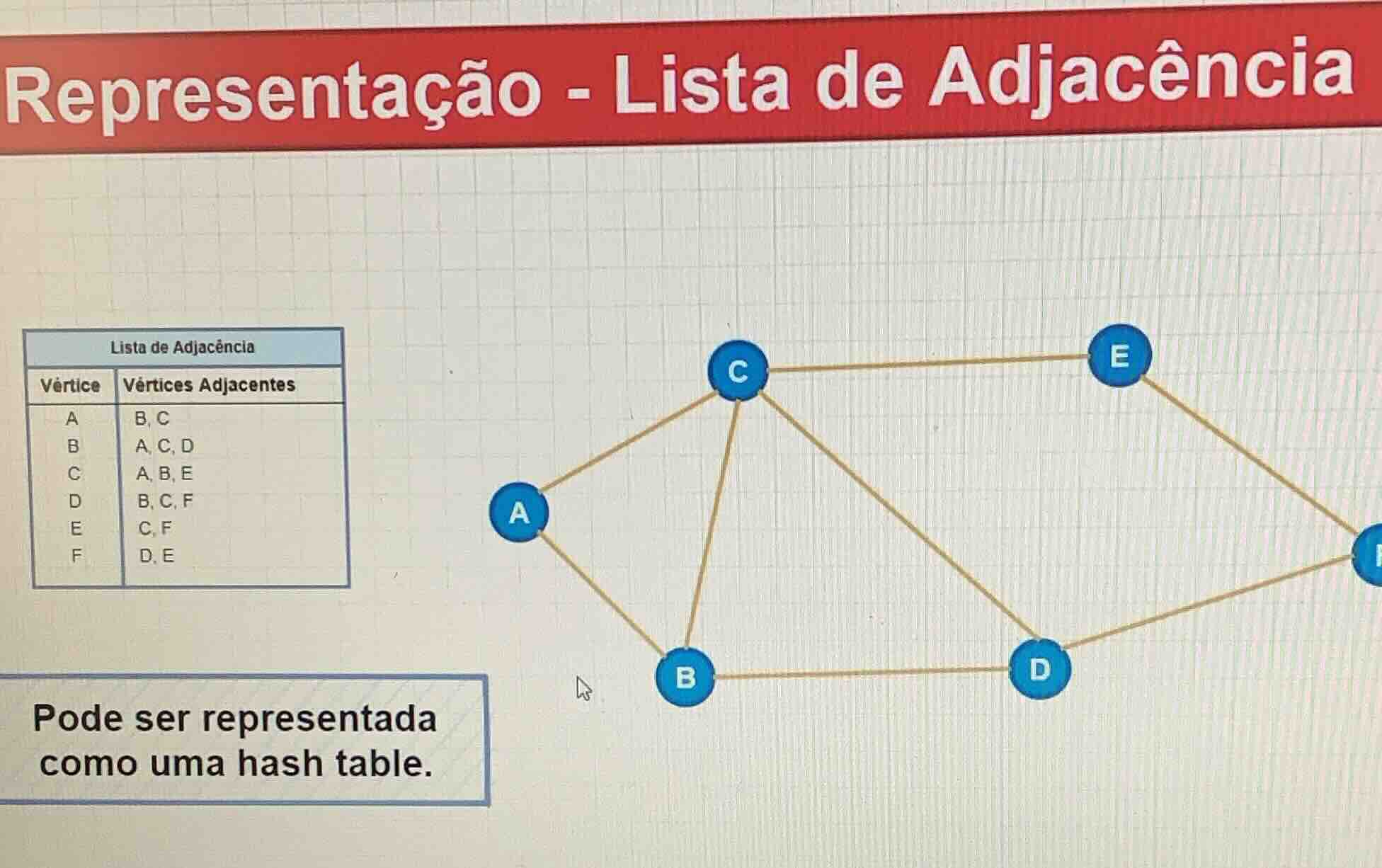
representação - lista de adjacência lista de adjacência vertice | verti…

Question

representação - lista de adjacência

lista de adjacência
vertice | vertices adjacentes
a | b, c
b | a, c, d
c | a, b, e
d | b, c, f
e | c, f
f | d, e

pode ser representada como uma hash table.

Explanation:

Response

<pre_analysis>
{
"quality": "clear",
"question_count": 1,
"skills_matched": [
"direct_cot",
"explain_then_answer",
"quick"
],
"needs_drawing": false,
"concepts_used": [],
"new_concepts": [
"Adjacency List",
"Graph Representation",
"Hash Table"
],
"current_concepts": [
"Adjacency List",
"Graph Representation",
"Hash Table"
]
}
</pre_analysis>

<reasoning>

验证邻接表与图的对应关系

\[

$$\begin{aligned} &\text{A: } \{B, C\} \implies \text{正确(连接 B, C)} \\ &\text{B: } \{A, C, D\} \implies \text{正确(连接 A, C, D)} \\ &\text{C: } \{A, B, E\} \implies \text{不完整(图中 C 还连接了 D)} \\ &\text{D: } \{B, C, F\} \implies \text{正确(连接 B, C, F)} \\ &\text{E: } \{C, F\} \implies \text{不完整(图中 E 还连接了 F,但 C-E-F 关系需确认)} \\ &\text{F: } \{D, E\} \implies \text{正确(连接 D, E)} \end{aligned}$$

\]

分析哈希表表示法的可行性

\[

$$\begin{aligned} &\text{Key: 顶点 (Vertex)} \\ &\text{Value: 邻接顶点列表 (List of Adjacent Vertices)} \\ &\text{结论: 邻接表完全可以使用哈希表(Hash Table)来实现。} \end{aligned}$$

\]
</reasoning>

<answer>
该图展示了图的邻接表表示法(Representação - Lista de Adjacência)

对于底部的陈述:
"Pode ser representada como uma hash table."(可以表示为一个哈希表。)

这是一个正确(True)的陈述。在计算机科学中,邻接表通常使用哈希表来实现,其中图的每个顶点作为键(Key),其相邻顶点的列表或集合作为值(Value)。
</answer>

<post_analysis>
{
"subject": "Mathematics",
"question_type": "Free Response",
"knowledge_point": [
"Mathematics",
"Geometry",
"Graph Theory"
]
}
</post_analysis>

Answer:

<pre_analysis>
{
"quality": "clear",
"question_count": 1,
"skills_matched": [
"direct_cot",
"explain_then_answer",
"quick"
],
"needs_drawing": false,
"concepts_used": [],
"new_concepts": [
"Adjacency List",
"Graph Representation",
"Hash Table"
],
"current_concepts": [
"Adjacency List",
"Graph Representation",
"Hash Table"
]
}
</pre_analysis>

<reasoning>

验证邻接表与图的对应关系

\[

$$\begin{aligned} &\text{A: } \{B, C\} \implies \text{正确(连接 B, C)} \\ &\text{B: } \{A, C, D\} \implies \text{正确(连接 A, C, D)} \\ &\text{C: } \{A, B, E\} \implies \text{不完整(图中 C 还连接了 D)} \\ &\text{D: } \{B, C, F\} \implies \text{正确(连接 B, C, F)} \\ &\text{E: } \{C, F\} \implies \text{不完整(图中 E 还连接了 F,但 C-E-F 关系需确认)} \\ &\text{F: } \{D, E\} \implies \text{正确(连接 D, E)} \end{aligned}$$

\]

分析哈希表表示法的可行性

\[

$$\begin{aligned} &\text{Key: 顶点 (Vertex)} \\ &\text{Value: 邻接顶点列表 (List of Adjacent Vertices)} \\ &\text{结论: 邻接表完全可以使用哈希表(Hash Table)来实现。} \end{aligned}$$

\]
</reasoning>

<answer>
该图展示了图的邻接表表示法(Representação - Lista de Adjacência)

对于底部的陈述:
"Pode ser representada como uma hash table."(可以表示为一个哈希表。)

这是一个正确(True)的陈述。在计算机科学中,邻接表通常使用哈希表来实现,其中图的每个顶点作为键(Key),其相邻顶点的列表或集合作为值(Value)。
</answer>

<post_analysis>
{
"subject": "Mathematics",
"question_type": "Free Response",
"knowledge_point": [
"Mathematics",
"Geometry",
"Graph Theory"
]
}
</post_analysis>