QUESTION IMAGE
Question
remarks on the signing of the civil rights act
by lyndon b. johnson
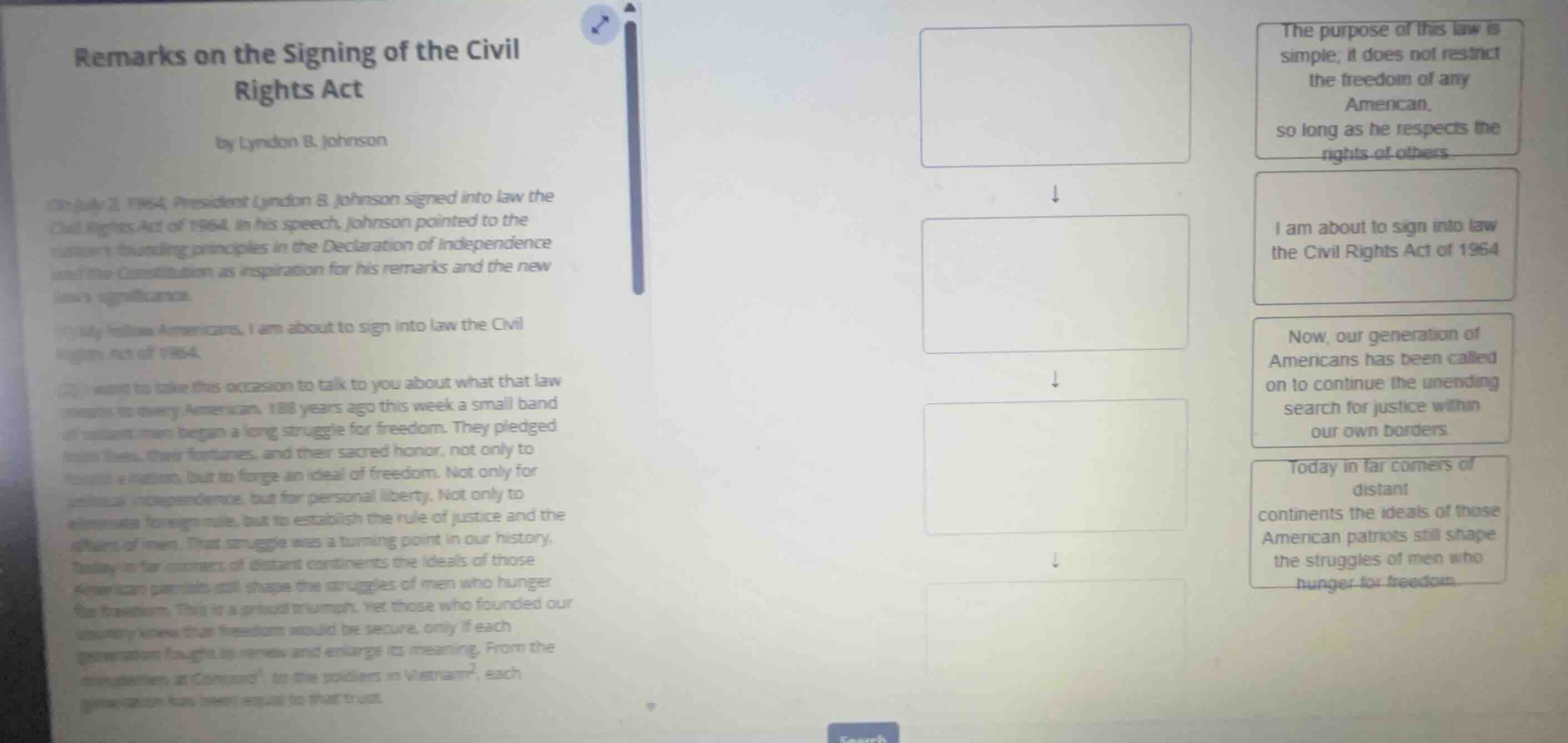
on july 2, 1964, president lyndon b. johnson signed into law the civil rights act of 1964. in his speech, johnson pointed to the nations founding principles in the declaration of independence and the constitution as inspiration for his remarks and the new laws significance.
my fellow americans, i am about to sign into law the civil rights act of 1964.
i want to take this occasion to talk to you about what that law means to every american. 188 years ago this week a small band of valiant men began a long struggle for freedom. they pledged their lives, their fortunes, and their sacred honor, not only to found a nation, but to forge an ideal of freedom. not only for political independence, but for personal liberty. not only to eliminate foreign rule, but to establish the rule of justice and the affairs of men. that struggle was a turning point in our history. today in far corners of distant continents the ideals of those american patriots still shape the struggles of men who hunger for freedom. this is a proud triumph. yet those who founded our country knew that freedom would be secure, only if each generation fought to renew and enlarge its meaning. from the minutemen at concord to the soldiers in vietnam, each generation has been equal to that trust.
drag and drop options
- the purpose of this law is simple; it does not restrict the freedom of any american, so long as he respects the rights of others.
- i am about to sign into law the civil rights act of 1964.
- now, our generation of americans has been called on to continue the unending search for justice within our own borders.
- today in far corners of distant continents the ideals of those american patriots still shape the struggles of men who hunger for freedom.
Analyze the source text structure
Using the Text Structure Analysis knowledge point, we examine the left-hand column containing Lyndon B. Johnson's speech, "Remarks on the Signing of the Civil Rights Act."
- Paragraph 1 (introductory context, not part of the speech text): "On July 2, 1964, President Lyndon B. Johnson signed into law..."
- Paragraph 2 (marked with "[1]"): "My fellow Americans, I am about to sign into law the Civil Rights Act of 1964."
- Paragraph 3 (marked with "[2]"): "I want to take this occasion to talk to you about what that law means to every American. 188 years ago this week a small band of valiant men began a long struggle for freedom... Today in far corners of distant continents the ideals of those American patriots still shape the struggles of men who hunger for freedom..."
Sequence the speech excerpts
Using the Plot Sequencing knowledge point, we match the draggable cards on the right to their chronological order of appearance in the speech text:
- First Box: The speech begins directly with:
"I am about to sign into law the Civil Rights Act of 1964" (from paragraph [1]).
- Second Box: Later in paragraph [2], the text mentions:
"Today in far corners of distant continents the ideals of those American patriots still shape the struggles of men who hunger for freedom."
- Third Box: Following that sentence in paragraph [2], the text continues:
"Now, our generation of Americans has been called on to continue the unending search for justice within our own borders."
- Fourth Box: Further down in the speech (subsequent paragraphs not fully visible but historically following the opening call to action), Johnson clarifies the purpose of the law:
"The purpose of this law is simple; it does not restrict the freedom of any American, so long as he respects the rights of others."
This establishes the correct top-to-bottom sequence for the flowchart.

Snap & solve any problem in the app
Get step-by-step solutions on Sovi AI
Photo-based solutions with guided steps
Explore more problems and detailed explanations
To complete the flowchart in the correct chronological order of the speech, place the cards in the following sequence from top to bottom:
- First Box (Top):
I am about to sign into law the Civil Rights Act of 1964
- Second Box:
Today in far corners of distant continents the ideals of those American patriots still shape the struggles of men who hunger for freedom.
- Third Box:
Now, our generation of Americans has been called on to continue the unending search for justice within our own borders.
- Fourth Box (Bottom):
The purpose of this law is simple; it does not restrict the freedom of any American, so long as he respects the rights of others.