QUESTION IMAGE
Question
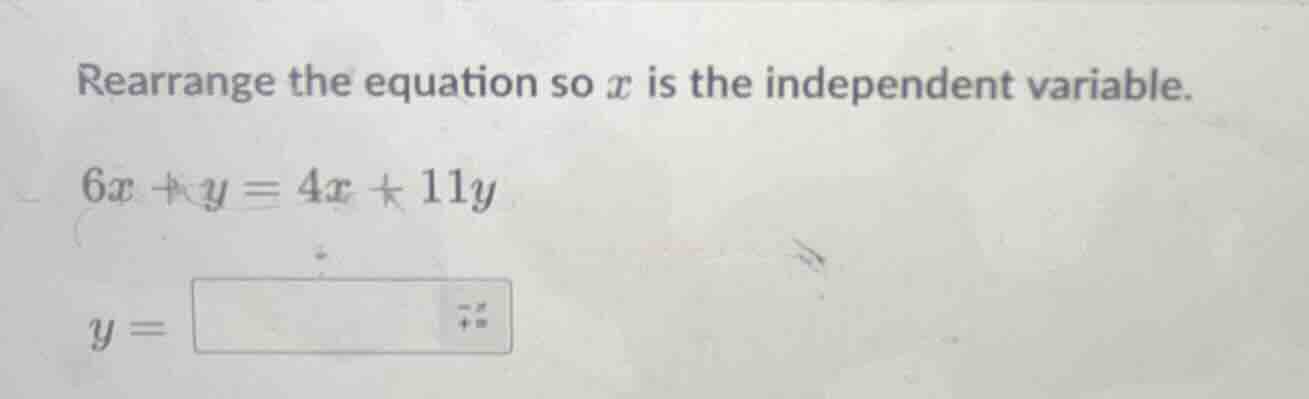
rearrange the equation so x is the independent variable. 6x + y = 4x + 11y y =
Step1: Subtract 4x and y from both sides
To isolate the terms with \( y \) on one side and terms with \( x \) on the other, we subtract \( 4x \) and \( y \) from both sides of the equation \( 6x + y = 4x + 11y \).
Step2: Simplify both sides
Simplifying the left side: \( 6x - 4x + y - y = 2x \).
Simplifying the right side: \( 4x - 4x + 11y - y = 10y \). Wait, no, actually, after step 1, we should have:
Left side: \( 6x - 4x + y - y = 2x \)
Right side: \( 4x - 4x + 11y - y = 10y \)? No, that's incorrect. Wait, let's redo step 1 correctly. We want to get all \( x \) terms on one side and \( y \) terms on the other. So subtract \( 4x \) from both sides and subtract \( 11y \) from both sides? Wait, no, original equation: \( 6x + y = 4x + 11y \). Let's subtract \( 4x \) from both sides: \( 6x - 4x + y = 11y \), which is \( 2x + y = 11y \). Then subtract \( y \) from both sides: \( 2x = 11y - y \), which is \( 2x = 10y \)? No, that's not right. Wait, no, to solve for \( y \) in terms of \( x \), we can collect like terms. Let's move all \( x \) terms to the left and \( y \) terms to the right. So subtract \( 4x \) from both sides: \( 6x - 4x + y = 11y \), so \( 2x + y = 11y \). Then subtract \( y \) from both sides: \( 2x = 11y - y \), so \( 2x = 10y \)? No, that's incorrect. Wait, no, the correct way is: starting with \( 6x + y = 4x + 11y \), subtract \( 4x \) from both sides: \( 2x + y = 11y \), then subtract \( 11y \) from both sides: \( 2x + y - 11y = 0 \), so \( 2x - 10y = 0 \), then add \( 10y \) to both sides: \( 2x = 10y \), then divide both sides by 10: \( y = \frac{2x}{10} \), which simplifies to \( y = \frac{x}{5} \). Wait, let's do it step by step correctly.
Starting over:
Equation: \( 6x + y = 4x + 11y \)
Step 1: Subtract \( 4x \) from both sides:
\( 6x - 4x + y = 11y \)
Simplify left side: \( 2x + y = 11y \)
Step 2: Subtract \( 11y \) from both sides:
\( 2x + y - 11y = 0 \)
Simplify: \( 2x - 10y = 0 \)
Step 3: Add \( 10y \) to both sides:
\( 2x = 10y \)
Step 4: Divide both sides by 10:
\( y = \frac{2x}{10} \)
Simplify the fraction: \( \frac{2x}{10} = \frac{x}{5} \)
Wait, that's correct. Alternatively, let's do it by moving \( y \) terms to one side and \( x \) terms to the other.
Original equation: \( 6x + y = 4x + 11y \)
Subtract \( 4x \) from both sides: \( 2x + y = 11y \)
Subtract \( 11y \) from both sides: \( 2x = 10y \)
Then divide both sides by 10: \( y = \frac{2x}{10} = \frac{x}{5} \)
Yes, that's correct.

Snap & solve any problem in the app
Get step-by-step solutions on Sovi AI
Photo-based solutions with guided steps
Explore more problems and detailed explanations
\( y = \frac{1}{5}x \) (or \( y = \frac{x}{5} \))