QUESTION IMAGE
Question
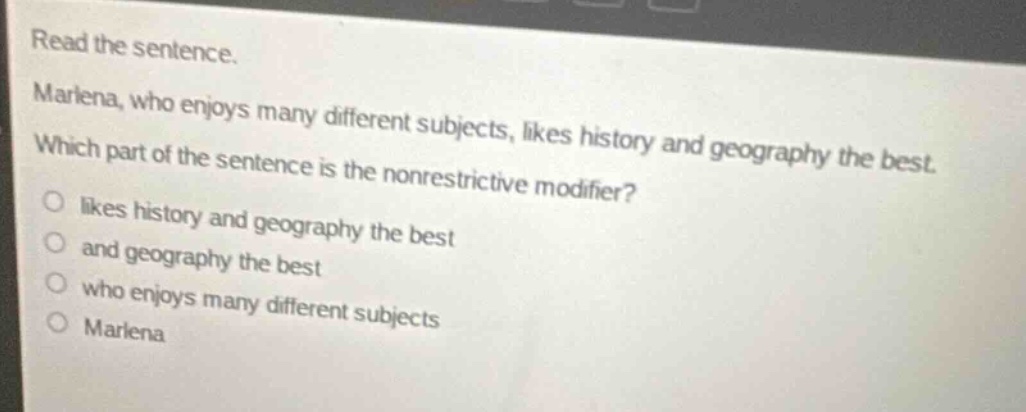
read the sentence.
marlena, who enjoys many different subjects, likes history and geography the best.
which part of the sentence is the nonrestrictive modifier?
likes history and geography the best
and geography the best
who enjoys many different subjects
marlena
🆕 New Concept Discovered: Nonrestrictive Modifiers
Extra information set off by commas
Step 1: Define a nonrestrictive modifier
A nonrestrictive modifier adds extra, non-essential information to a sentence. If you remove it, the sentence still makes complete sense and retains its core meaning. In writing, nonrestrictive modifiers are set off from the rest of the sentence by commas.
Step 2: Analyze the sentence structure
Let's look at the sentence:
"Marlena, who enjoys many different subjects, likes history and geography the best."
- Subject: Marlena
- Main Verb/Predicate: likes history and geography the best
- Extra Information: ", who enjoys many different subjects,"
If we remove the phrase "who enjoys many different subjects", the sentence still functions perfectly:
"Marlena likes history and geography the best."
Step 3: Identify the correct option
Because the clause "who enjoys many different subjects" is surrounded by commas and adds non-essential details about Marlena, it is the nonrestrictive modifier.

Snap & solve any problem in the app
Get step-by-step solutions on Sovi AI
Photo-based solutions with guided steps
Explore more problems and detailed explanations
who enjoys many different subjects