QUESTION IMAGE
Question
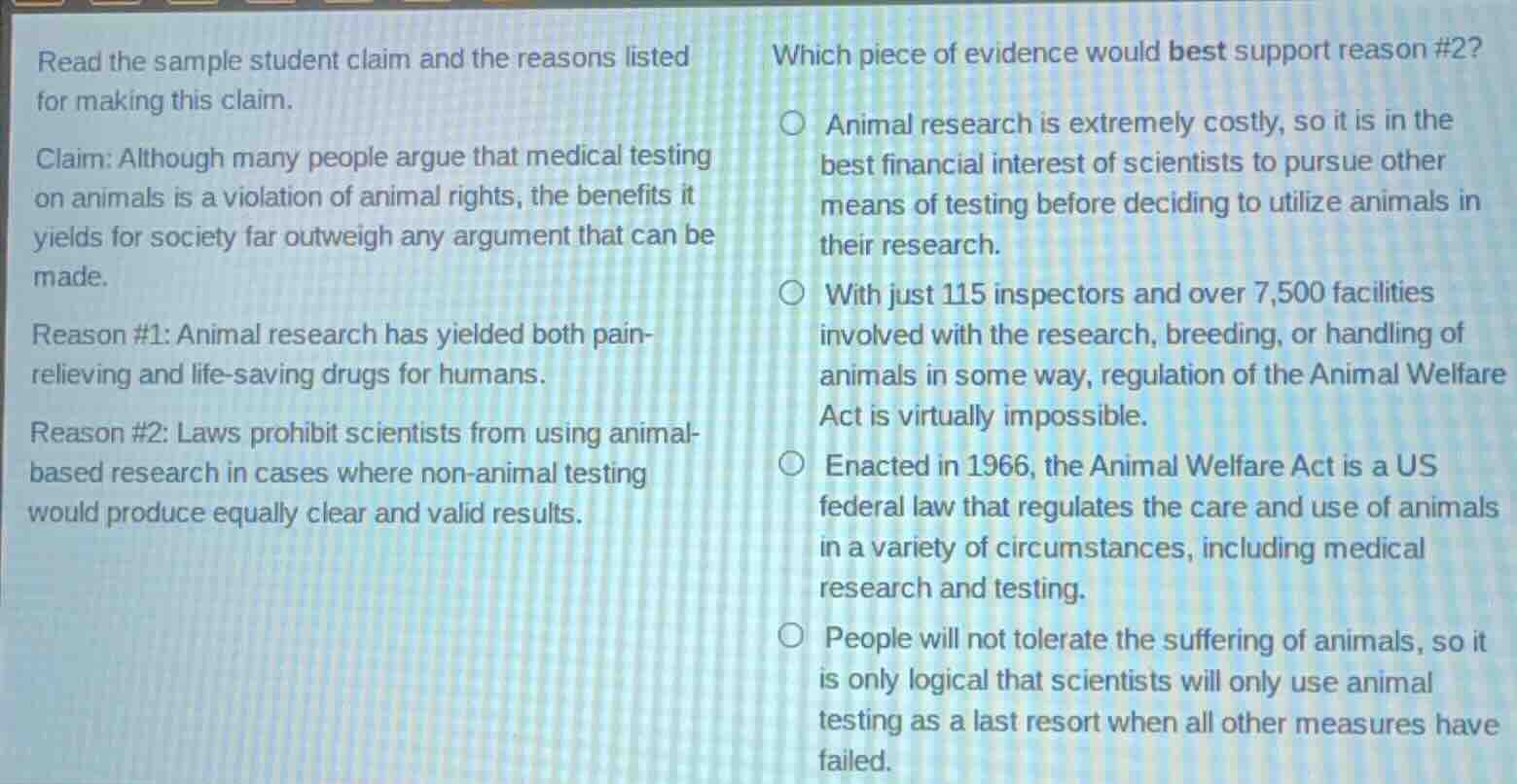
read the sample student claim and the reasons listed for making this claim.
claim: although many people argue that medical testing on animals is a violation of animal rights, the benefits it yields for society far outweigh any argument that can be made.
reason #1: animal research has yielded both pain-relieving and life-saving drugs for humans.
reason #2: laws prohibit scientists from using animal-based research in cases where non-animal testing would produce equally clear and valid results.
which piece of evidence would best support reason #2?
animal research is extremely costly, so it is in the best financial interest of scientists to pursue other means of testing before deciding to utilize animals in their research.
with just 115 inspectors and over 7,500 facilities involved with the research, breeding, or handling of animals in some way, regulation of the animal welfare act is virtually impossible.
enacted in 1966, the animal welfare act is a us federal law that regulates the care and use of animals in a variety of circumstances, including medical research and testing.
people will not tolerate the suffering of animals, so it is only logical that scientists will only use animal testing as a last resort when all other measures have failed.
Analyze the target reason
The question asks which piece of evidence best supports "Reason #2".
Reason #2 states: "Laws prohibit scientists from using animal-based research in cases where non-animal testing would produce equally clear and valid results."
This reason focuses specifically on the existence of legal prohibitions (laws) that restrict animal testing when alternative, non-animal methods are equally effective.
Evaluate the first option
- Option 1: "Animal research is extremely costly, so it is in the best financial interest of scientists to pursue other means of testing..."
- Analysis: This option discusses financial costs and economic incentives, not legal prohibitions or laws. Therefore, it does not support Reason #2.
Evaluate the second option
- Option 2: "With just 115 inspectors and over 7,500 facilities... regulation of the Animal Welfare Act is virtually impossible."
- Analysis: This option highlights the failure or difficulty of enforcing regulations, which weakens the idea of effective legal prohibitions rather than supporting the claim that laws successfully prohibit certain testing.
Evaluate the third option
- Option 3: "Enacted in 1966, the Animal Welfare Act is a US federal law that regulates the care and use of animals in a variety of circumstances, including medical research and testing."
- Analysis: While this mentions a law regulating animal use, it only describes general care and use regulations. It does not state that the law prohibits animal testing when valid non-animal alternatives exist.
Evaluate the fourth option
- Option 4: "People will not tolerate the suffering of animals, so it is only logical that scientists will only use animal testing as a last resort when all other measures have failed."
- Analysis: This option focuses on public tolerance and logical choices by scientists, rather than legal mandates or laws.
Re-evaluating the options for legal restrictions
Let's look closer at the options to see if one of them directly aligns with the legal restriction of using alternatives.
- Reason #2: "Laws prohibit scientists from using animal-based research in cases where non-animal testing would produce equally clear and valid results."
- Let's re-examine Option 3: The Animal Welfare Act (AWA) and its amendments actually contain provisions requiring researchers to consider alternatives to painful procedures and to demonstrate that no alternative is available. However, looking at the literal text of the options provided:
- Option 1: Cost-based.
- Option 2: Enforcement difficulty of the Animal Welfare Act.
- Option 3: "Enacted in 1966, the Animal Welfare Act is a US federal law that regulates..." This establishes the existence of a federal law regulating medical research and testing on animals, serving as the foundational legal framework that would contain such prohibitions.
- Option 4: Public opinion/logic.
Among the choices, Option 3 is the only one that provides factual, objective Argumentative Evidence regarding actual "laws" (specifically, the Animal Welf…

Snap & solve any problem in the app
Get step-by-step solutions on Sovi AI
Photo-based solutions with guided steps
Explore more problems and detailed explanations
- (A) Animal research is extremely costly, so it is in the best financial interest of scientists to pursue other means of testing before deciding to utilize animals in their research.
- (B) With just 115 inspectors and over 7,500 facilities involved with the research, breeding, or handling of animals in some way, regulation of the Animal Welfare Act is virtually impossible.
- (C) Enacted in 1966, the Animal Welfare Act is a US federal law that regulates the care and use of animals in a variety of circumstances, including medical research and testing. (Correct answer)
- (D) People will not tolerate the suffering of animals, so it is only logical that scientists will only use animal testing as a last resort when all other measures have failed.