QUESTION IMAGE
Question
read the passage.
teens deserve access to public spaces
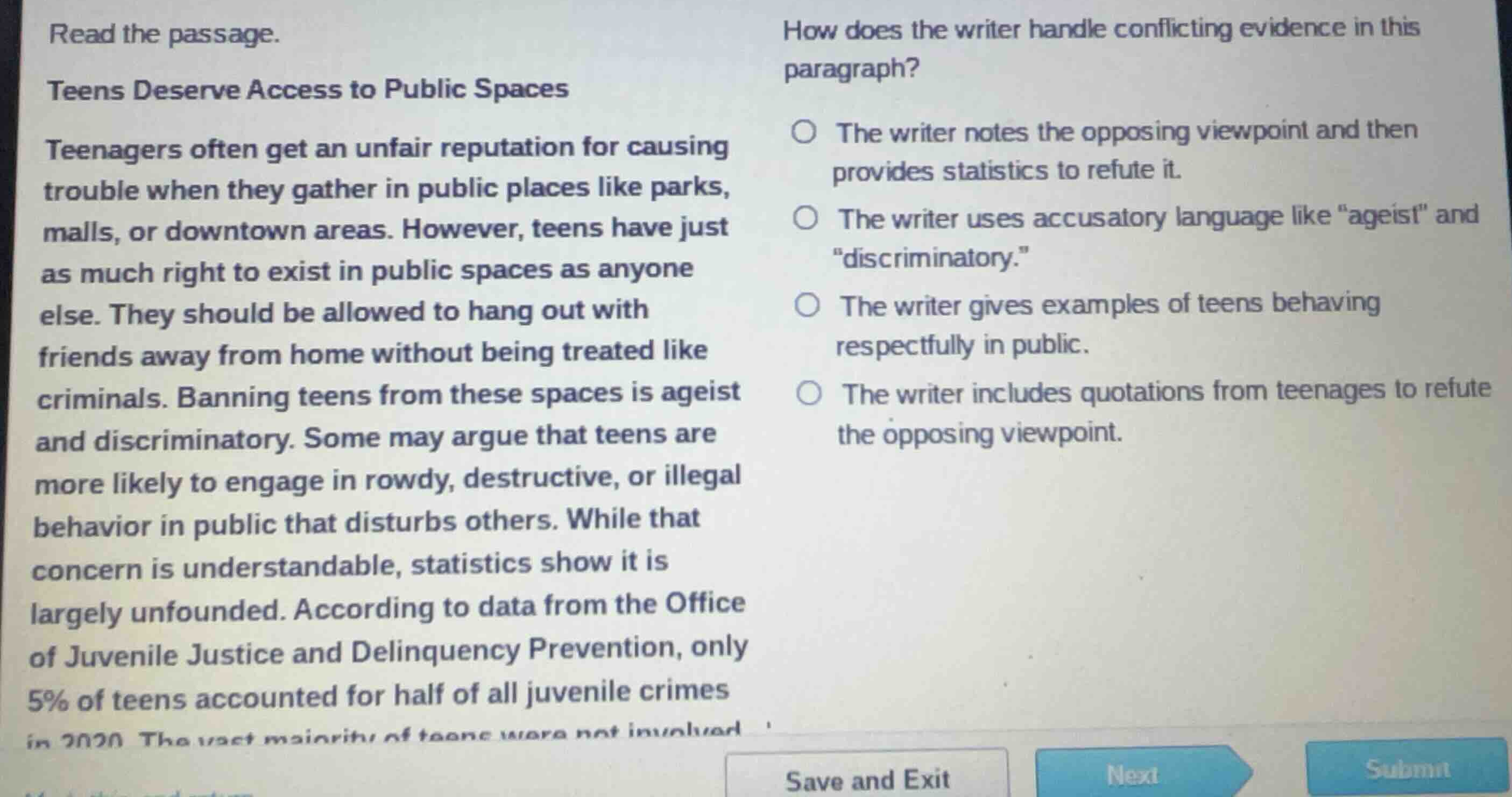
teenagers often get an unfair reputation for causing trouble when they gather in public places like parks, malls, or downtown areas. however, teens have just as much right to exist in public spaces as anyone else. they should be allowed to hang out with friends away from home without being treated like criminals. banning teens from these spaces is ageist and discriminatory. some may argue that teens are more likely to engage in rowdy, destructive, or illegal behavior in public that disturbs others. while that concern is understandable, statistics show it is largely unfounded. according to data from the office of juvenile justice and delinquency prevention, only 5% of teens accounted for half of all juvenile crimes in 2020. the vast majority of teens were not involved...
how does the writer handle conflicting evidence in this paragraph?
- the writer notes the opposing viewpoint and then provides statistics to refute it.
- the writer uses accusatory language like \ageist\ and \discriminatory.\
- the writer gives examples of teens behaving respectfully in public.
- the writer includes quotations from teenagers to refute the opposing viewpoint.
Identify the opposing viewpoint in the text
The text introduces the counterargument: "Some may argue that teens are more likely to engage in rowdy, destructive, or illegal behavior in public that disturbs others."
Analyze the writer's response to the counterargument
The writer acknowledges this concern ("While that concern is understandable...") and immediately refutes it using data: "...statistics show it is largely unfounded. According to data from the Office of Juvenile Justice and Delinquency Prevention, only 5% of teens accounted for half of all juvenile crimes in 2020."
Match with the correct multiple-choice option
The writer addresses the conflicting evidence by noting the opposing viewpoint and then presenting statistical data to disprove it, which directly matches the first option.

Snap & solve any problem in the app
Get step-by-step solutions on Sovi AI
Photo-based solutions with guided steps
Explore more problems and detailed explanations
- (A) The writer notes the opposing viewpoint and then provides statistics to refute it. (Correct answer)
- (B) The writer uses accusatory language like "ageist" and "discriminatory."
- (C) The writer gives examples of teens behaving respectfully in public.
- (D) The writer includes quotations from teenagers to refute the opposing viewpoint.