QUESTION IMAGE
Question
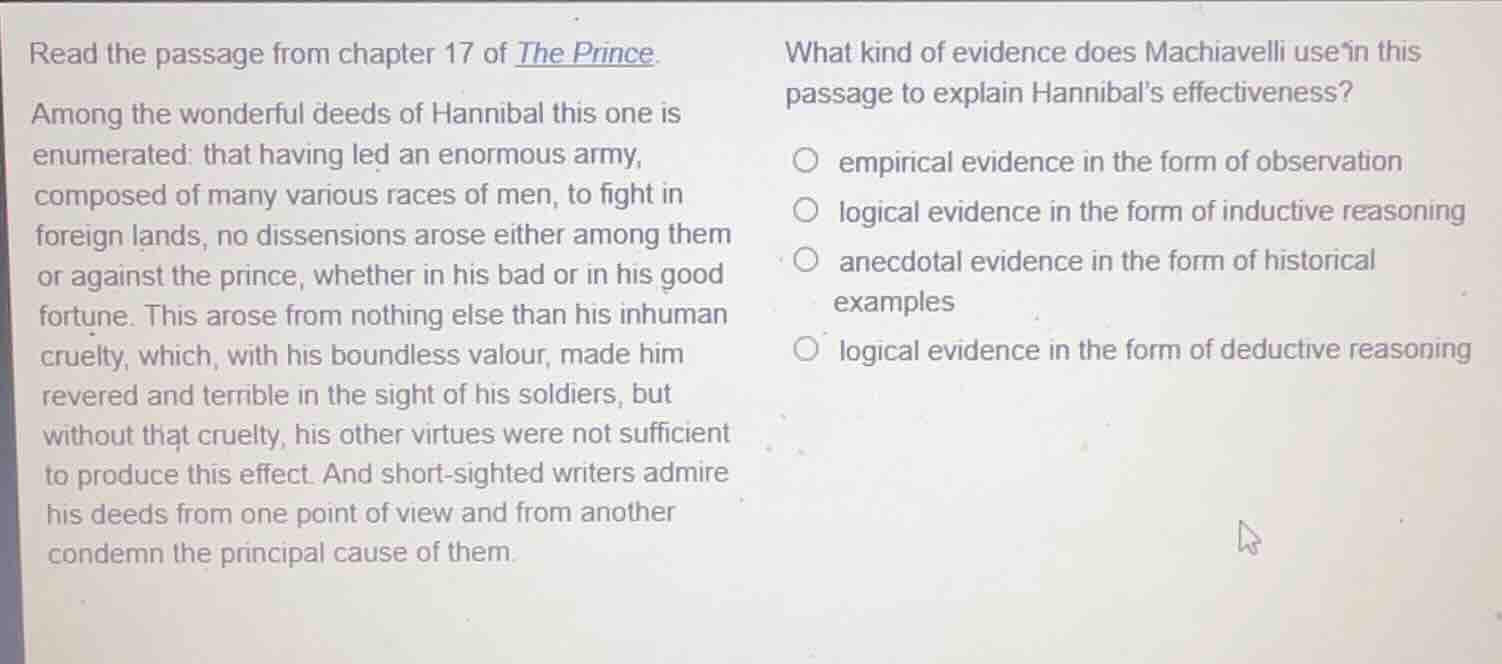
read the passage from chapter 17 of the prince.
among the wonderful deeds of hannibal this one is enumerated: that having led an enormous army, composed of many various races of men, to fight in foreign lands, no dissensions arose either among them or against the prince, whether in his bad or in his good fortune. this arose from nothing else than his inhuman cruelty, which, with his boundless valour, made him revered and terrible in the sight of his soldiers, but without that cruelty, his other virtues were not sufficient to produce this effect. and short - sighted writers admire his deeds from one point of view and from another condemn the principal cause of them.
what kind of evidence does machiavelli use in this passage to explain hannibal’s effectiveness?
- empirical evidence in the form of observation
- logical evidence in the form of inductive reasoning
- anecdotal evidence in the form of historical examples
- logical evidence in the form of deductive reasoning
Machiavelli uses a specific historical account of Hannibal's leadership of a multi-racial army without internal conflict to explain his effectiveness. This is a specific historical story/example, which fits anecdotal evidence in historical form. The passage does not rely on direct observation, inductive/deductive logical reasoning, but a historical anecdote.

Snap & solve any problem in the app
Get step-by-step solutions on Sovi AI
Photo-based solutions with guided steps
Explore more problems and detailed explanations
C. anecdotal evidence in the form of historical examples