QUESTION IMAGE
Question
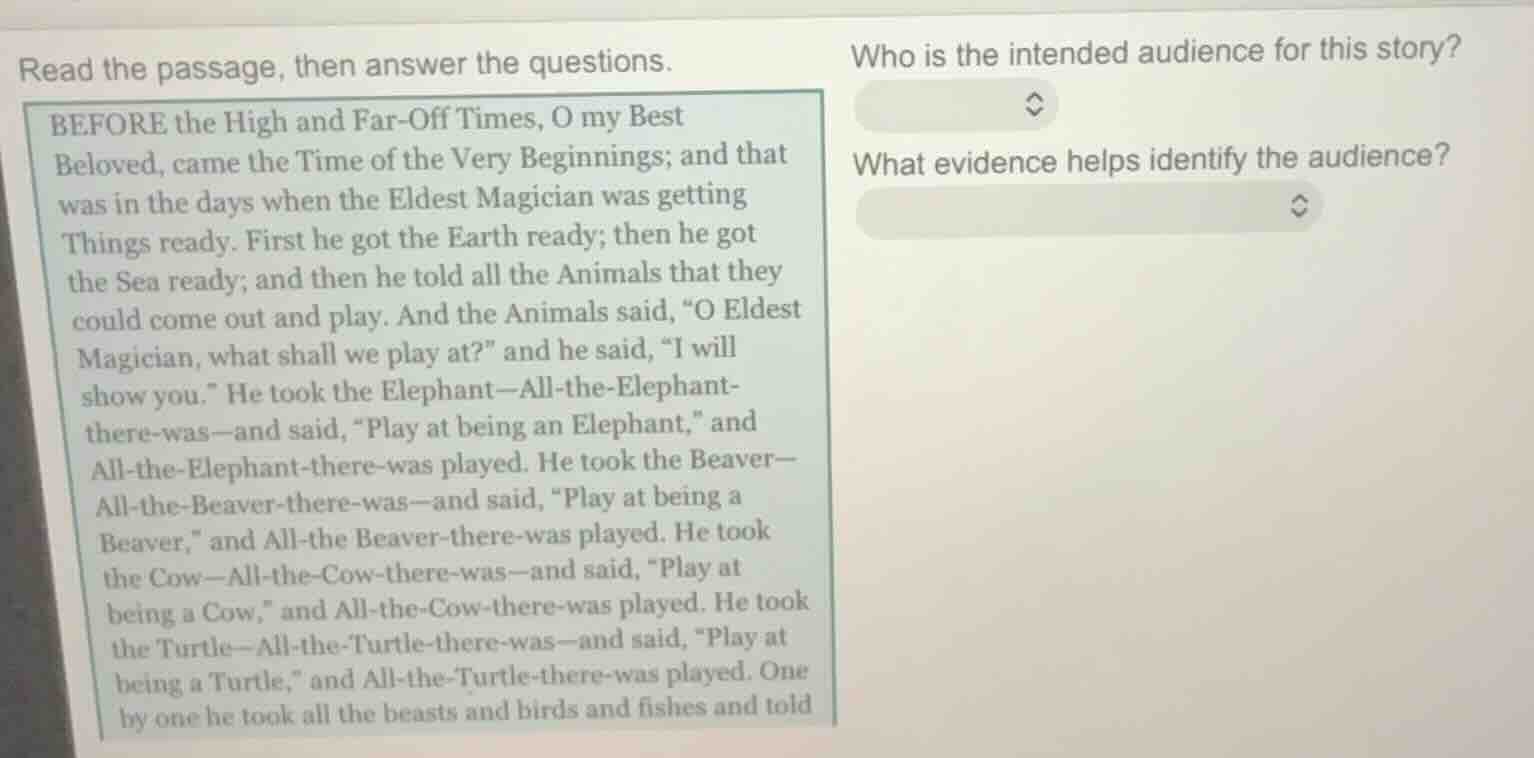
read the passage, then answer the questions.
before the high and far-off times, o my best beloved, came the time of the very beginnings; and that was in the days when the eldest magician was getting things ready. first he got the earth ready; then he got the sea ready; and then he told all the animals that they could come out and play. and the animals said, \o eldest magician, what shall we play at?\ and he said, \i will show you.\ he took the elephant-all-the-elephant-there-was-and said, \play at being an elephant,\ and all-the-elephant-there-was played. he took the beaver-all-the-beaver-there-was-and said, \play at being a beaver,\ and all-the-beaver-there-was played. he took the cow-all-the-cow-there-was-and said, \play at being a cow,\ and all-the-cow-there-was played. he took the turtle-all-the-turtle-there-was-and said, \play at being a turtle,\ and all-the-turtle-there-was played. one by one he took all the beasts and birds and fishes and told
who is the intended audience for this story?
what evidence helps identify the audience?
Identify the intended audience
The passage begins with the direct address, "O my Best Beloved." This affectionate, conversational phrasing is characteristic of stories told by an adult storyteller directly to a young child. The playful, repetitive, and imaginative description of creation ("Eldest Magician," "All-the-Elephant-there-was") further indicates that the story is written for children. Applying Just So Stories Analysis, we recognize this style as Rudyard Kipling's signature way of addressing a young listener.
Locate textual evidence for the audience
To support the identification of the audience, we look for direct textual evidence. The opening line contains the phrase "O my Best Beloved," which is a direct address to the listener/reader. This specific term of endearment serves as the primary textual evidence identifying the intended audience as a beloved child.

Snap & solve any problem in the app
Get step-by-step solutions on Sovi AI
Photo-based solutions with guided steps
Explore more problems and detailed explanations
Question 1
Who is the intended audience for this story?
<blank>children</blank>
Question 2
What evidence helps identify the audience?
<blank>the phrase "O my Best Beloved"</blank>