QUESTION IMAGE
Question
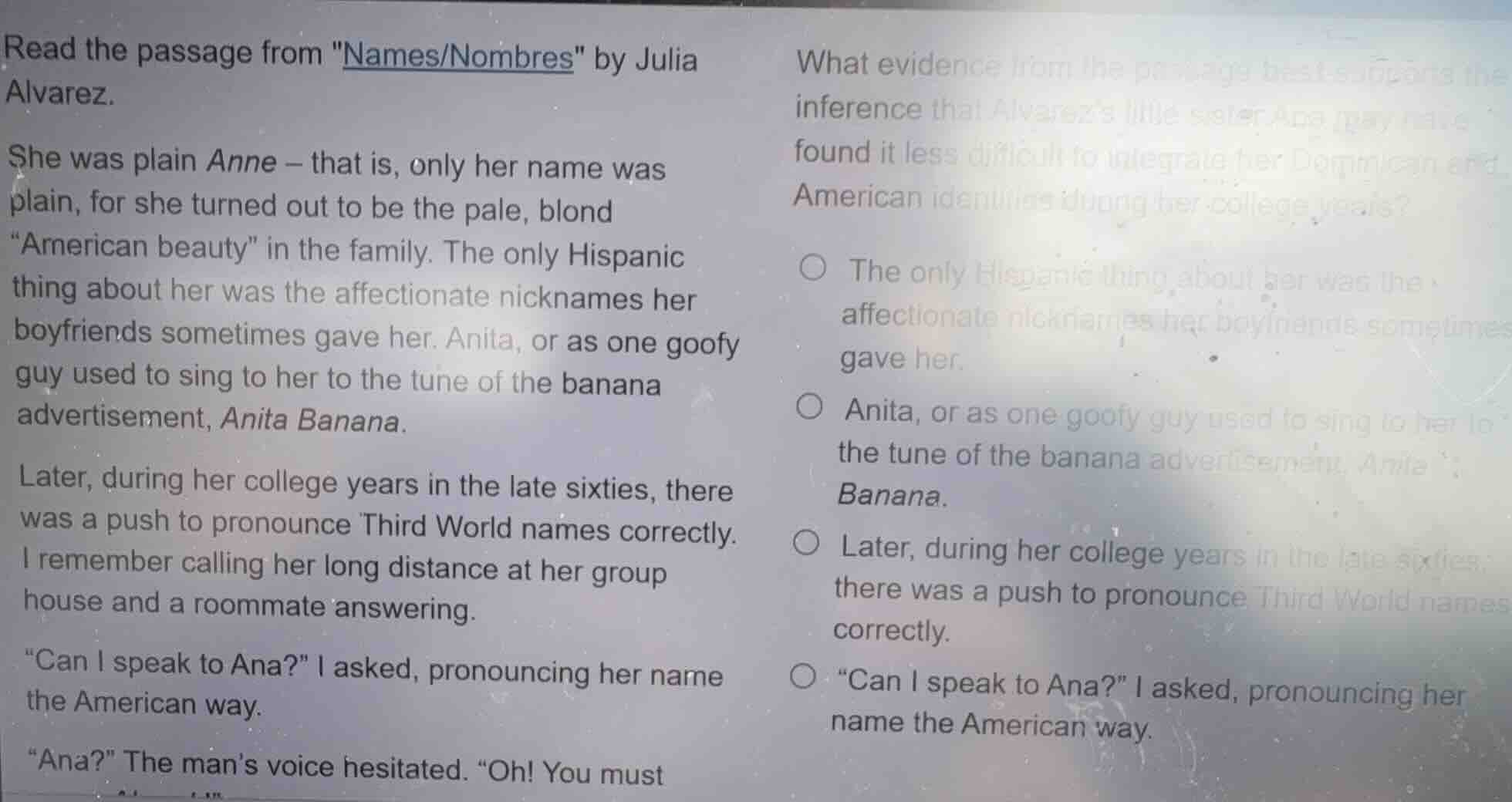
read the passage from
ames/nombres\ by julia alvarez.
she was plain anne - that is, only her name was plain, for she turned out to be the pale, blond \american beauty\ in the family. the only hispanic thing about her was the affectionate nicknames her boyfriends sometimes gave her. anita, or as one goofy guy used to sing to her to the tune of the banana advertisement, anita banana.
later, during her college years in the late sixties, there was a push to pronounce third world names correctly. i remember calling her long distance at her group house and a roommate answering.
\can i speak to ana?\ i asked, pronouncing her name the american way.
\ana?\ the mans voice hesitated. \oh! you must
what evidence from the passage best supports the inference that alvarezs little sister ana may have found it less difficult to integrate her dominican and american identities during her college years?
- the only hispanic thing about her was the affectionate nicknames her boyfriends sometimes gave her.
- anita, or as one goofy guy used to sing to her to the tune of the banana advertisement, anita banana.
- later, during her college years in the late sixties, there was a push to pronounce third world names correctly.
- \can i speak to ana?\ i asked, pronouncing her name the american way.
Analyze the question prompt
The question asks for textual evidence supporting the inference that Alvarez's sister Ana found it easier to integrate her Dominican and American identities during her college years.
Connect to mastered concepts
Using the Names as Identity and Assimilation Pressures knowledge points, we examine how names reflect cultural integration.
Evaluate the historical context
Using the Textual Evidence Analysis knowledge point, we analyze the passage's description of the late sixties.
Assess the answer choices
- Option 1 focuses on her appearance and high school nicknames.
- Option 2 describes a silly nickname.
- Option 3 mentions a cultural shift in college: "there was a push to pronounce 'Third World' names correctly." This directly supports easier integration.
- Option 4 shows the narrator still using the Americanized pronunciation.

Snap & solve any problem in the app
Get step-by-step solutions on Sovi AI
Photo-based solutions with guided steps
Explore more problems and detailed explanations
- (A) The only Hispanic thing about her was the affectionate nicknames her boyfriends sometimes gave her.
- (B) Anita, or as one goofy guy used to sing to her to the tune of the banana advertisement, Anita Banana.
- (C) Later, during her college years in the late sixties, there was a push to pronounce Third World names correctly. (Correct answer)
- (D) "Can I speak to Ana?" I asked, pronouncing her name the American way.