QUESTION IMAGE
Question
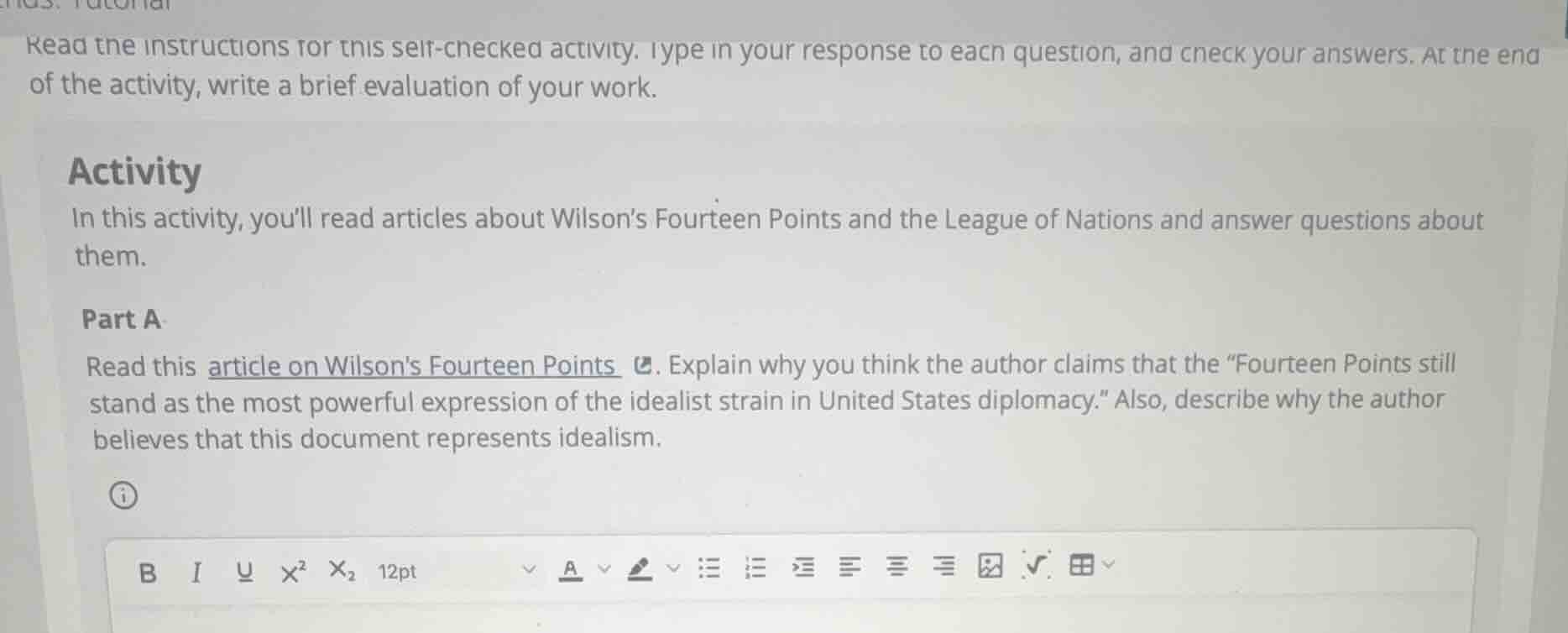
read the instructions for this self-checked activity. type in your response to each question, and check your answers. at the end of the activity, write a brief evaluation of your work.
activity
in this activity, youll read articles about wilsons fourteen points and the league of nations and answer questions about them.
part a
read this article on wilsons fourteen points. explain why you think the author claims that the \fourteen points still stand as the most powerful expression of the idealist strain in united states diplomacy.\ also, describe why the author believes that this document represents idealism.
Analyze the prompt requirements
The prompt asks us to address two main points based on Woodrow Wilson's Fourteen Points:
- Explain why the author claims that the "Fourteen Points still stand as the most powerful expression of the idealist strain in United States diplomacy."
- Describe why the author believes that this document represents idealism.
Define diplomatic idealism
Idealism in foreign policy is the school of thought which asserts that a state should make its internal political philosophy the goal of its foreign policy. In US history, Wilsonian idealism is characterized by promoting democracy, free trade, open agreements, and collective security rather than traditional balance-of-power politics or imperial self-interest.
Explain the "most powerful expression" claim
The Fourteen Points represent a comprehensive blueprint for a completely restructured international order. Rather than seeking territorial gains or punitive reparations (the traditional realist goals of victors in war), it proposed universal principles:
- Open diplomacy (no secret treaties)
- Freedom of the seas
- Removal of economic barriers
- Reduction of armaments
- Self-determination for colonized and occupied peoples
- A general association of nations (the League of Nations) to guarantee political independence and territorial integrity.
This sweeping, global vision is why it is considered the ultimate expression of American diplomatic idealism.
Describe why the document represents idealism
The document represents idealism because it prioritizes moral principles, international cooperation, and collective security over national self-interest and military dominance. It assumes that nations can transcend selfish motives to work together for permanent peace. By advocating for "self-determination," it champions the moral right of peoples to govern themselves, and through the League of Nations, it seeks to replace secret alliances with open, collective security.

Snap & solve any problem in the app
Get step-by-step solutions on Sovi AI
Photo-based solutions with guided steps
Explore more problems and detailed explanations
Woodrow Wilson's Fourteen Points represent a landmark shift in international relations, serving as the foundational text for modern foreign policy idealism.
The "Most Powerful Expression of Idealism"
The author claims the Fourteen Points are the most powerful expression of the idealist strain in United States diplomacy because they proposed a complete, systematic restructuring of the global order based on moral principles rather than imperial conquest, secret alliances, or the traditional balance of power. Instead of seeking territorial gains or punitive spoils of war for the United States, the document offered a universal blueprint for a peaceful world, establishing a high-water mark for American moral leadership on the global stage.
Why the Document Represents Idealism
The document represents diplomatic idealism through several core principles:
- Collective Security: It proposed a "general association of nations" (which became the League of Nations) to guarantee the political independence and territorial integrity of great and small states alike, relying on mutual cooperation rather than military deterrence.
- Self-Determination: It championed the right of national groups to self-governance and sovereignty, challenging the traditional imperialist system of colonization and territorial division.
- Global Cooperation and Transparency: It advocated for "open covenants of peace, openly arrived at," freedom of navigation on the seas, and the removal of economic barriers to foster peaceful trade and prevent the secret alliances that led to World War I.