QUESTION IMAGE
Question
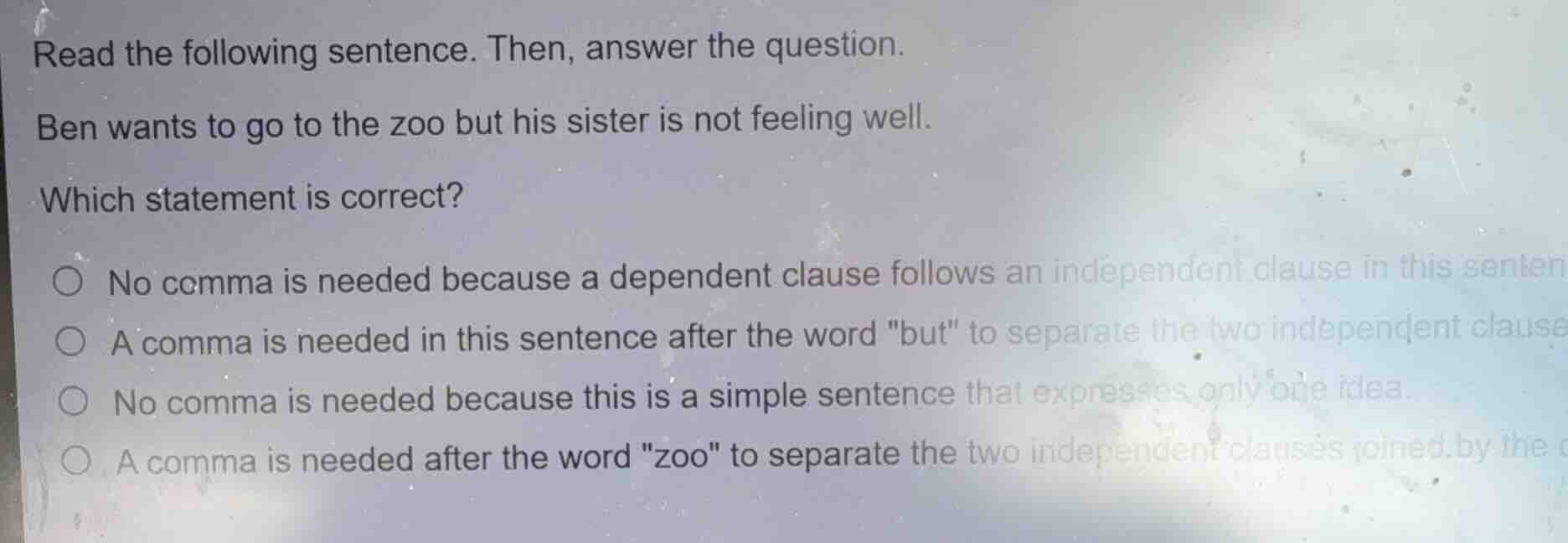
read the following sentence. then, answer the question.
ben wants to go to the zoo but his sister is not feeling well.
which statement is correct?
no comma is needed because a dependent clause follows an independent clause in this sentence.
a comma is needed in this sentence after the word \but\ to separate the two independent clauses.
no comma is needed because this is a simple sentence that expresses only one idea.
a comma is needed after the word \zoo\ to separate the two independent clauses joined by the coordinating conjunction.
Analyze the sentence structure
We begin by identifying the clauses in the given sentence: "Ben wants to go to the zoo but his sister is not feeling well."
- Clause 1: "Ben wants to go to the zoo" (contains subject "Ben" and verb "wants"; can stand alone as a complete thought). This is an independent clause.
- Clause 2: "his sister is not feeling well" (contains subject "his sister" and verb phrase "is not feeling"; can stand alone as a complete thought). This is also an independent clause.
Identify the conjunction
The two independent clauses are joined by the word "but". The word "but" is a coordinating conjunction (one of the FANBOYS: for, and, nor, but, or, yet, so). When two independent clauses are joined by a coordinating conjunction, they form a Compound Sentences structure.
Apply punctuation rules
According to standard Punctuation Rules, when joining two independent clauses with a Coordinating Conjunction, a comma must be placed immediately before the coordinating conjunction.
- The coordinating conjunction is "but".
- Therefore, a comma is required before "but", which places it directly after the word "zoo".
- The correctly punctuated sentence is: "Ben wants to go to the zoo, but his sister is not feeling well."
Evaluate the given options
- Option 1: "No comma is needed because a dependent clause follows an independent clause in this sentence." (Incorrect, both clauses are independent).
- Option 2: "A comma is needed in this sentence after the word 'but' to separate the two independent clauses." (Incorrect, the comma goes before the conjunction, not after it).
- Option 3: "No comma is needed because this is a simple sentence that expresses only one idea." (Incorrect, this is a compound sentence expressing two distinct ideas).
- Option 4: "A comma is needed after the word 'zoo' to separate the two independent clauses joined by the coordinating conjunction." (Correct, as it correctly identifies the placement and the grammatical reason).

Snap & solve any problem in the app
Get step-by-step solutions on Sovi AI
Photo-based solutions with guided steps
Explore more problems and detailed explanations
- (A) No comma is needed because a dependent clause follows an independent clause in this sentence.
- (B) A comma is needed in this sentence after the word "but" to separate the two independent clauses.
- (C) No comma is needed because this is a simple sentence that expresses only one idea.
- (D) A comma is needed after the word "zoo" to separate the two independent clauses joined by the coordinating conjunction. (Correct answer)