QUESTION IMAGE
Question
read the excerpt from h. g. wellss the war of the worlds.
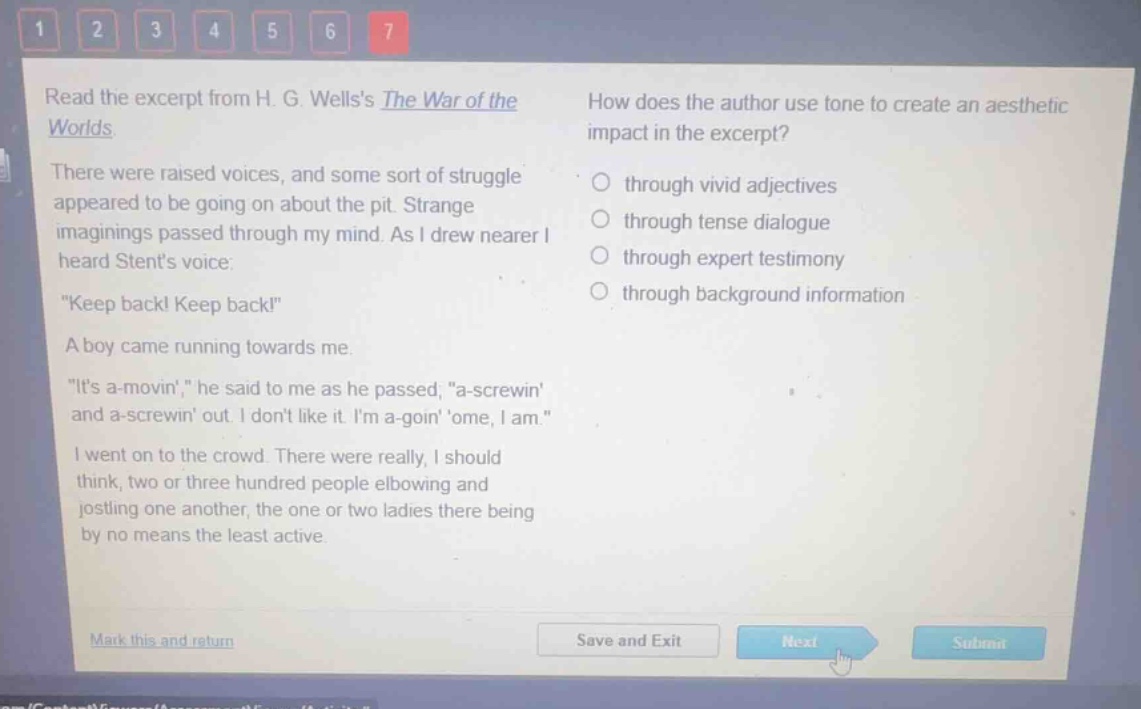
there were raised voices, and some sort of struggle appeared to be going on about the pit. strange imaginings passed through my mind. as i drew nearer i heard stents voice:
\keep back! keep back!\
a boy came running towards me.
\its a-movin,\ he said to me as he passed; \a-screwin and a-screwin out. i dont like it. im a-goin ome, i am.\
i went on to the crowd. there were really, i should think, two or three hundred people elbowing and jostling one another, the one or two ladies there being by no means the least active.
how does the author use tone to create an aesthetic impact in the excerpt?
through vivid adjectives
through tense dialogue
through expert testimony
through background information
Analyze the question and literary excerpt
The question asks how the author uses tone to create an aesthetic impact in the excerpt from H. G. Wells's The War of the Worlds. We need to examine the text's tone and identify which literary element listed in the options is used to establish this tone.
Evaluate the literary elements in the text
The excerpt contains direct speech from characters in a state of panic and urgency:
- Stent's voice shouting: "Keep back! Keep back!"
- A boy running away, speaking in a panicked, colloquial manner: "It's a-movin',... a-screwin' and a-screwin' out. I don't like it. I'm a-goin' 'ome, I am."
This dialogue is highly tense, urgent, and fearful, which directly establishes a suspenseful and anxious tone.
Connect tone to aesthetic impact
Using Tone and Mood Analysis, we see that the urgent dialogue creates a tense atmosphere. This suspenseful mood is a key Aesthetic Element that engages the reader's emotions. The tension is built primarily through the characters' spoken words rather than descriptive adjectives, background information, or expert testimony. Therefore, the author achieves this aesthetic impact "through tense dialogue."

Snap & solve any problem in the app
Get step-by-step solutions on Sovi AI
Photo-based solutions with guided steps
Explore more problems and detailed explanations
- through vivid adjectives
- through tense dialogue (Correct answer)
- through expert testimony
- through background information