QUESTION IMAGE
Question
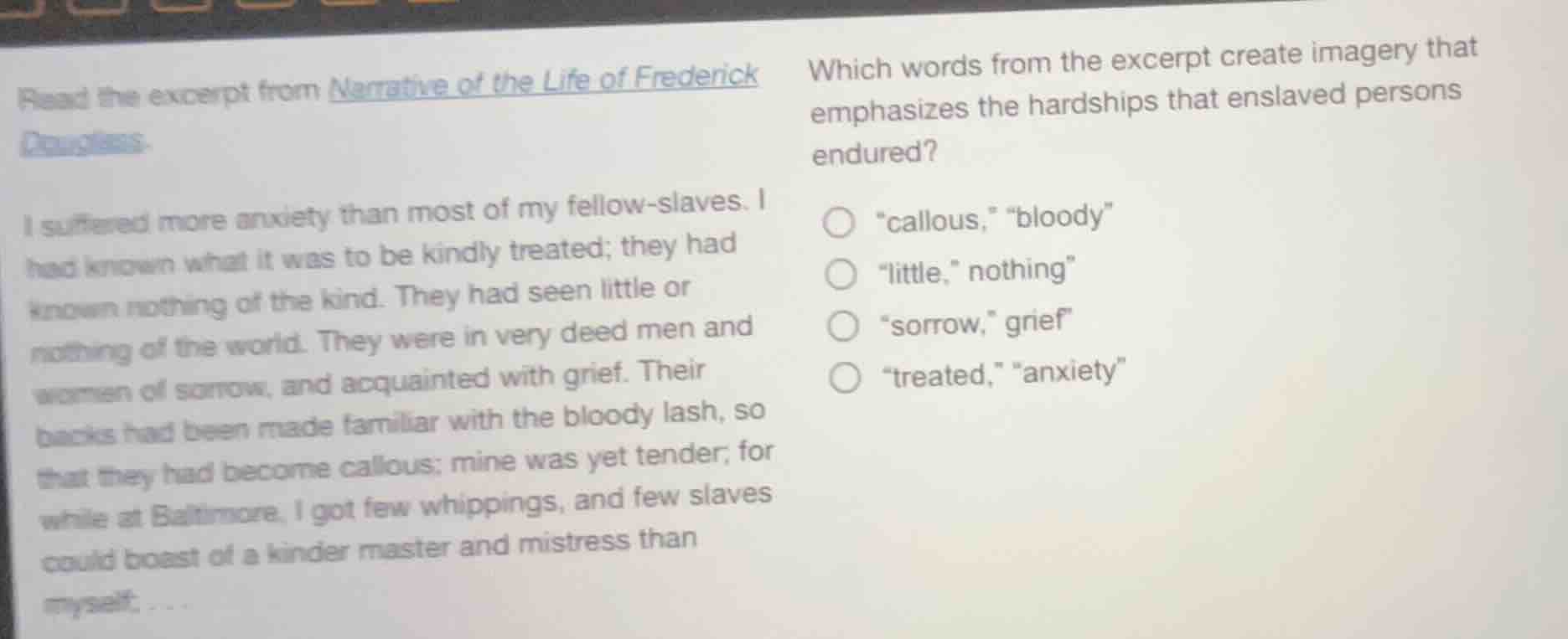
read the excerpt from narrative of the life of frederick douglass.
i suffered more anxiety than most of my fellow-slaves. i had known what it was to be kindly treated; they had known nothing of the kind. they had seen little or nothing of the world. they were in very deed men and women of sorrow, and acquainted with grief. their backs had been made familiar with the bloody lash, so that they had become callous; mine was yet tender; for while at baltimore, i got few whippings, and few slaves could boast of a kinder master and mistress than myself...
which words from the excerpt create imagery that emphasizes the hardships that enslaved persons endured?
\callous,\ \bloody\
\little,\
othing\
\sorrow,\ \grief\
\treated,\ \anxiety\
Analyze the question prompt
The question asks which words from the excerpt create imagery that emphasizes the physical hardships endured by enslaved persons.
Examine the excerpt for sensory details
Using the Sensory Imagery and Frederick Douglass Narrative knowledge points:
The passage describes how the backs of enslaved people "had been made familiar with the bloody lash, so that they had become callous."
Evaluate the answer choices
- "callous," "bloody": These words appeal directly to the sense of touch and sight, describing physical scars and violence.
- "little," "nothing": These are quantifiers, not sensory words.
- "sorrow," "grief": These describe emotional states rather than physical imagery.
- "treated," "anxiety": These describe actions and emotional states.
Select the correct option
The words "callous" and "bloody" provide the physical, sensory details of bodily suffering.

Snap & solve any problem in the app
Get step-by-step solutions on Sovi AI
Photo-based solutions with guided steps
Explore more problems and detailed explanations
- (A) "callous," "bloody" (Correct answer)
- (B) "little," "nothing"
- (C) "sorrow," "grief"
- (D) "treated," "anxiety"