QUESTION IMAGE
Question
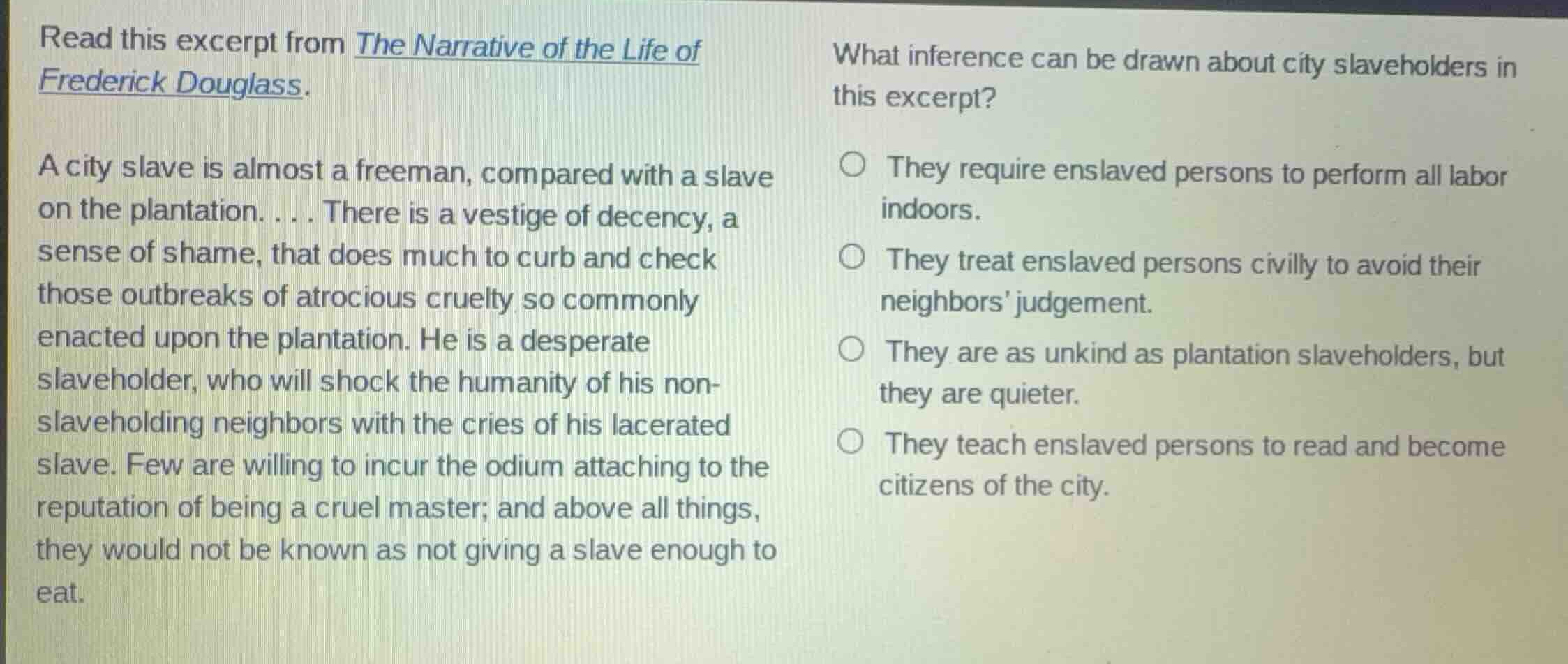
read this excerpt from the narrative of the life of frederick douglass.
a city slave is almost a freeman, compared with a slave on the plantation. ... there is a vestige of decency, a sense of shame, that does much to curb and check those outbreaks of atrocious cruelty so commonly enacted upon the plantation. he is a desperate slaveholder, who will shock the humanity of his non-slaveholding neighbors with the cries of his lacerated slave. few are willing to incur the odium attaching to the reputation of being a cruel master; and above all things, they would not be known as not giving a slave enough to eat.
what inference can be drawn about city slaveholders in this excerpt?
they require enslaved persons to perform all labor indoors.
they treat enslaved persons civilly to avoid their neighbors judgement.
they are as unkind as plantation slaveholders, but they are quieter.
they teach enslaved persons to read and become citizens of the city.
Analyze the excerpt
Using the Reading Comprehension knowledge point, we examine the text's description of city slaveholders. The passage states that in the city, "There is a vestige of decency, a sense of shame, that does much to curb and check those outbreaks of atrocious cruelty so commonly enacted upon the plantation."
Identify the motivation
Using the Text Evidence knowledge point, we locate the reason for this behavior: "He is a desperate slaveholder, who will shock the humanity of his non-slaveholding neighbors with the cries of his lacerated slave. Few are willing to incur the odium attaching to the reputation of being a cruel master..." This shows they curb their cruelty to avoid public disapproval.
Evaluate the options
Using the Reading Comprehension and Text Evidence knowledge points, we compare our findings to the choices:
- Option 1: The text does not mention indoor labor.
- Option 2: This matches the evidence that they act with more decency to avoid the "odium" (disapproval) of neighbors.
- Option 3: The text states they are "almost a freeman, compared with a slave on the plantation," showing a real difference in treatment, not just volume.
- Option 4: The text does not mention teaching them to read or become citizens.

Snap & solve any problem in the app
Get step-by-step solutions on Sovi AI
Photo-based solutions with guided steps
Explore more problems and detailed explanations
- They require enslaved persons to perform all labor indoors.
- They treat enslaved persons civilly to avoid their neighbors' judgement. (Correct answer)
- They are as unkind as plantation slaveholders, but they are quieter.
- They teach enslaved persons to read and become citizens of the city.