QUESTION IMAGE
Question
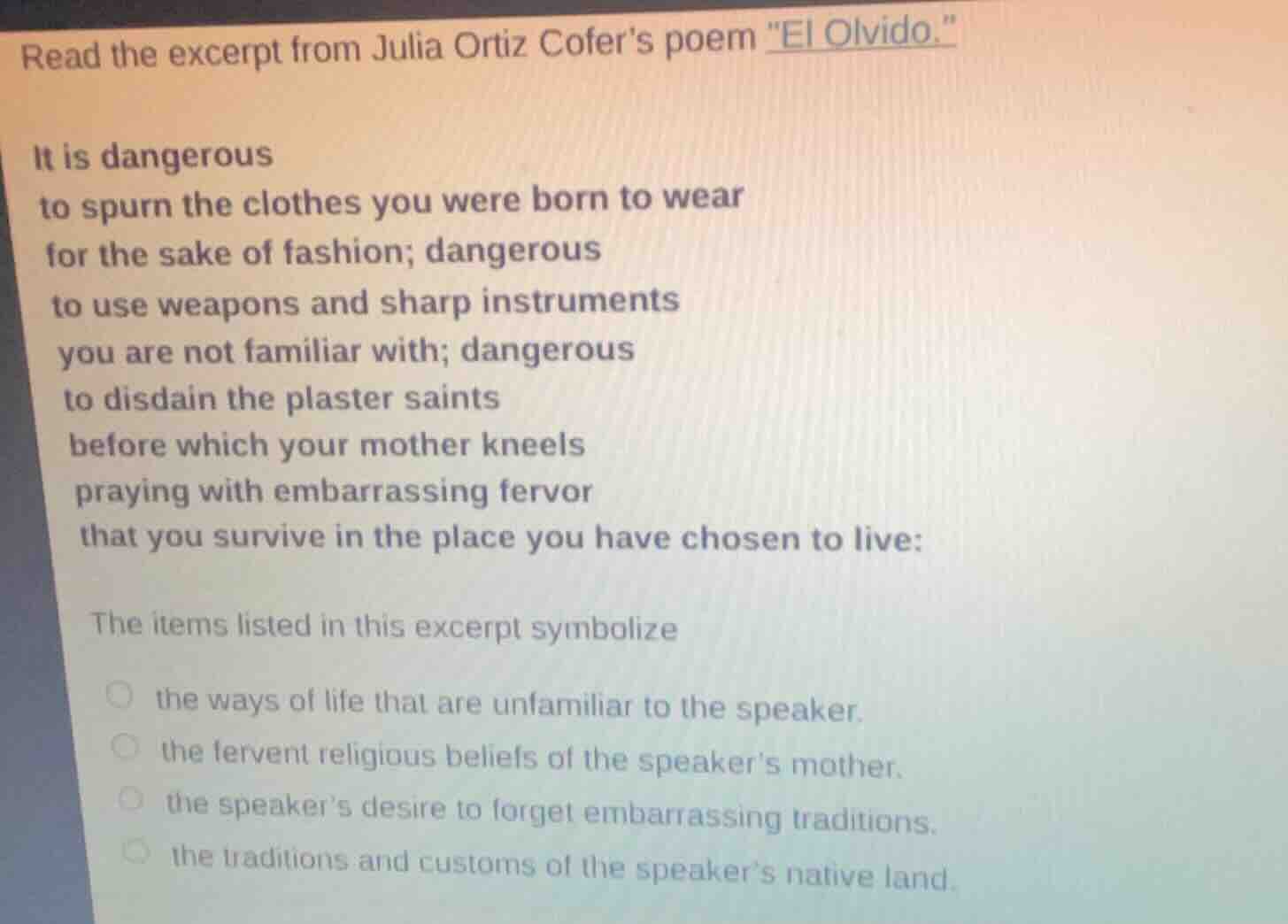
read the excerpt from julia ortiz cofers poem \el olvido.\
it is dangerous
to spurn the clothes you were born to wear
for the sake of fashion; dangerous
to use weapons and sharp instruments
you are not familiar with; dangerous
to disdain the plaster saints
before which your mother kneels
praying with embarrassing fervor
that you survive in the place you have chosen to live:
the items listed in this excerpt symbolize
the ways of life that are unfamiliar to the speaker.
the fervent religious beliefs of the speakers mother.
the speakers desire to forget embarrassing traditions.
the traditions and customs of the speakers native land.
Analyze the listed items in the poem
The excerpt from Judith Ortiz Cofer's poem "El Olvido" lists several specific items:
- "the clothes you were born to wear" (traditional clothing)
- "weapons and sharp instruments you are not familiar with"
- "the plaster saints before which your mother kneels" (religious icons)
These items represent cultural practices, religious devotions, and ancestral ways of living.
Connect the items to their symbolic meaning
Using Literary Symbolism, we analyze what these concrete objects represent on a deeper level.
- The clothes represent cultural identity and heritage.
- The plaster saints represent traditional religious faith and maternal devotion.
- Together, these items represent the cultural heritage, customs, and traditions of the speaker's homeland that the younger generation is warned not to forget ("El Olvido" means "The Forgetting") or disdain for the sake of modern fashion or assimilation.
Evaluate the multiple-choice options
Using Poetry Analysis, we evaluate the given choices:
- Option 1: "the ways of life that are unfamiliar to the speaker" — Incorrect, as these are the traditional customs of the speaker's family/native culture.
- Option 2: "the fervent religious beliefs of the speaker's mother" — Too narrow, as this only describes the "plaster saints" and not the clothes or other items.
- Option 3: "the speaker's desire to forget embarrassing traditions" — Incorrect, the poem warns that it is "dangerous" to spurn or disdain these things.
- Option 4: "the traditions and customs of the speaker's native land" — Correct, as it encompasses all the cultural elements listed (clothing, faith, heritage).

Snap & solve any problem in the app
Get step-by-step solutions on Sovi AI
Photo-based solutions with guided steps
Explore more problems and detailed explanations
- the ways of life that are unfamiliar to the speaker.
- the fervent religious beliefs of the speaker's mother.
- the speaker's desire to forget embarrassing traditions.
- the traditions and customs of the speaker's native land. (Correct answer)