Sovi.AI - AI Math Tutor

Scan to solve math questions

QUESTION IMAGE

read the excerpt from chapter 41 of moby-dick. the white whale swam bef…

Question

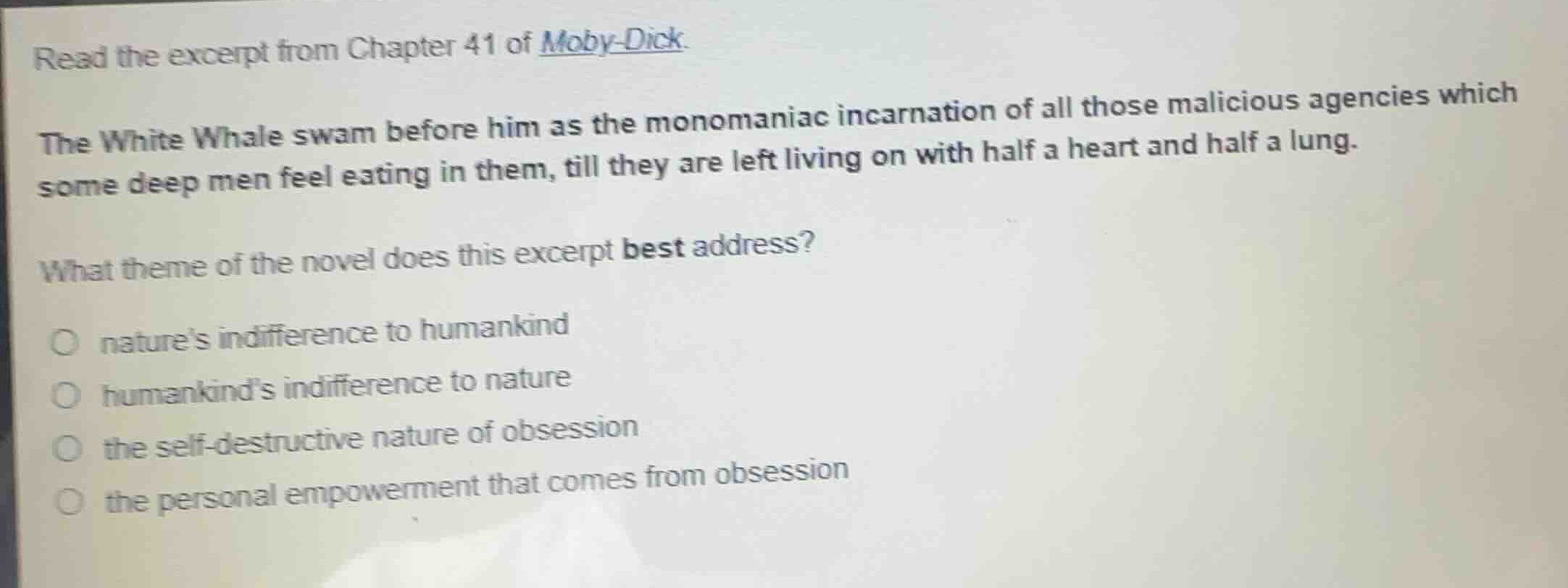
read the excerpt from chapter 41 of moby-dick.

the white whale swam before him as the monomaniac incarnation of all those malicious agencies which some deep men feel eating in them, till they are left living on with half a heart and half a lung.

what theme of the novel does this excerpt best address?

natures indifference to humankind
humankinds indifference to nature
the self-destructive nature of obsession
the personal empowerment that comes from obsession

Explanation:

Response

<pre_analysis>
{
"quality": "clear",
"question_count": 1,
"skills_matched": [
"direct_cot",
"multiple_choice_formatter",
"explain_then_answer",
"tutor",
"mastery_adaptive_brevity"
],
"needs_drawing": false,
"concepts_used": [
"Moby-Dick Analysis",
"Thematic Analysis"
],
"new_concepts": [],
"current_concepts": [
"Moby-Dick Analysis",
"Thematic Analysis",
"Literary Symbolism"
]
}
</pre_analysis>

<reasoning>

Analyze the excerpt

Using the Moby-Dick Analysis knowledge point, we examine the passage: "The White Whale swam before him as the monomaniac incarnation of all those malicious agencies which some deep men feel eating in them, till they are left living on with half a heart and half a lung." The term "monomaniac" refers to a pathological obsession with a single thing, which directly points to Ahab's intense focus on the whale.

Connect to theme

Using the Thematic Analysis knowledge point, we evaluate how this obsession affects the individual. The text describes these "malicious agencies" as "eating in them, till they are left living on with half a heart and half a lung." This vivid imagery depicts physical and emotional decay, illustrating how consuming obsession is inherently self-destructive rather than empowering.
</reasoning>

<answer>
<mcq-option>nature's indifference to humankind</mcq-option>
<mcq-option>humankind's indifference to nature</mcq-option>
<mcq-correct>the self-destructive nature of obsession</mcq-correct>
<mcq-option>the personal empowerment that comes from obsession</mcq-option>
</answer>

<post_analysis>
{
"subject": "Arts",
"question_type": "Multiple Choice",
"knowledge_point": [
"Arts",
"Literature",
"Thematic Analysis"
]
}
</post_analysis>

Answer:

<pre_analysis>
{
"quality": "clear",
"question_count": 1,
"skills_matched": [
"direct_cot",
"multiple_choice_formatter",
"explain_then_answer",
"tutor",
"mastery_adaptive_brevity"
],
"needs_drawing": false,
"concepts_used": [
"Moby-Dick Analysis",
"Thematic Analysis"
],
"new_concepts": [],
"current_concepts": [
"Moby-Dick Analysis",
"Thematic Analysis",
"Literary Symbolism"
]
}
</pre_analysis>

<reasoning>

Analyze the excerpt

Using the Moby-Dick Analysis knowledge point, we examine the passage: "The White Whale swam before him as the monomaniac incarnation of all those malicious agencies which some deep men feel eating in them, till they are left living on with half a heart and half a lung." The term "monomaniac" refers to a pathological obsession with a single thing, which directly points to Ahab's intense focus on the whale.

Connect to theme

Using the Thematic Analysis knowledge point, we evaluate how this obsession affects the individual. The text describes these "malicious agencies" as "eating in them, till they are left living on with half a heart and half a lung." This vivid imagery depicts physical and emotional decay, illustrating how consuming obsession is inherently self-destructive rather than empowering.
</reasoning>

<answer>
<mcq-option>nature's indifference to humankind</mcq-option>
<mcq-option>humankind's indifference to nature</mcq-option>
<mcq-correct>the self-destructive nature of obsession</mcq-correct>
<mcq-option>the personal empowerment that comes from obsession</mcq-option>
</answer>

<post_analysis>
{
"subject": "Arts",
"question_type": "Multiple Choice",
"knowledge_point": [
"Arts",
"Literature",
"Thematic Analysis"
]
}
</post_analysis>