QUESTION IMAGE
Question
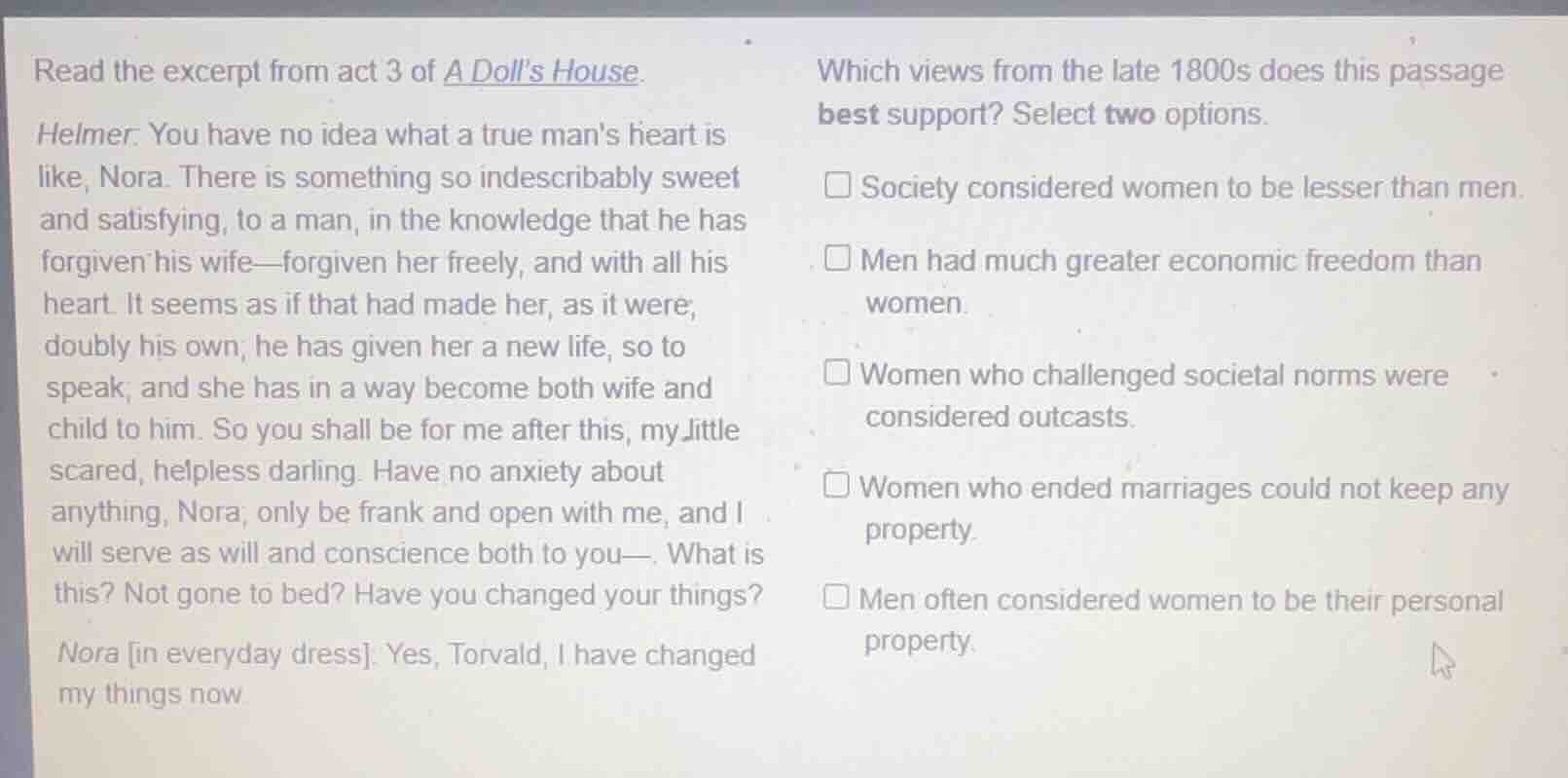
read the excerpt from act 3 of a dolls house.
helmer: you have no idea what a true mans heart is like, nora. there is something so indescribably sweet and satisfying, to a man, in the knowledge that he has forgiven his wife—forgiven her freely, and with all his heart. it seems as if that had made her, as it were, doubly his own; he has given her a new life, so to speak, and she has in a way become both wife and child to him. so you shall be for me after this, my little scared, helpless darling. have no anxiety about anything, nora; only be frank and open with me, and i will serve as will and conscience both to you—. what is this? not gone to bed? have you changed your things?
nora in everyday dress: yes, torvald, i have changed my things now
which views from the late 1800s does this passage best support? select two options.
□ society considered women to be lesser than men.
□ men had much greater economic freedom than women.
□ women who challenged societal norms were considered outcasts.
□ women who ended marriages could not keep any property.
□ men often considered women to be their personal property.
- Helmer's statement that forgiving Nora makes her "doubly his own" and that she becomes "both wife and child to him" directly reflects the view that men considered women their personal property, framing her as dependent and under his control.
- His assertion that he will "serve as will and conscience both to you" positions Nora as incapable of independent judgment, which supports the late-1800s societal view that women were lesser than men, lacking the autonomy and rationality attributed to men.
The other options are not supported by this specific excerpt: there is no mention of economic freedom, outcast status for norm-challenging women, or property rules for women who ended marriages.

Snap & solve any problem in the app
Get step-by-step solutions on Sovi AI
Photo-based solutions with guided steps
Explore more problems and detailed explanations
Society considered women to be lesser than men.
Men often considered women to be their personal property.