QUESTION IMAGE
Question
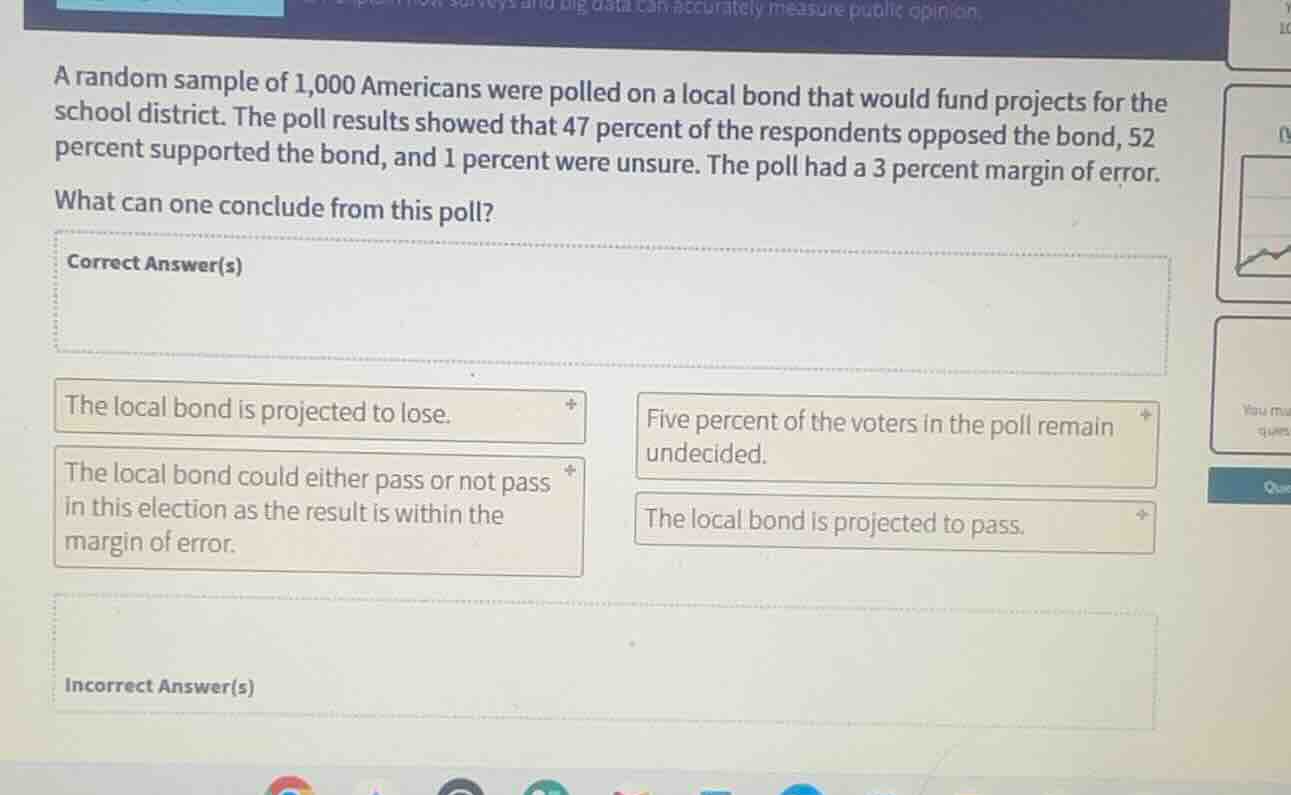
a random sample of 1,000 americans were polled on a local bond that would fund projects for the school district. the poll results showed that 47 percent of the respondents opposed the bond, 52 percent supported the bond, and 1 percent were unsure. the poll had a 3 percent margin of error.
what can one conclude from this poll?
- the local bond is projected to lose.
- the local bond could either pass or not pass in this election as the result is within the margin of error.
- five percent of the voters in the poll remain undecided.
- the local bond is projected to pass.
Analyze the poll data and margin of error
The poll shows:
- Support for the bond: \(52\%\)
- Opposition to the bond: \(47\%\)
- Unsure: \(1\%\)
- Margin of error: \(\pm 3\%\)
Calculate the confidence intervals
Applying the \(\pm 3\%\) margin of error to the results:
- True support range: \(52\% - 3\% = 49\%\) to \(52\% + 3\% = 55\%\)
- True opposition range: \(47\% - 3\% = 44\%\) to \(47\% + 3\% = 50\%\)
Determine the correct conclusion
Because the confidence intervals overlap (support can be as low as \(49\%\) and opposition can be as high as \(50\%\)), the outcome of the election cannot be definitively projected. Therefore, the bond could either pass or not pass.

Snap & solve any problem in the app
Get step-by-step solutions on Sovi AI
Photo-based solutions with guided steps
Explore more problems and detailed explanations
- The local bond is projected to lose.
- The local bond could either pass or not pass in this election as the result is within the margin of error. (Correct answer)
- Five percent of the voters in the poll remain undecided.
- The local bond is projected to pass.