QUESTION IMAGE
Question
question 3
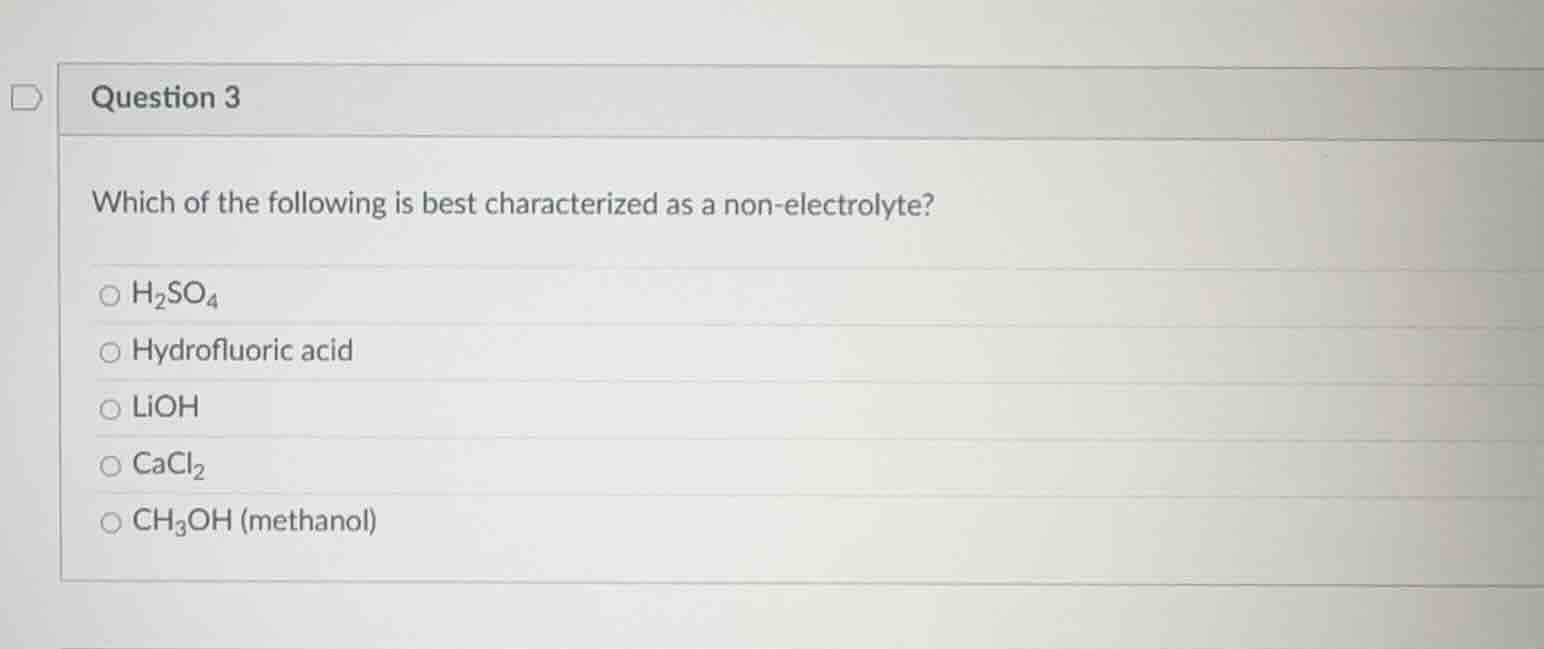
which of the following is best characterized as a non-electrolyte?
\\(\text{h}_2\text{so}_4\\)
hydrofluoric acid
\\(\text{lioh}\\)
\\(\text{cacl}_2\\)
\\(\text{ch}_3\text{oh}\\) (methanol)
<pre_analysis>
{
"quality": "clear",
"question_count": 1,
"skills_matched": [
"direct_cot",
"multiple_choice_formatter",
"explain_then_answer",
"quick"
],
"needs_drawing": false,
"concepts_used": [],
"new_concepts": [],
"current_concepts": [
"Electrolytes",
"Strong Acids",
"Weak Acids"
]
}
</pre_analysis>
<reasoning>
Classify each substance by its electrolyte strength
- \(\text{H}_2\text{SO}_4\) (sulfuric acid) is a strong acid, which dissociates completely in water to form ions. It is a strong electrolyte.
- Hydrofluoric acid (\(\text{HF}\)) is a weak acid, which partially dissociates in water to form some ions. It is a weak electrolyte.
- \(\text{LiOH}\) (lithium hydroxide) is a strong base, which dissociates completely in water. It is a strong electrolyte.
- \(\text{CaCl}_2\) (calcium chloride) is a soluble ionic salt, which dissociates completely into \(\text{Ca}^{2+}\) and \(\text{Cl}^-\) ions. It is a strong electrolyte.
- \(\text{CH}_3\text{OH}\) (methanol) is a molecular covalent compound that dissolves in water as intact molecules without producing ions. It is a non-electrolyte.
</reasoning>
<answer>
<mcq-option>(A) \(\text{H}_2\text{SO}_4\)</mcq-option>
<mcq-option>(B) Hydrofluoric acid</mcq-option>
<mcq-option>(C) \(\text{LiOH}\)</mcq-option>
<mcq-option>(D) \(\text{CaCl}_2\)</mcq-option>
<mcq-correct>(E) \(\text{CH}_3\text{OH}\) (methanol)</mcq-correct>
</answer>
<post_analysis>
{
"subject": "Natural Science",
"question_type": "Multiple Choice",
"knowledge_point": [
"Natural Science",
"Chemistry",
"Electrolytes"
]
}
</post_analysis>
Snap & solve any problem in the app
Get step-by-step solutions on Sovi AI
Photo-based solutions with guided steps
Explore more problems and detailed explanations
<pre_analysis>
{
"quality": "clear",
"question_count": 1,
"skills_matched": [
"direct_cot",
"multiple_choice_formatter",
"explain_then_answer",
"quick"
],
"needs_drawing": false,
"concepts_used": [],
"new_concepts": [],
"current_concepts": [
"Electrolytes",
"Strong Acids",
"Weak Acids"
]
}
</pre_analysis>
<reasoning>
Classify each substance by its electrolyte strength
- \(\text{H}_2\text{SO}_4\) (sulfuric acid) is a strong acid, which dissociates completely in water to form ions. It is a strong electrolyte.
- Hydrofluoric acid (\(\text{HF}\)) is a weak acid, which partially dissociates in water to form some ions. It is a weak electrolyte.
- \(\text{LiOH}\) (lithium hydroxide) is a strong base, which dissociates completely in water. It is a strong electrolyte.
- \(\text{CaCl}_2\) (calcium chloride) is a soluble ionic salt, which dissociates completely into \(\text{Ca}^{2+}\) and \(\text{Cl}^-\) ions. It is a strong electrolyte.
- \(\text{CH}_3\text{OH}\) (methanol) is a molecular covalent compound that dissolves in water as intact molecules without producing ions. It is a non-electrolyte.
</reasoning>
<answer>
<mcq-option>(A) \(\text{H}_2\text{SO}_4\)</mcq-option>
<mcq-option>(B) Hydrofluoric acid</mcq-option>
<mcq-option>(C) \(\text{LiOH}\)</mcq-option>
<mcq-option>(D) \(\text{CaCl}_2\)</mcq-option>
<mcq-correct>(E) \(\text{CH}_3\text{OH}\) (methanol)</mcq-correct>
</answer>
<post_analysis>
{
"subject": "Natural Science",
"question_type": "Multiple Choice",
"knowledge_point": [
"Natural Science",
"Chemistry",
"Electrolytes"
]
}
</post_analysis>