QUESTION IMAGE
Question
question 9
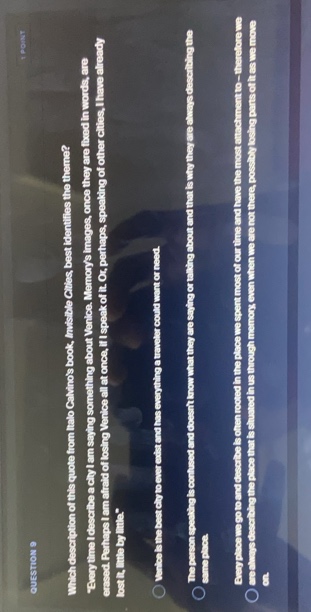
which description of this quote from italo calvinos book, invisible cities, best identifies the theme?
\every time i describe a city i am saying something about venice. memorys images, once they are fixed in words, are erased. perhaps i am afraid of losing venice all at once, if i speak of it. or, perhaps, speaking of other cities, i have already lost it, little by little.\
venice is the best city to ever exist and has everything a traveler could want or need.
the person speaking is confused and doesnt know what they are saying or talking about and that is why they are always describing the same place.
every place we go to and describe is often rooted in the place we spent most of our time and have the most attachment to - therefore we are always describing the place that is situated in us through memory, even when we are not there, possibly losing parts of it as we move on.
🆕 New Concept Discovered: Theme Identification in Literature
Finding the deeper message or central idea of a text
Step 1: Analyze the Quote
Let's look closely at what the speaker is saying in the quote:
- "Every time I describe a city I am saying something about Venice."
- "Memory's images, once they are fixed in words, are erased."
- "Perhaps I am afraid of losing Venice all at once, if I speak of it. Or, perhaps, speaking of other cities, I have already lost it, little by little."
The speaker is explaining that no matter what city they describe, they are actually reflecting on their home city, Venice. However, by trying to capture Venice in words or by describing other places, they feel they are gradually losing their true memory of it.
Step 2: Evaluate the Options
Let's compare our analysis with the given choices:
- Option 1: "Venice is the best city to ever exist and has everything a traveler could want or need."
- Analysis: This is a literal, highly exaggerated statement about Venice's quality. The quote is about memory, loss, and description, not about Venice being a perfect tourist destination.
- Option 2: "The person speaking is confused and doesn't know what they are saying or talking about and that is why they are always describing the same place."
- Analysis: The speaker is not confused; they are highly reflective and self-aware about how memory and language interact.
- Option 3: "Every place we go to and describe is often rooted in the place we spent most of our time and have the most attachment to - therefore we are always describing the place that is situated in us through memory, even when we are not there, possibly losing parts of it as we move on."
- Analysis: This perfectly captures the essence of the quote. The speaker's descriptions of other cities are rooted in their attachment to Venice ("Every time I describe a city I am saying something about Venice"). It also captures the fear of losing that original place through memory and language ("perhaps, speaking of other cities, I have already lost it, little by little").

Snap & solve any problem in the app
Get step-by-step solutions on Sovi AI
Photo-based solutions with guided steps
Explore more problems and detailed explanations
Every place we go to and describe is often rooted in the place we spent most of our time and have the most attachment to - therefore we are always describing the place that is situated in us through memory, even when we are not there, possibly losing parts of it as we move on.