QUESTION IMAGE
Question
question 2
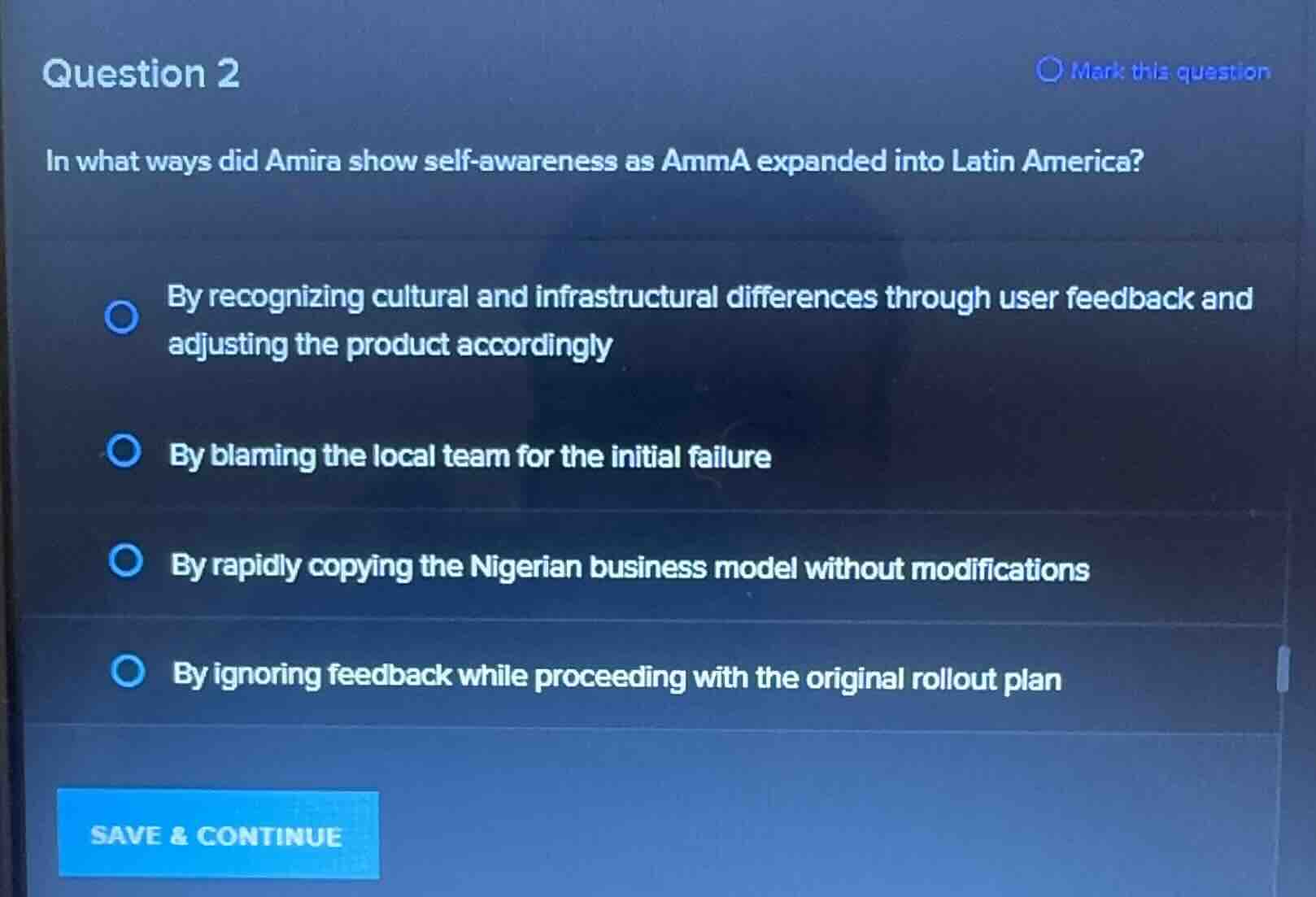
in what ways did amira show self-awareness as amma expanded into latin america?
- by recognizing cultural and infrastructural differences through user feedback and adjusting the product accordingly
- by blaming the local team for the initial failure
- by rapidly copying the nigerian business model without modifications
- by ignoring feedback while proceeding with the original rollout plan
Analyze the concept of self-awareness
Self-awareness in a business leadership context, particularly within Emotional Intelligence, involves recognizing one's own limitations, understanding the impact of cultural differences, and being open to feedback rather than defensively shifting blame or rigidly sticking to a failing plan.
Evaluate the given options
- Option 1: "By recognizing cultural and infrastructural differences through user feedback and adjusting the product accordingly" directly demonstrates self-awareness and Product Localization. It shows the leader acknowledged that their initial assumptions might not fit the new market and adapted based on real-world feedback.
- Option 2: "By blaming the local team for the initial failure" represents a lack of self-awareness and poor emotional intelligence.
- Option 3: "By rapidly copying the Nigerian business model without modifications" shows a lack of adaptation and disregard for local context.
- Option 4: "By ignoring feedback while proceeding with the original rollout plan" represents rigidity and a lack of self-awareness regarding the product's performance.
Determine the correct choice
The first option is the only behavior that reflects positive self-awareness, openness to learning, and constructive adaptation.

Snap & solve any problem in the app
Get step-by-step solutions on Sovi AI
Photo-based solutions with guided steps
Explore more problems and detailed explanations
- (A) By recognizing cultural and infrastructural differences through user feedback and adjusting the product accordingly (Correct answer)
- (B) By blaming the local team for the initial failure
- (C) By rapidly copying the Nigerian business model without modifications
- (D) By ignoring feedback while proceeding with the original rollout plan