QUESTION IMAGE
Question
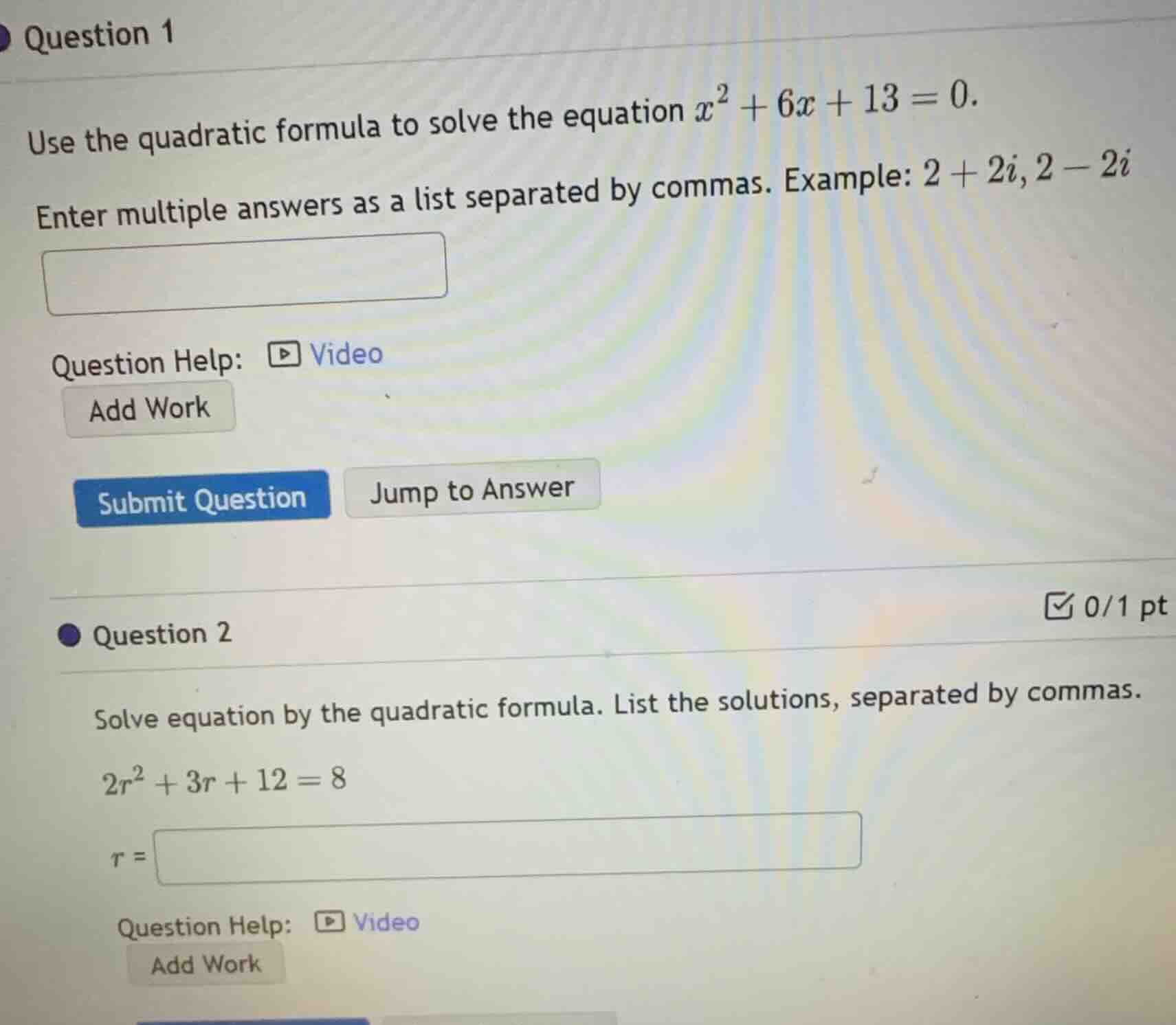
question 1
use the quadratic formula to solve the equation (x^2 + 6x + 13 = 0).
enter multiple answers as a list separated by commas. example: (2 + 2i, 2 - 2i)
question 2
solve equation by the quadratic formula. list the solutions, separated by commas.
(2r^2 + 3r + 12 = 8)
(r =)
🆕 New Concept Discovered: Solving Quadratic Equations with Complex Roots
Finding solutions when the discriminant is negative
---
Question 1
Solve the equation:
Step 1: Identify coefficients
Identify the coefficients \( a \), \( b \), and \( c \) from the standard form \( ax^2 + bx + c = 0 \):
Step 2: Apply the quadratic formula
The quadratic formula is:
Substitute the coefficients into the formula:
Step 3: Simplify using complex numbers
Since we have a negative number under the square root, we use the imaginary unit \( i \) where \( \sqrt{-1} = i \):
Substitute this back into the expression:
The solutions are:
---
Question 2
Solve the equation:
Step 1: Write in standard form
Subtract \( 8 \) from both sides to set the quadratic equation to \( 0 \):
Identify the coefficients:
Step 2: Apply the quadratic formula
Substitute the coefficients into the quadratic formula:
Step 3: Simplify using complex numbers
Express the square root of the negative number using \( i \):
Substitute this back into the expression:
The solutions are:
(or written as \(\frac{-3 + i\sqrt{23}}{4}, \frac{-3 - i\sqrt{23}}{4}\))

Snap & solve any problem in the app
Get step-by-step solutions on Sovi AI
Photo-based solutions with guided steps
Explore more problems and detailed explanations
Question 1:
Question 2: