QUESTION IMAGE
Question
question
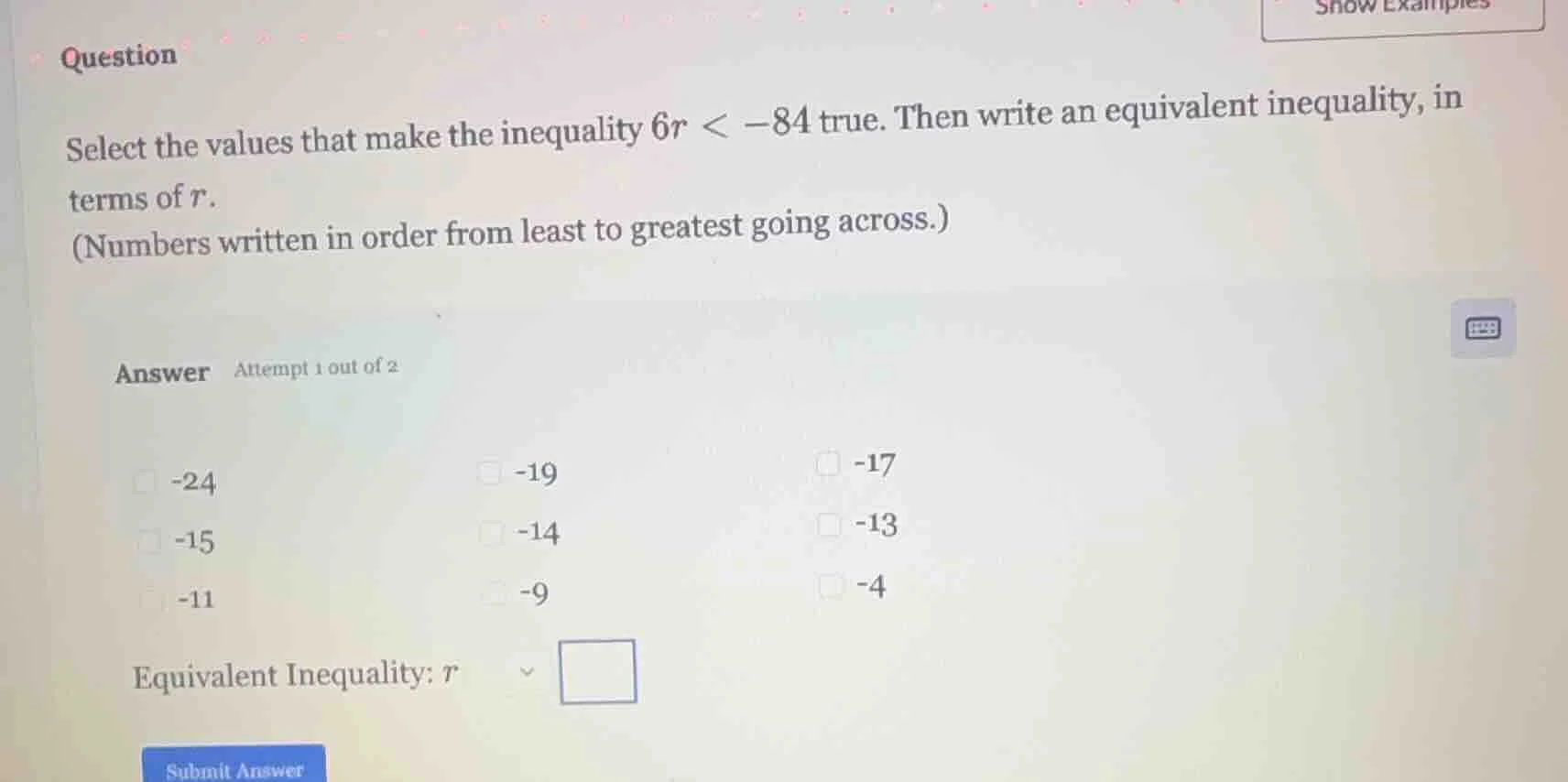
select the values that make the inequality $6r < -84$ true. then write an equivalent inequality, in terms of $r$.
(numbers written in order from least to greatest going across.)
answer attempt 1 out of 2
-24 -19 -17
-15 -14 -13
-11 -9 -4
equivalent inequality: $r$ $\square$
Step1: Solve the inequality \(6r < -84\)
To solve for \(r\), divide both sides of the inequality by 6. Since 6 is a positive number, the direction of the inequality sign remains the same.
\[
\frac{6r}{6} < \frac{-84}{6}
\]
Step2: Simplify both sides
Simplifying the left side gives \(r\), and simplifying the right side gives \(-14\). So the equivalent inequality is \(r < -14\).
Now, we check which values from the list are less than \(-14\). The values less than \(-14\) are \(-24\), \(-19\), \(-17\), \(-15\) (wait, \(-15\) is greater than \(-14\)? Wait, no: \(-24 < -14\), \(-19 < -14\), \(-17 < -14\), \(-15\) is \(-15\), which is less than \(-14\)? Wait, \(-15\) is less than \(-14\) (since on the number line, numbers to the left are smaller). Wait, let's list the values and compare with \(-14\):
- \(-24\): \(-24 < -14\) → yes
- \(-19\): \(-19 < -14\) → yes
- \(-17\): \(-17 < -14\) → yes
- \(-15\): \(-15 < -14\) → yes? Wait, \(-15\) is less than \(-14\) (because \(-15\) is to the left of \(-14\) on the number line). Wait, but let's check the calculation again. Wait, the inequality is \(r < -14\), so any \(r\) less than \(-14\) is a solution. So:
- \(-24\): yes
- \(-19\): yes
- \(-17\): yes
- \(-15\): yes (since \(-15 < -14\))
Wait, no: \(-15\) is less than \(-14\)? Wait, \(-14\) is greater than \(-15\) (because \(-14\) is to the right of \(-15\) on the number line). So \(-15 < -14\) is true. Wait, but let's check the values:
Wait, the values given are: -24, -19, -17, -15, -14, -13, -11, -9, -4. Wait, the options are: -24, -19, -17, -15, -14, -13, -11, -9, -4? Wait, no, the original options are:
-24, -19, -17,
-15, -14, -13,
-11, -9, -4.
Wait, the equivalent inequality is \(r < -14\), so the values less than \(-14\) are:
-24 (since \(-24 < -14\)),
-19 (since \(-19 < -14\)),
-17 (since \(-17 < -14\)),
-15 (since \(-15 < -14\))? Wait, no: \(-15\) is less than \(-14\)? Wait, \(-14\) is greater than \(-15\) (because \(-14\) is to the right of \(-15\) on the number line). So \(-15 < -14\) is true. Wait, but let's check with the inequality \(6r < -84\). Let's test \(r = -15\): \(6(-15) = -90\), and \(-90 < -84\) → true. \(r = -14\): \(6(-14) = -84\), which is not less than \(-84\) (it's equal), so \(r = -14\) is not a solution. \(r = -13\): \(6*(-13) = -78\), which is greater than \(-84\) → not a solution. So the values less than \(-14\) are: -24, -19, -17, -15? Wait, no, \(-15\) is less than \(-14\), but let's check the numbers:
Wait, the values are: -24, -19, -17, -15, -14, -13, -11, -9, -4.
So the values that satisfy \(r < -14\) are:
-24 (since \(-24 < -14\))
-19 (since \(-19 < -14\))
-17 (since \(-17 < -14\))
-15 (since \(-15 < -14\))? Wait, no, \(-15\) is less than \(-14\), but let's check with the inequality. Let's compute \(6r\) for each:
- For \(r = -24\): \(6*(-24) = -144\), and \(-144 < -84\) → true.
- For \(r = -19\): \(6*(-19) = -114\), \(-114 < -84\) → true.
- For \(r = -17\): \(6*(-17) = -102\), \(-102 < -84\) → true.
- For \(r = -15\): \(6*(-15) = -90\), \(-90 < -84\) → true.
- For \(r = -14\): \(6*(-14) = -84\), which is not less than \(-84\) → false.
- For \(r = -13\): \(6*(-13) = -78\), \(-78 > -84\) → false.
- For \(r = -11\): \(6*(-11) = -66\), \(-66 > -84\) → false.
- For \(r = -9\): \(6*(-9) = -54\), \(-54 > -84\) → false.
- For \(r = -4\): \(6*(-4) = -24\), \(-24 > -84\) → false.
Wait, so actually, the values that satisfy \(6r < -84\) are -24, -19, -17, -15? Wait, but \(-15\) gives \(6*(-15) = -90 < -84\), which is true. Wait, but let's check the equivalent inequality: \(r < -14\). So…

Snap & solve any problem in the app
Get step-by-step solutions on Sovi AI
Photo-based solutions with guided steps
Explore more problems and detailed explanations
Values that make the inequality true: -24, -19, -17, -15
Equivalent Inequality: \(r < -14\)