QUESTION IMAGE
Question
question 5 of 5
select the correct answer.
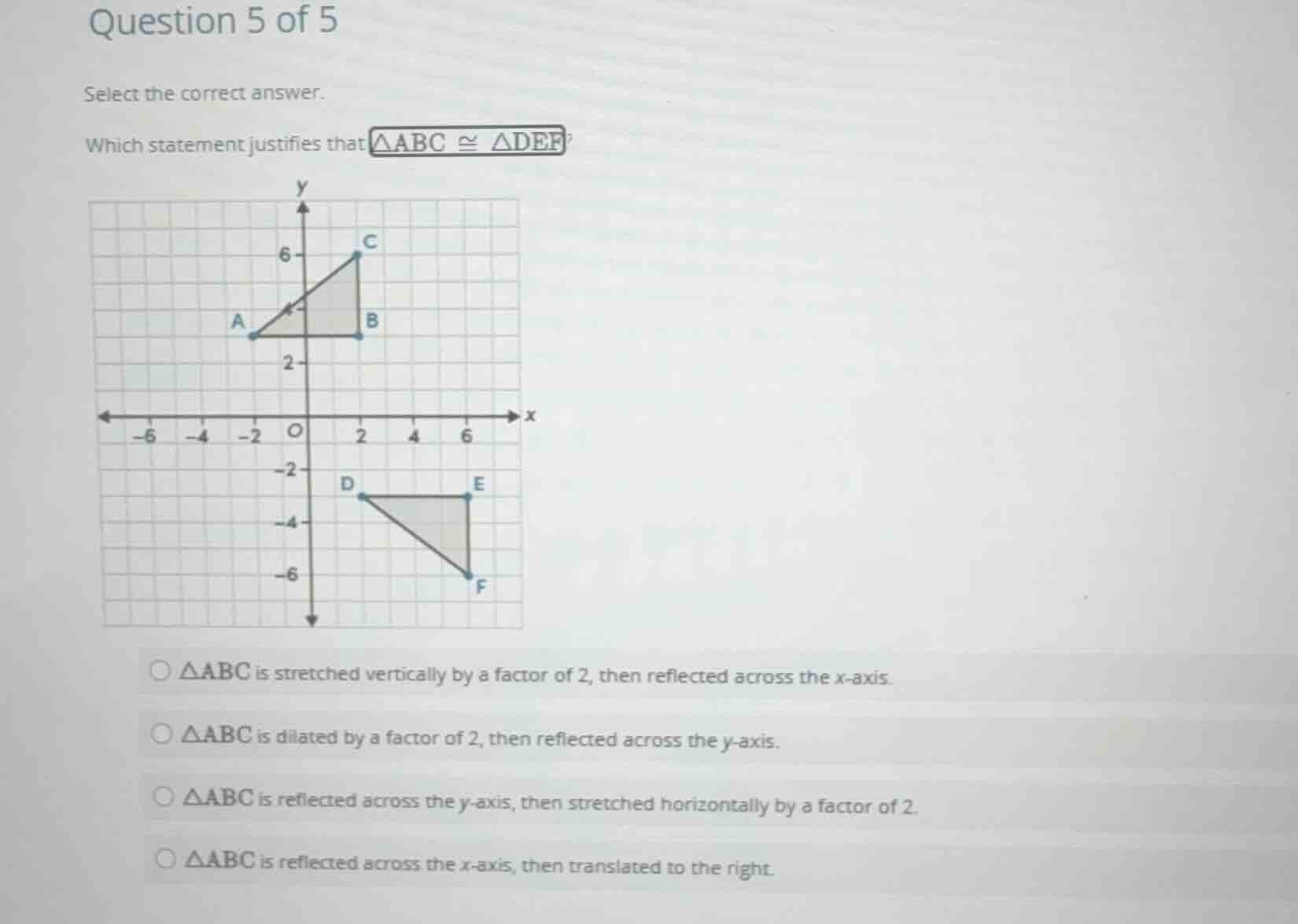
which statement justifies that \\(\triangle abc \cong \triangle def\\)?
\\(\triangle abc\\) is stretched vertically by a factor of 2, then reflected across the x-axis.
\\(\triangle abc\\) is dilated by a factor of 2, then reflected across the y-axis.
\\(\triangle abc\\) is reflected across the y-axis, then stretched horizontally by a factor of 2.
\\(\triangle abc\\) is reflected across the x-axis, then translated to the right.
Identify the coordinates of both triangles
Using the Geometric Transformations knowledge point
We find the coordinates of the vertices of \(\triangle ABC\) and \(\triangle DEF\) from the grid:
- \(A(-2, 3)\), \(B(2, 3)\), \(C(2, 6)\)
- \(D(1, -3)\), \(E(5, -3)\), \(F(5, -6)\)
Analyze the side lengths of both triangles
Using the Geometric Congruence Definition knowledge point
We calculate the lengths of the corresponding sides to check for congruence:
- \(AB = 2 - (-2) = 4\) units, and \(DE = 5 - 1 = 4\) units.
- \(BC = 6 - 3 = 3\) units, and \(EF = -3 - (-6) = 3\) units.
- Since the corresponding side lengths are equal, the triangles are congruent (\(\triangle ABC \cong \triangle DEF\)).
Evaluate transformations preserving congruence
Using the Rigid Transformations knowledge point
- Congruence is preserved only by rigid transformations (translations, reflections, and rotations).
- Any transformation involving stretching or dilation changes the size of the figure, which does not preserve congruence.
- Therefore, options involving stretching or dilating are incorrect.
Determine the specific sequence of rigid transformations
Using the Reflections in the Coordinate Plane and Translation of Figures knowledge points
- Reflecting \(\triangle ABC\) across the \(x\)-axis:
\((x, y)
ightarrow (x, -y)\)
\(A(-2, 3)
ightarrow A'(-2, -3)\)
\(B(2, 3)
ightarrow B'(2, -3)\)
\(C(2, 6)
ightarrow C'(2, -6)\)
- Translating the reflected triangle \(\triangle A'B'C'\) to the right by 3 units:
\((x, -y)
ightarrow (x + 3, -y)\)
\(A'(-2, -3)
ightarrow D(1, -3)\)
\(B'(2, -3)
ightarrow E(5, -3)\)
\(C'(2, -6)
ightarrow F(5, -6)\)
- This sequence perfectly maps \(\triangle ABC\) onto \(\triangle DEF\).

Snap & solve any problem in the app
Get step-by-step solutions on Sovi AI
Photo-based solutions with guided steps
Explore more problems and detailed explanations
- \(\triangle ABC\) is stretched vertically by a factor of 2, then reflected across the x-axis.
- \(\triangle ABC\) is dilated by a factor of 2, then reflected across the y-axis.
- \(\triangle ABC\) is reflected across the y-axis, then stretched horizontally by a factor of 2.
- \(\triangle ABC\) is reflected across the x-axis, then translated to the right. (Correct answer)