QUESTION IMAGE
Question
question 2 of 5
select the correct answer.
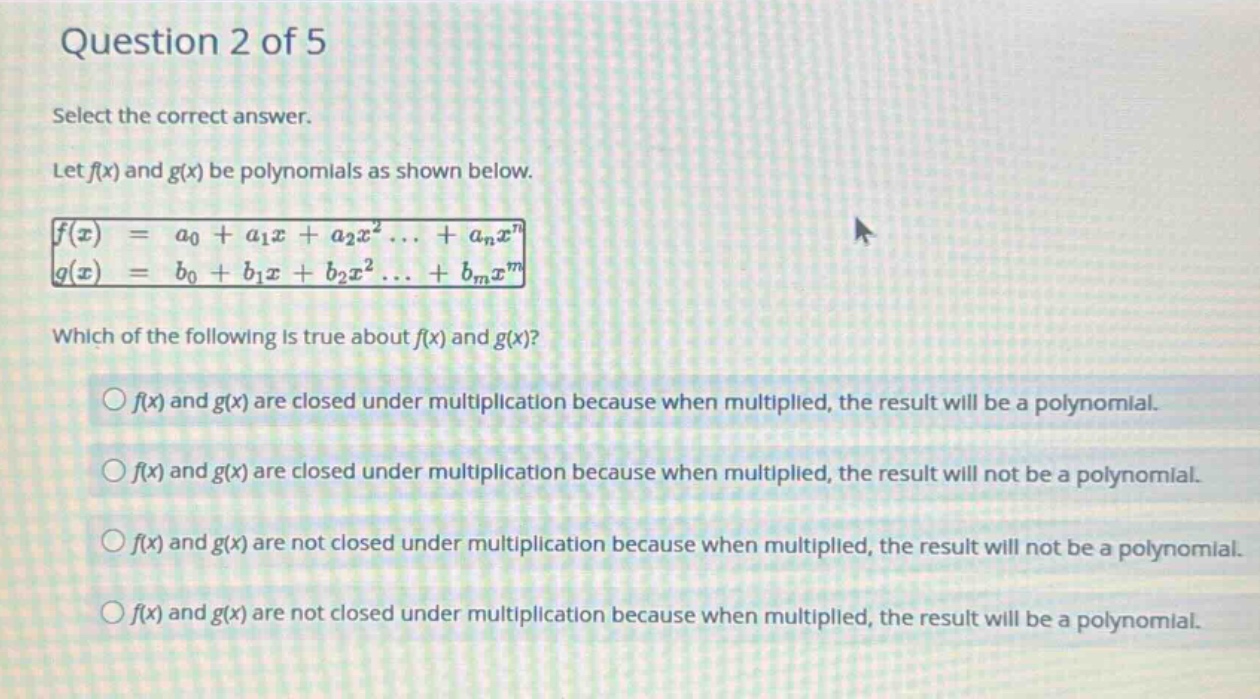
let \\(f(x)\\) and \\(g(x)\\) be polynomials as shown below.
\\
\
\\
which of the following is true about \\(f(x)\\) and \\(g(x)\\)?
- \\(f(x)\\) and \\(g(x)\\) are closed under multiplication because when multiplied, the result will be a polynomial.
- \\(f(x)\\) and \\(g(x)\\) are closed under multiplication because when multiplied, the result will not be a polynomial.
- \\(f(x)\\) and \\(g(x)\\) are not closed under multiplication because when multiplied, the result will not be a polynomial.
- \\(f(x)\\) and \\(g(x)\\) are not closed under multiplication because when multiplied, the result will be a polynomial.
🆕 New Concept Discovered: Closure Property of Polynomials
An operation is closed if the output is always the same type of object as the inputs.
Step 1: Understand the Closure Property
A set is said to be closed under an operation (like addition, subtraction, or multiplication) if performing that operation on any two elements in the set always produces another element that is also in that same set.
For polynomials, this means:
- If we multiply two polynomials, is the result always a polynomial?
Step 2: Analyze Polynomial Multiplication
Let \( f(x) \) and \( g(x) \) be two polynomials:
When we multiply \( f(x) \cdot g(x) \), we distribute the terms. Every term in the product is of the form:
Since the exponents \( i \) and \( j \) are non-negative integers, their sum \( i+j \) is also a non-negative integer. The coefficients \( a_i b_j \) are real numbers.
Therefore, the resulting expression is a sum of terms with non-negative integer exponents, which is by definition another polynomial.
Step 3: Match with the Options
Since multiplying any two polynomials always results in another polynomial, polynomials are closed under multiplication.
- Option 1: "\( f(x) \) and \( g(x) \) are closed under multiplication because when multiplied, the result will be a polynomial." (Correct)
- Option 2: "...closed... because... the result will not be a polynomial." (Incorrect reasoning)
- Option 3: "...not closed... because... the result will not be a polynomial." (Incorrect statement)
- Option 4: "...not closed... because... the result will be a polynomial." (Contradictory statement)

Snap & solve any problem in the app
Get step-by-step solutions on Sovi AI
Photo-based solutions with guided steps
Explore more problems and detailed explanations
\( f(x) \) and \( g(x) \) are closed under multiplication because when multiplied, the result will be a polynomial.