QUESTION IMAGE
Question
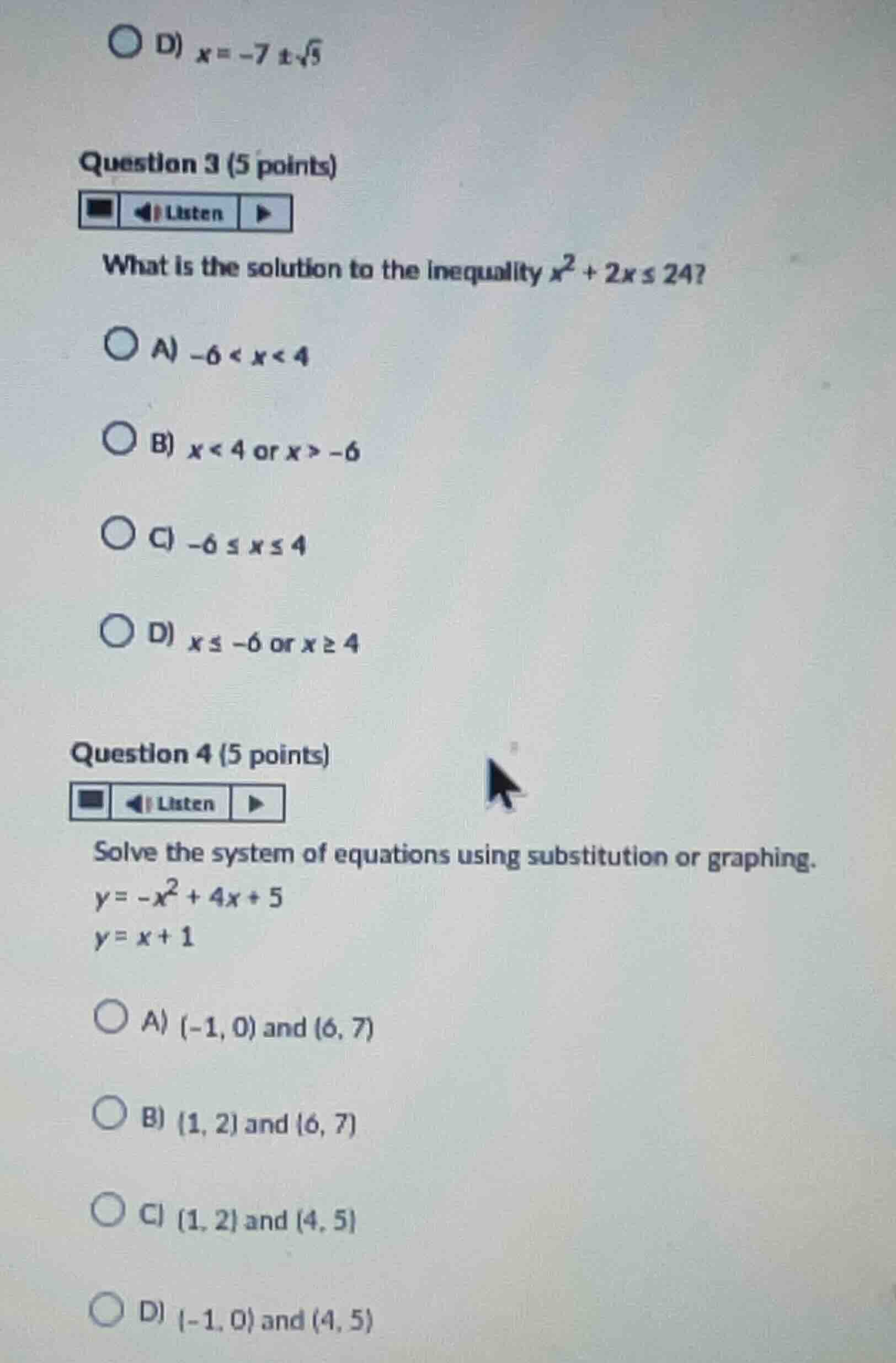
question 3 (5 points)
what is the solution to the inequality \\(x^2 + 2x \le 24\\)?
a) \\(-6 < x < 4\\)
b) \\(x < 4\\) or \\(x > -6\\)
c) \\(-6 \le x \le 4\\)
d) \\(x \le -6\\) or \\(x \ge 4\\)
question 4 (5 points)
solve the system of equations using substitution or graphing.
\\(y = -x^2 + 4x + 5\\)
\\(y = x + 1\\)
a) \\((-1, 0)\\) and \\((6, 7)\\)
b) \\((1, 2)\\) and \\((6, 7)\\)
c) \\((1, 2)\\) and \\((4, 5)\\)
d) \\((-1, 0)\\) and \\((4, 5)\\)
Solve the quadratic inequality
We want to solve the inequality:
First, we rearrange it into standard form by subtracting \(24\) from both sides:
Next, we find the boundary points by factoring the quadratic expression:
The roots of the equation are \(x = -6\) and \(x = 4\). Since the inequality is \(\le 0\), the solution is the interval between and including these boundary points:
This corresponds to option C.
Solve the system of equations
We are given the system:
We substitute the second equation into the first:
Rearranging all terms to one side to form a quadratic equation:
Factoring the quadratic equation:
This gives the \(x\)-values:
Now, we find the corresponding \(y\)-values using \(y = x + 1\):
- For \(x = 4\): \(y = 4 + 1 = 5\), giving the point \((4, 5)\).
- For \(x = -1\): \(y = -1 + 1 = 0\), giving the point \((-1, 0)\).
The solutions are \((-1, 0)\) and \((4, 5)\), which corresponds to option D.

Snap & solve any problem in the app
Get step-by-step solutions on Sovi AI
Photo-based solutions with guided steps
Explore more problems and detailed explanations
Question 3
- A) \(-6 < x < 4\)
- B) \(x < 4 \text{ or } x > -6\)
- C) \(-6 \le x \le 4\) (Correct answer)
- D) \(x \le -6 \text{ or } x \ge 4\)
Question 4
- A) \((-1, 0)\) and \((6, 7)\)
- B) \((1, 2)\) and \((6, 7)\)
- C) \((1, 2)\) and \((4, 5)\)
- D) \((-1, 0)\) and \((4, 5)\) (Correct answer)