QUESTION IMAGE
Question
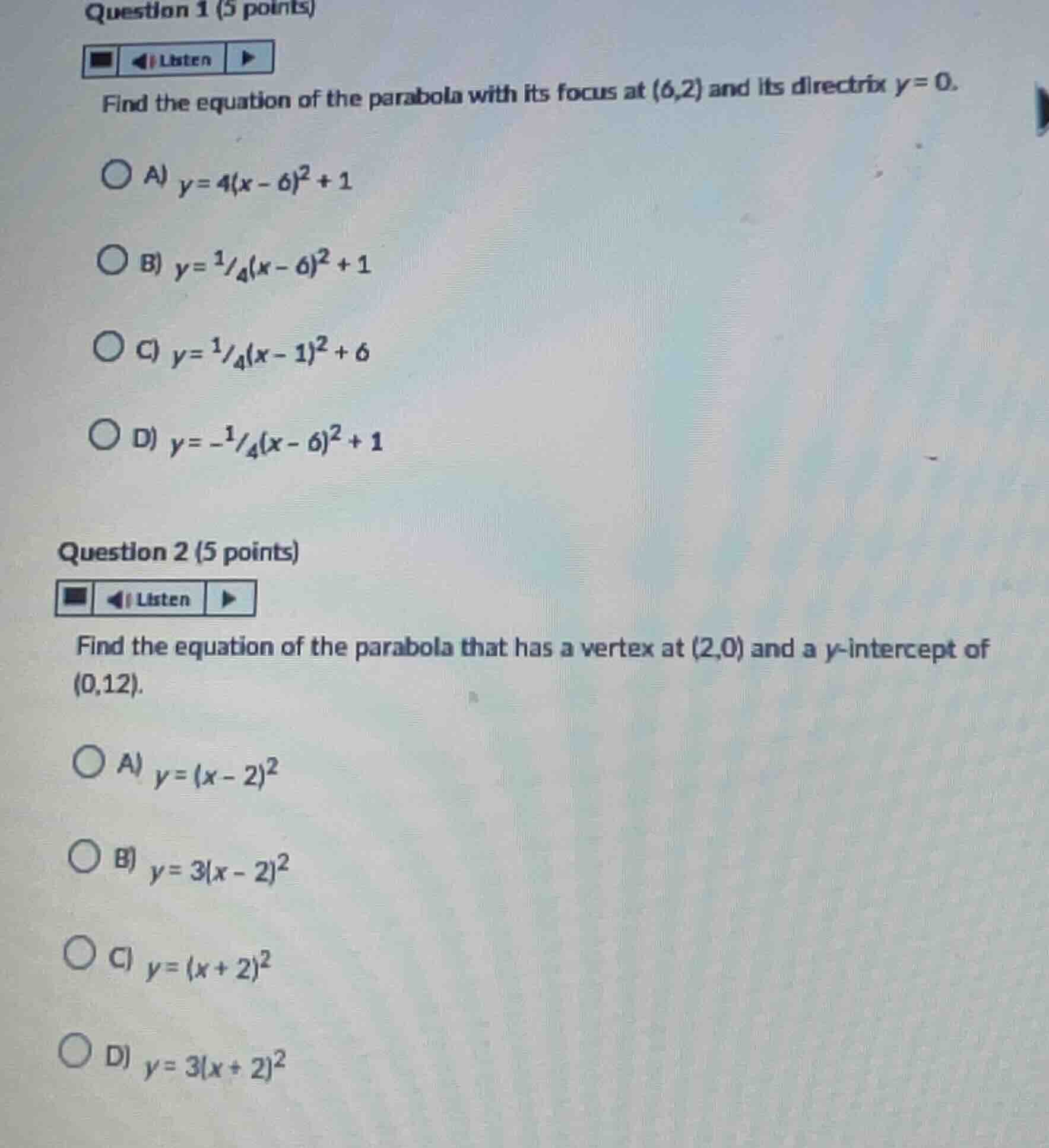
question 1 (5 points)
find the equation of the parabola with its focus at \\((6,2)\\) and its directrix \\(y = 0\\).
a) \\(y = 4(x - 6)^2 + 1\\)
b) \\(y = \frac{1}{4}(x - 6)^2 + 1\\)
c) \\(y = \frac{1}{4}(x - 1)^2 + 6\\)
d) \\(y = -\frac{1}{4}(x - 6)^2 + 1\\)
question 2 (5 points)
find the equation of the parabola that has a vertex at \\((2,0)\\) and a y-intercept of \\((0,12)\\).
a) \\(y = (x - 2)^2\\)
b) \\(y = 3(x - 2)^2\\)
c) \\(y = (x + 2)^2\\)
d) \\(y = 3(x + 2)^2\\)
Analyze Question 1
We need to find the equation of a parabola with focus at \((6,2)\) and directrix \(y = 0\).
Since the directrix is a horizontal line \(y = 0\), the parabola opens vertically.
The vertex \((h,k)\) lies exactly halfway between the focus \((6,2)\) and the directrix \(y = 0\).
The \(x\)-coordinate of the vertex is the same as the focus:
The \(y\)-coordinate of the vertex is the midpoint between the focus \(y\)-coordinate and the directrix:
Thus, the vertex is \((h,k) = (6,1)\).
The distance \(p\) from the vertex to the focus is:
Since the focus is above the directrix, the parabola opens upward, so \(p > 0\).
The standard vertex form of a vertical parabola is:
where \(a = \frac{1}{4p}\).
Substituting \(p = 1\):
Substituting \(h = 6\), \(k = 1\), and \(a = \frac{1}{4}\):
This matches option B.
Analyze Question 2
We need to find the equation of a parabola with vertex at \((2,0)\) and \(y\)-intercept at \((0,12)\).
The vertex form of a vertical parabola is:
Substituting the vertex \((h,k) = (2,0)\):
Now, we use the \(y\)-intercept \((0,12)\) to solve for \(a\):
Substituting \(a = 3\) back into the equation:
This matches option B.

Snap & solve any problem in the app
Get step-by-step solutions on Sovi AI
Photo-based solutions with guided steps
Explore more problems and detailed explanations
Question 1
- A) \(y = 4(x-6)^2 + 1\)
- B) \(y = 1/4(x-6)^2 + 1\) (Correct answer)
- C) \(y = 1/4(x-1)^2 + 6\)
- D) \(y = -1/4(x-6)^2 + 1\)
Question 2
- A) \(y = (x-2)^2\)
- B) \(y = 3(x-2)^2\) (Correct answer)
- C) \(y = (x+2)^2\)
- D) \(y = 3(x+2)^2\)