QUESTION IMAGE
Question
question 6 (5 points)
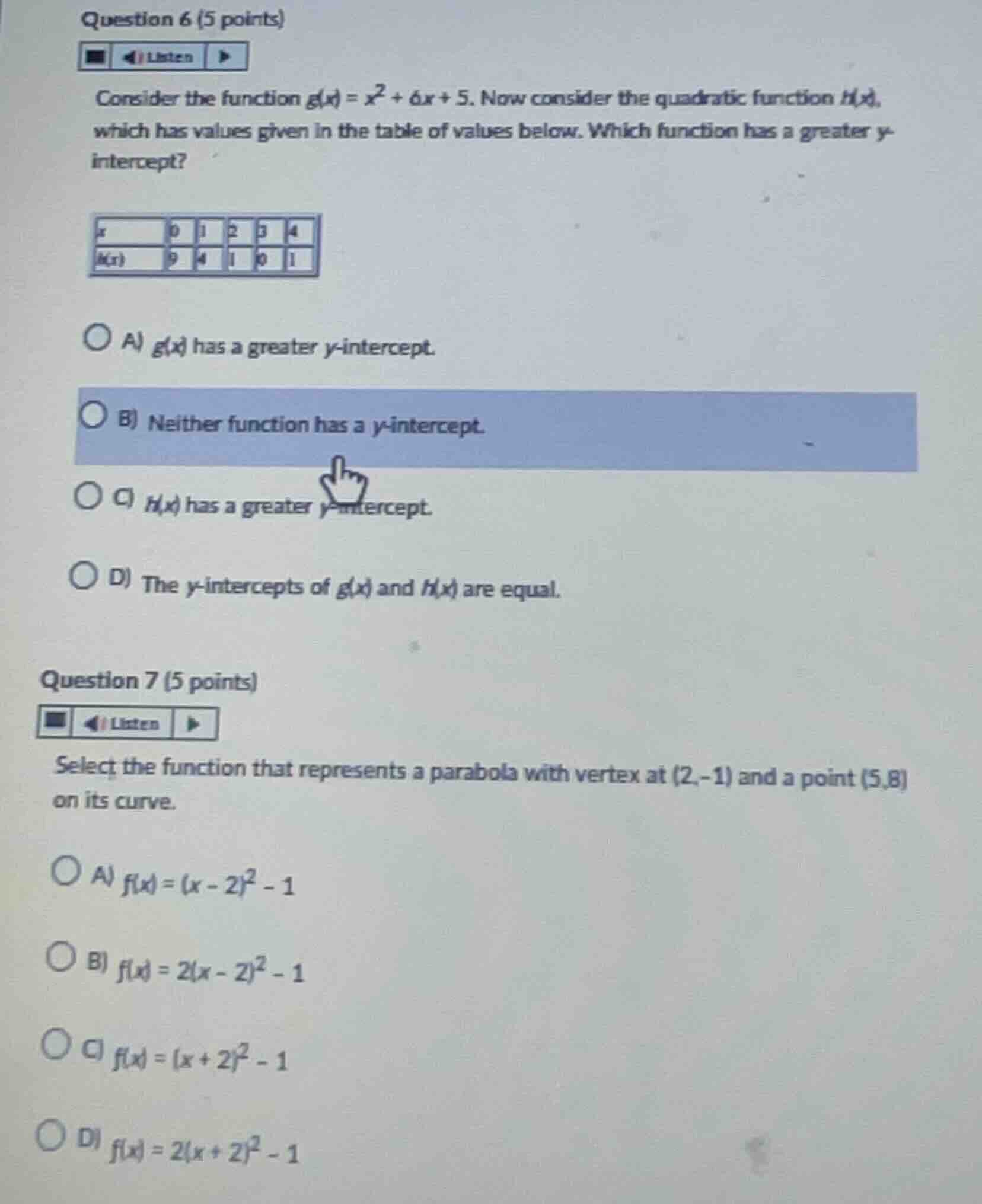
consider the function \\(g(x) = x^2 + 6x + 5\\). now consider the quadratic function \\(h(x)\\), which has values given in the table of values below. which function has a greater y-intercept?
\\(\
\\)
a) \\(g(x)\\) has a greater y-intercept.
b) neither function has a y-intercept.
c) \\(h(x)\\) has a greater y-intercept.
d) the y-intercepts of \\(g(x)\\) and \\(h(x)\\) are equal.
question 7 (5 points)
select the function that represents a parabola with vertex at \\((2,-1)\\) and a point \\((5,8)\\) on its curve.
a) \\(f(x) = (x-2)^2 - 1\\)
b) \\(f(x) = 2(x-2)^2 - 1\\)
c) \\(f(x) = (x+2)^2 - 1\\)
d) \\(f(x) = 2(x+2)^2 - 1\\)
Find the y-intercept of g(x)
To find the y-intercept of \(g(x) = x^2 + 6x + 5\), we evaluate the function at \(x = 0\):
Thus, the y-intercept of \(g(x)\) is \(5\).
Find the y-intercept of h(x)
The table provides values for \(h(x)\). The y-intercept occurs where \(x = 0\). Looking at the table:
- When \(x = 0\), \(h(0) = 9\).
Thus, the y-intercept of \(h(x)\) is \(9\).
Compare the y-intercepts
We compare the two y-intercept values:
- \(g(0) = 5\)
- \(h(0) = 9\)
Since \(9 > 5\), \(h(x)\) has a greater y-intercept. This corresponds to option C.
Determine the vertex form of the parabola
Using the Parabola Vertex Form knowledge point
Solve for the leading coefficient a
Using the Parabola Vertex Form knowledge point
This corresponds to option A.

Snap & solve any problem in the app
Get step-by-step solutions on Sovi AI
Photo-based solutions with guided steps
Explore more problems and detailed explanations
Question 6
- (A) \(g(x)\) has a greater y-intercept.
- (B) Neither function has a y-intercept.
- (C) \(h(x)\) has a greater y-intercept. (Correct answer)
- (D) The y-intercepts of \(g(x)\) and \(h(x)\) are equal.
Question 7
- (A) \(f(x) = (x - 2)^2 - 1\) (Correct answer)
- (B) \(f(x) = 2(x - 2)^2 - 1\)
- (C) \(f(x) = (x + 2)^2 - 1\)
- (D) \(f(x) = 2(x + 2)^2 - 1\)