QUESTION IMAGE
Question
question 8 (1 point)
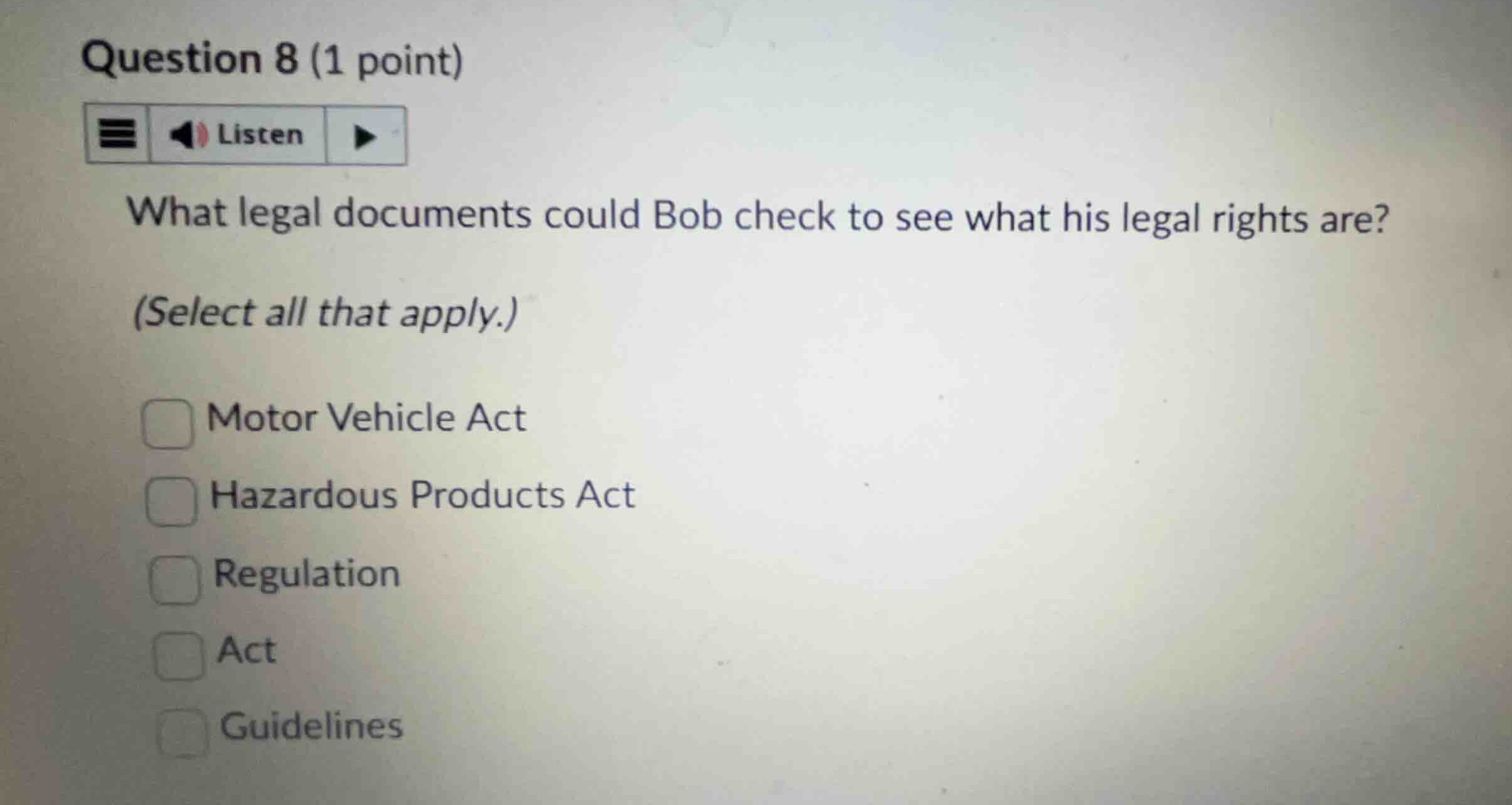
what legal documents could bob check to see what his legal rights are?
(select all that apply.)
motor vehicle act
hazardous products act
regulation
act
guidelines
<pre_analysis>
{
"quality": "clear",
"question_count": 1,
"skills_matched": [
"direct_cot",
"multiple_choice_formatter",
"explain_then_answer",
"quick"
],
"needs_drawing": false,
"concepts_used": [
"Workplace Legislation",
"Legal Documents Hierarchy",
"Occupational Health and Safety Regulation",
"Workers Compensation Act",
"WorkSafeBC Guidelines"
],
"new_concepts": [],
"current_concepts": [
"Workplace Legislation",
"Legal Documents Hierarchy",
"Occupational Health and Safety Regulation",
"Workers Compensation Act",
"WorkSafeBC Guidelines"
]
}
</pre_analysis>
<reasoning>
Identify the legal documents containing worker rights
The Workers Compensation Act (the "Act") and the Occupational Health and Safety Regulation (the "Regulation") are legally binding documents that establish and protect workers' legal rights and safety requirements in the workplace.
Evaluate guidelines and other options
Guidelines (such as WorkSafeBC Guidelines) explain and provide guidance on how to comply with the Act and Regulation but are not themselves the primary legal documents establishing legal rights. The Motor Vehicle Act and Hazardous Products Act are specific to traffic and chemical products rather than general workplace safety rights.
</reasoning>
<answer>
<mcq-option>Motor Vehicle Act</mcq-option>
<mcq-option>Hazardous Products Act</mcq-option>
<mcq-correct>Regulation</mcq-correct>
<mcq-correct>Act</mcq-correct>
<mcq-option>Guidelines</mcq-option>
</answer>
<post_analysis>
{
"subject": "Social Science",
"question_type": "Multiple Choice",
"knowledge_point": [
"Social Science",
"Law",
"Workplace Legislation"
]
}
</post_analysis>
Snap & solve any problem in the app
Get step-by-step solutions on Sovi AI
Photo-based solutions with guided steps
Explore more problems and detailed explanations
<pre_analysis>
{
"quality": "clear",
"question_count": 1,
"skills_matched": [
"direct_cot",
"multiple_choice_formatter",
"explain_then_answer",
"quick"
],
"needs_drawing": false,
"concepts_used": [
"Workplace Legislation",
"Legal Documents Hierarchy",
"Occupational Health and Safety Regulation",
"Workers Compensation Act",
"WorkSafeBC Guidelines"
],
"new_concepts": [],
"current_concepts": [
"Workplace Legislation",
"Legal Documents Hierarchy",
"Occupational Health and Safety Regulation",
"Workers Compensation Act",
"WorkSafeBC Guidelines"
]
}
</pre_analysis>
<reasoning>
Identify the legal documents containing worker rights
The Workers Compensation Act (the "Act") and the Occupational Health and Safety Regulation (the "Regulation") are legally binding documents that establish and protect workers' legal rights and safety requirements in the workplace.
Evaluate guidelines and other options
Guidelines (such as WorkSafeBC Guidelines) explain and provide guidance on how to comply with the Act and Regulation but are not themselves the primary legal documents establishing legal rights. The Motor Vehicle Act and Hazardous Products Act are specific to traffic and chemical products rather than general workplace safety rights.
</reasoning>
<answer>
<mcq-option>Motor Vehicle Act</mcq-option>
<mcq-option>Hazardous Products Act</mcq-option>
<mcq-correct>Regulation</mcq-correct>
<mcq-correct>Act</mcq-correct>
<mcq-option>Guidelines</mcq-option>
</answer>
<post_analysis>
{
"subject": "Social Science",
"question_type": "Multiple Choice",
"knowledge_point": [
"Social Science",
"Law",
"Workplace Legislation"
]
}
</post_analysis>