QUESTION IMAGE
Question
question 7 (1 point) saved
answer the question true or false.
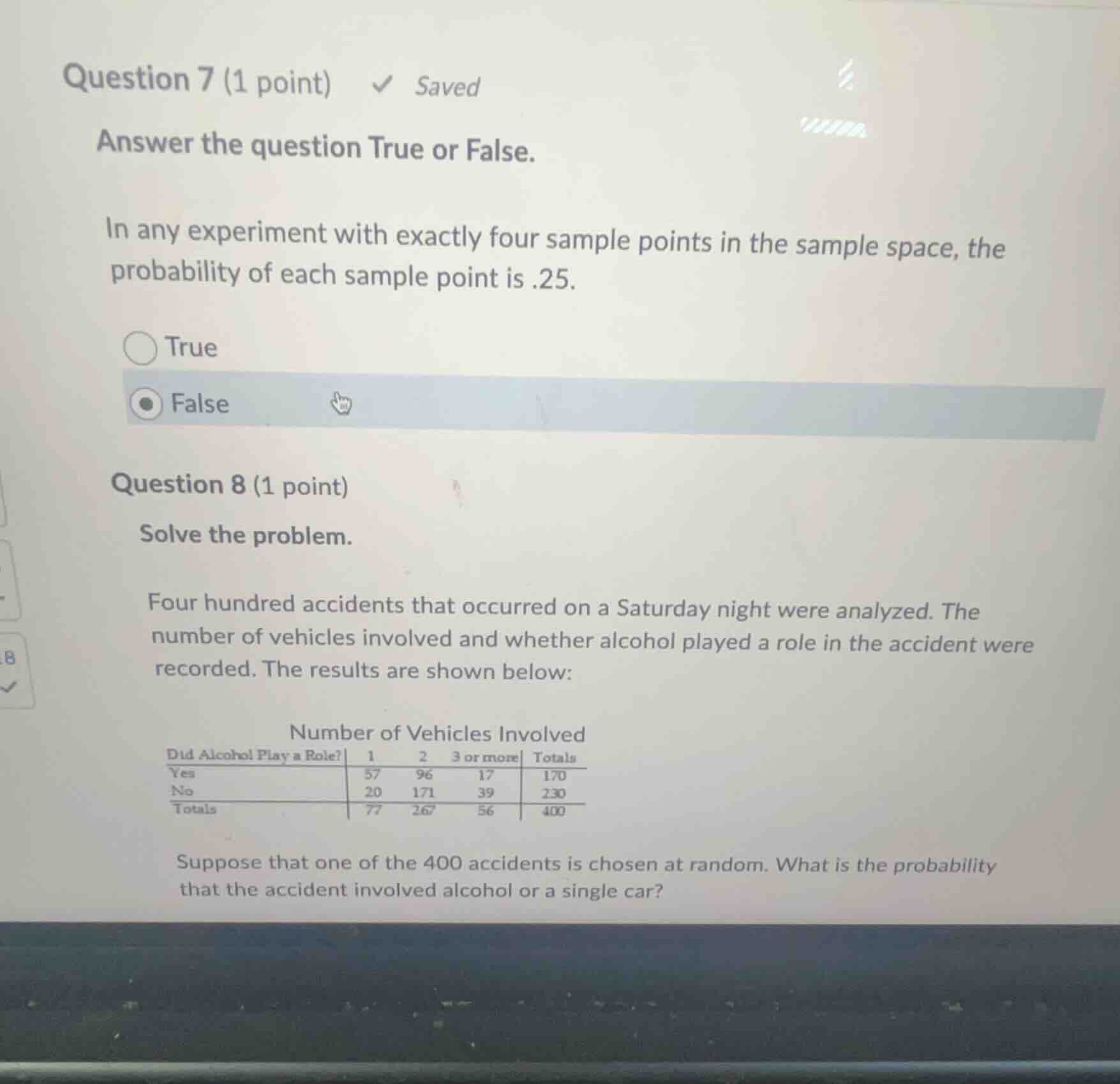
in any experiment with exactly four sample points in the sample space, the probability of each sample point is .25.
true
false
question 8 (1 point)
solve the problem.
four hundred accidents that occurred on a saturday night were analyzed. the number of vehicles involved and whether alcohol played a role in the accident were recorded. the results are shown below:
number of vehicles involved
did alcohol play a role? | 1 | 2 | 3 or more | totals
yes | 57 | 96 | 17 | 170
no | 20 | 171 | 39 | 230
totals | 77 | 267 | 56 | 400
suppose that one of the 400 accidents is chosen at random. what is the probability that the accident involved alcohol or a single car?
Analyze Question 7
We are asked to evaluate the truth value of the statement: "In any experiment with exactly four sample points in the sample space, the probability of each sample point is .25."
A sample space \(S\) containing exactly four sample points can be written as \(S = \{e_1, e_2, e_3, e_4\}\). According to the fundamental axioms of probability, the sum of the probabilities of all sample points in a sample space must equal 1:
However, there is no requirement that the sample points must be equally likely (i.e., symmetric). For example, we could have:
Since the probabilities do not have to be equal, the statement is false.
Identify given values for Question 8
We are given a contingency table summarizing 400 accidents:
| Did Alcohol Play a Role? | 1 Vehicle | 2 Vehicles | 3 or more | Totals |
|---|---|---|---|---|
| No | 20 | 171 | 39 | 230 |
| Totals | 77 | 267 | 56 | 400 |
We need to find the probability that a randomly chosen accident involved alcohol or a single car (1 vehicle).
Apply the addition rule for probability
Let \(A\) be the event that alcohol played a role.
Let \(B\) be the event that a single car (1 vehicle) was involved.
We want to find the union probability \(P(A \cup B)\). Using the addition rule:
From the table, we find the frequencies:
- Total number of accidents: \(N = 400\)
- Number of accidents involving alcohol, \(n(A) = 170\)
- Number of accidents involving a single car, \(n(B) = 77\)
- Number of accidents involving both alcohol and a single car, \(n(A \cap B) = 57\)
Calculate the final probability
Substitute the values into the probability formula:

Snap & solve any problem in the app
Get step-by-step solutions on Sovi AI
Photo-based solutions with guided steps
Explore more problems and detailed explanations
Question 7
- True
- False (Correct answer)
Question 8
The probability that the accident involved alcohol or a single car is \(0.475\) (or \(\frac{19}{40}\)).