QUESTION IMAGE
Question
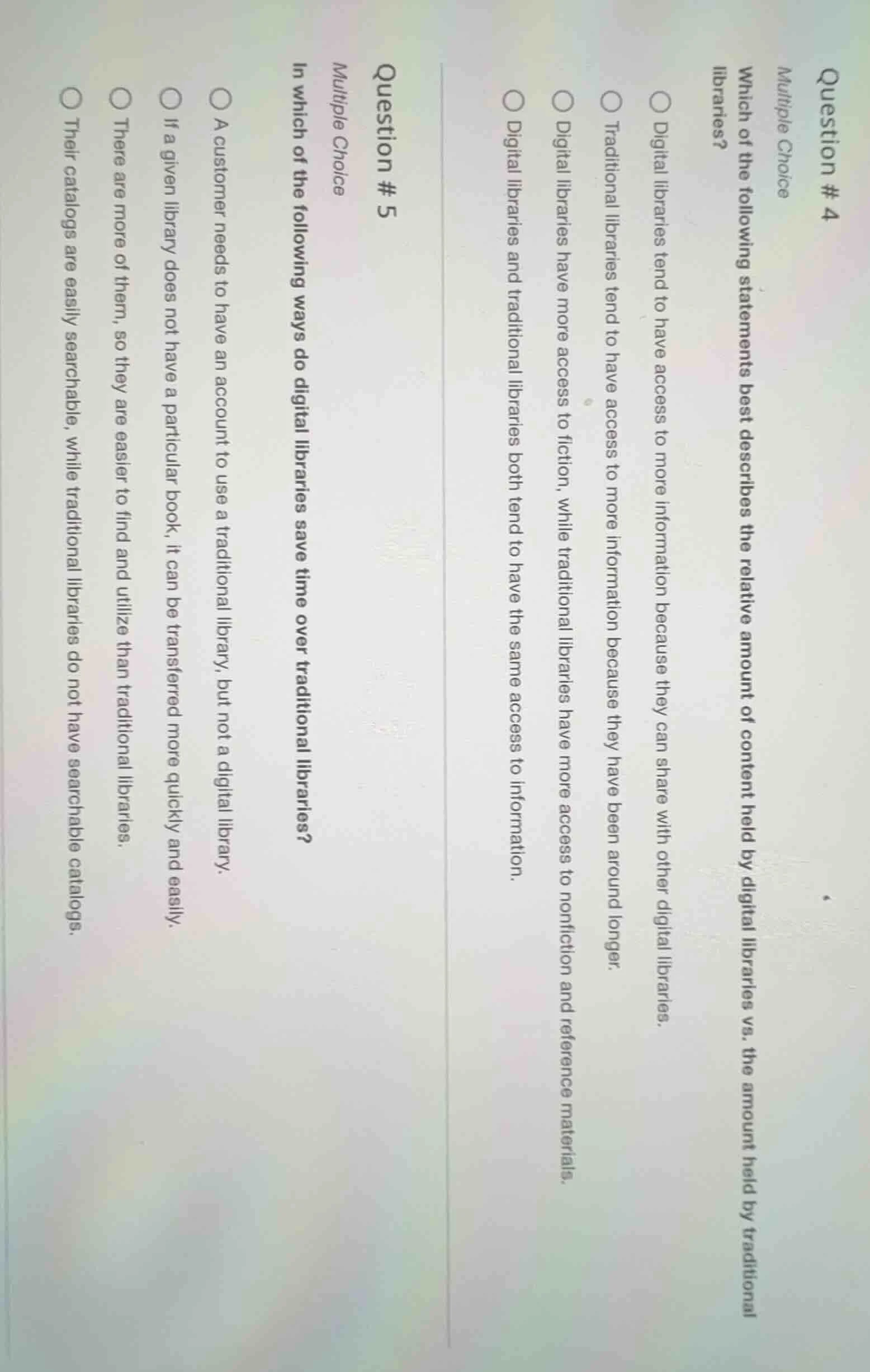
question # 4
multiple choice
which of the following statements best describes the relative amount of content held by digital libraries vs. the amount held by traditional libraries?
○ digital libraries tend to have access to more information because they can share with other digital libraries.
○ traditional libraries tend to have access to more information because they have been around longer.
○ digital libraries have more access to fiction, while traditional libraries have more access to nonfiction and reference materials.
○ digital libraries and traditional libraries both tend to have the same access to information.
question # 5
multiple choice
in which of the following ways do digital libraries save time over traditional libraries?
○ a customer needs to have an account to use a traditional library, but not a digital library.
○ if a given library does not have a particular book, it can be transferred more quickly and easily.
○ there are more of them, so they are easier to find and utilize than traditional libraries.
○ their catalogs are easily searchable, while traditional libraries do not have searchable catalogs.
Question #4
Digital libraries can share resources with other digital libraries, allowing them to aggregate a vast amount of information from multiple sources. Traditional libraries are limited by their physical collections, while digital libraries' ability to share (e.g., through inter - library digital resource sharing, access to online databases from various institutions) gives them more information access. The other options are incorrect: traditional libraries don't inherently have more information just because they've been around longer; the fiction/non - fiction access distinction is not a standard way to compare their information amounts; and they don't have the same access amount as digital libraries due to digital's sharing and aggregation capabilities.
Digital libraries have searchable catalogs that allow users to quickly find materials. If a user needs a specific book from a digital library, the process of locating it (via search) and then accessing or transferring (e.g., downloading) it is quick. Traditional libraries may require physical searching or waiting for availability. The first option is incorrect as having an account is not a time - saving aspect in terms of the library type comparison here. The second option is wrong as the number of materials doesn't directly relate to time - saving in the way described. The last option is incorrect as traditional libraries do have searchable catalogs (though digital catalogs are often more efficient, but the statement says traditional libraries do not have searchable catalogs which is false).

Snap & solve any problem in the app
Get step-by-step solutions on Sovi AI
Photo-based solutions with guided steps
Explore more problems and detailed explanations
A. Digital libraries tend to have access to more information because they can share with other digital libraries.