Sovi.AI - AI Math Tutor

Scan to solve math questions

QUESTION IMAGE

question 6 make connections three connections between any one of the fo…

Question

question 6

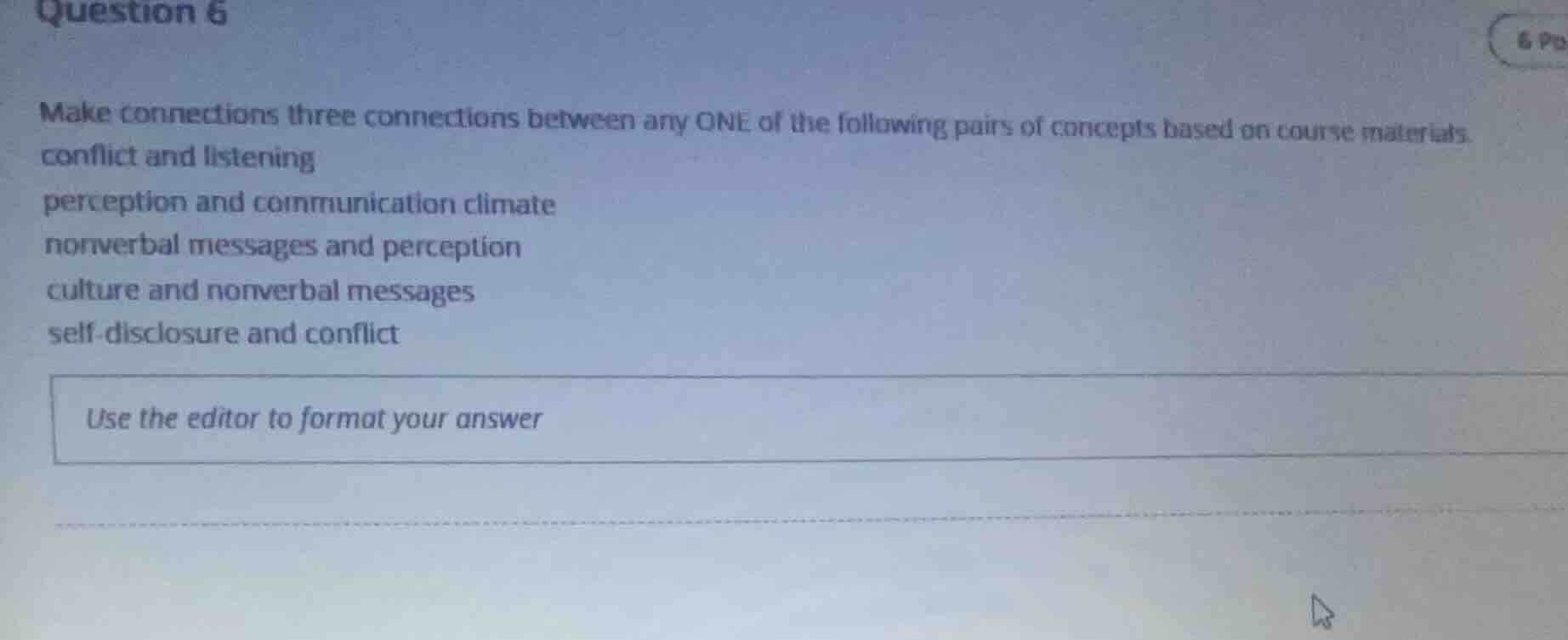
make connections three connections between any one of the following pairs of concepts based on course materials.
conflict and listening
perception and communication climate
nonverbal messages and perception
culture and nonverbal messages
self-disclosure and conflict

use the editor to format your answer

Explanation:

Response

<pre_analysis>
{
"quality": "clear",
"question_count": 1,
"skills_matched": [
"direct_cot",
"explain_then_answer",
"tutor"
],
"needs_drawing": false,
"concepts_used": [
"Interpersonal Communication"
],
"new_concepts": [
"Conflict Resolution",
"Active Listening",
"Communication Climate"
],
"current_concepts": [
"Interpersonal Communication",
"Conflict Resolution",
"Active Listening",
"Communication Climate"
]
}
</pre_analysis>

<reasoning>

Select a pair of concepts

We select the pair conflict and listening to analyze. This pair directly relates to core principles of Interpersonal Communication.

Connection 1: Listening styles and conflict escalation

Using the Interpersonal Communication knowledge point, active listening helps de-escalate conflict. Conversely, poor listening styles (such as defensive listening or selective listening) cause misunderstandings, which escalate interpersonal tension and turn minor disagreements into major conflicts.

Connection 2: Empathy and collaborative problem-solving

Effective listening involves empathy, which allows individuals to understand the other party's underlying needs and feelings during a conflict. This understanding shifts the conflict dynamic from a competitive (win-lose) orientation to a collaborative (win-win) orientation.

Connection 3: Feedback and conflict resolution

In conflict management, active listening requires paraphrasing and perception-checking. Providing this verbal feedback ensures both parties are on the same page, reducing defensive communication climates and facilitating a mutually agreeable resolution.
</reasoning>

<answer>
Selected Pair: Conflict and Listening

  • Connection 1 (Escalation vs. De-escalation): Poor listening habits (such as defensive or selective listening) fuel misunderstandings and escalate conflict, whereas active listening helps de-escalate emotional tension.
  • Connection 2 (Empathy and Collaboration): Empathetic listening allows parties to understand each other's underlying needs, shifting the conflict from a competitive "win-lose" struggle to a collaborative "win-win" problem-solving process.
  • Connection 3 (Feedback and Clarification): Using active listening techniques like paraphrasing and perception-checking clarifies intentions, reduces defensive communication, and helps resolve conflicts accurately.

</answer>

<post_analysis>
{
"subject": "Social Science",
"question_type": "Free Response",
"knowledge_point": [
"Social Science",
"Communication Studies",
"Interpersonal Communication"
]
}
</post_analysis>

Answer:

<pre_analysis>
{
"quality": "clear",
"question_count": 1,
"skills_matched": [
"direct_cot",
"explain_then_answer",
"tutor"
],
"needs_drawing": false,
"concepts_used": [
"Interpersonal Communication"
],
"new_concepts": [
"Conflict Resolution",
"Active Listening",
"Communication Climate"
],
"current_concepts": [
"Interpersonal Communication",
"Conflict Resolution",
"Active Listening",
"Communication Climate"
]
}
</pre_analysis>

<reasoning>

Select a pair of concepts

We select the pair conflict and listening to analyze. This pair directly relates to core principles of Interpersonal Communication.

Connection 1: Listening styles and conflict escalation

Using the Interpersonal Communication knowledge point, active listening helps de-escalate conflict. Conversely, poor listening styles (such as defensive listening or selective listening) cause misunderstandings, which escalate interpersonal tension and turn minor disagreements into major conflicts.

Connection 2: Empathy and collaborative problem-solving

Effective listening involves empathy, which allows individuals to understand the other party's underlying needs and feelings during a conflict. This understanding shifts the conflict dynamic from a competitive (win-lose) orientation to a collaborative (win-win) orientation.

Connection 3: Feedback and conflict resolution

In conflict management, active listening requires paraphrasing and perception-checking. Providing this verbal feedback ensures both parties are on the same page, reducing defensive communication climates and facilitating a mutually agreeable resolution.
</reasoning>

<answer>
Selected Pair: Conflict and Listening

  • Connection 1 (Escalation vs. De-escalation): Poor listening habits (such as defensive or selective listening) fuel misunderstandings and escalate conflict, whereas active listening helps de-escalate emotional tension.
  • Connection 2 (Empathy and Collaboration): Empathetic listening allows parties to understand each other's underlying needs, shifting the conflict from a competitive "win-lose" struggle to a collaborative "win-win" problem-solving process.
  • Connection 3 (Feedback and Clarification): Using active listening techniques like paraphrasing and perception-checking clarifies intentions, reduces defensive communication, and helps resolve conflicts accurately.

</answer>

<post_analysis>
{
"subject": "Social Science",
"question_type": "Free Response",
"knowledge_point": [
"Social Science",
"Communication Studies",
"Interpersonal Communication"
]
}
</post_analysis>