QUESTION IMAGE
Question
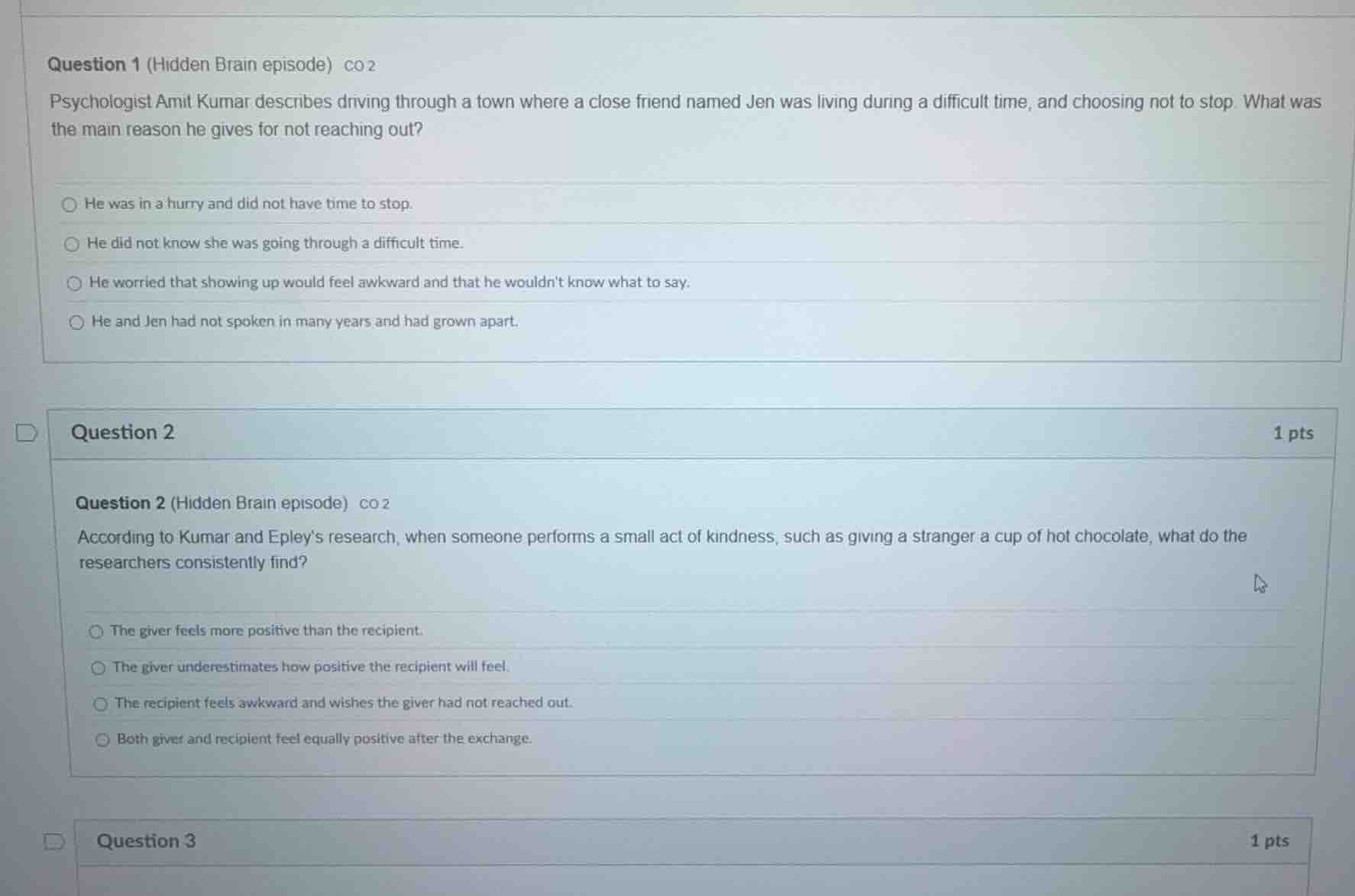
question 1 (hidden brain episode) co 2
psychologist amit kumar describes driving through a town where a close friend named jen was living during a difficult time, and choosing not to stop. what was the main reason he gives for not reaching out?
he was in a hurry and did not have time to stop.
he did not know she was going through a difficult time.
he worried that showing up would feel awkward and that he wouldnt know what to say.
he and jen had not spoken in many years and had grown apart.
question 2 (hidden brain episode) co 2
according to kumar and epleys research, when someone performs a small act of kindness, such as giving a stranger a cup of hot chocolate, what do the researchers consistently find?
the giver feels more positive than the recipient.
the giver underestimates how positive the recipient will feel.
the recipient feels awkward and wishes the giver had not reached out.
both giver and recipient feel equally positive after the exchange.
Analyze Amit Kumar's personal anecdote
In the "Hidden Brain" episode discussing the psychology of reaching out, psychologist Amit Kumar shares a personal story about driving through a town where his friend Jen lived. He explains that he hesitated and chose not to stop because of a common psychological barrier: he worried that reaching out unexpectedly would feel awkward and that he wouldn't know the right words to say.
Analyze Kumar and Epley's research findings
Amit Kumar and Nicholas Epley's research focuses on prosocial behavior and how people perceive small acts of kindness. Their studies consistently demonstrate a systematic asymmetry: givers systematically underestimate how much recipients appreciate a small gesture (like receiving a cup of hot chocolate). The researchers found that while givers focus on the competence or potential awkwardness of the act, recipients focus primarily on the warmth and positive intent, making them feel significantly happier than the givers expect.

Snap & solve any problem in the app
Get step-by-step solutions on Sovi AI
Photo-based solutions with guided steps
Explore more problems and detailed explanations
Question 1
- (A) He was in a hurry and did not have time to stop.
- (B) He did not know she was going through a difficult time.
- (C) He worried that showing up would feel awkward and that he wouldn't know what to say. (Correct answer)
- (D) He and Jen had not spoken in many years and had grown apart.
Question 2
- (A) The giver feels more positive than the recipient.
- (B) The giver underestimates how positive the recipient will feel. (Correct answer)
- (C) The recipient feels awkward and wishes the giver had not reached out.
- (D) Both giver and recipient feel equally positive after the exchange.