QUESTION IMAGE
Question
question 2:
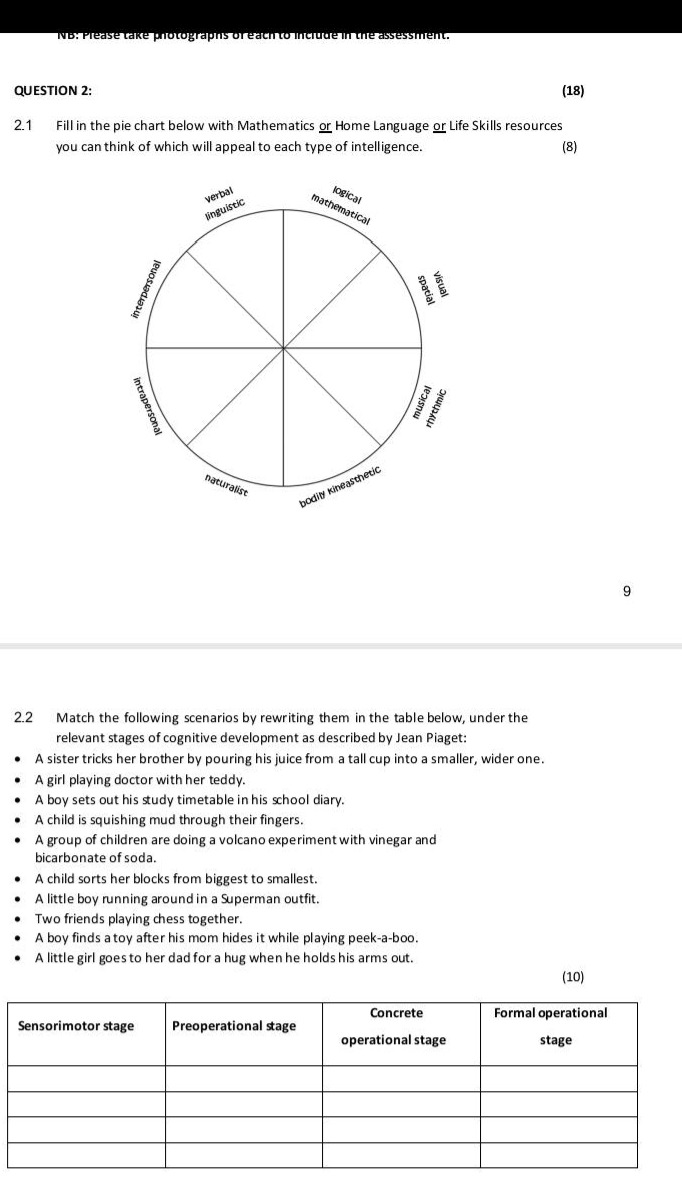
2.1 fill in the pie chart below with mathematics or home language or life skills resources you can think of which will appeal to each type of intelligence.
2.2 match the following scenarios by rewriting them in the table below, under the relevant stages of cognitive development as described by jean piaget:
- a sister tricks her brother by pouring his juice from a tall cup into a smaller, wider one.
- a girl playing doctor with her teddy.
- a boy sets out his study timetable in his school diary.
- a child is squishing mud through their fingers.
- a group of children are doing a volcano experiment with vinegar and bicarbonate of soda.
- a child sorts her blocks from biggest to smallest.
- a little boy running around in a superman outfit.
- two friends playing chess together.
- a boy finds a toy after his mom hides it while playing peek-a-boo.
- a little girl goes to her dad for a hug when he holds his arms out.
\
$$\begin{tabular}{|c|c|c|c|}
\\hline
sensorimotor stage & preoperational stage & \\begin{tabular}{c} concrete \\\\ operational stage \\end{tabular}$$
& \
$$\begin{tabular}{c} formal operational \\\\ stage \\end{tabular}$$
\\\\
\hline
& & & \\\\
\hline
& & & \\\\
\hline
& & & \\\\
\hline
& & & \\\\
\hline
\end{tabular}
Brief Explanations
- Question 2.1: Howard Gardner's Theory of Multiple Intelligences suggests individuals process information through distinct modalities. Resources from early childhood curricula (Mathematics, Home Language, and Life Skills) are mapped to target each specific intelligence (e.g., counting blocks for logical-mathematical, and storybooks for verbal-linguistic).
- Question 2.2: Jean Piaget's stages of cognitive development classify children's thinking patterns:
- Sensorimotor stage (0–2 years): Focuses on sensory exploration, motor activities, and developing object permanence (e.g., squishing mud, peek-a-boo, physical responses to gestures).
- Preoperational stage (2–7 years): Characterized by symbolic play, egocentrism, and animism (e.g., playing doctor with a teddy, wearing a superhero costume).
- Concrete operational stage (7–11 years): Involves logical thinking about concrete events, conservation, classification, and rule-based games (e.g., sorting blocks, understanding volume conservation/tricks, playing chess).
- Formal operational stage (11+ years): Characterized by abstract thinking, systematic planning, and scientific reasoning (e.g., planning a study timetable, conducting a chemical volcano experiment).

Snap & solve any problem in the app
Get step-by-step solutions on Sovi AI
Photo-based solutions with guided steps
Explore more problems and detailed explanations
2.1
| Type of Intelligence | Resource (Mathematics / Home Language / Life Skills) |
|---|---|
| Logical mathematical | Counting blocks / Abacus (Mathematics) |
| Visual spatial | Geometric shape puzzles / Tangrams (Mathematics) |
| Musical rhythmic | Nursery rhyme audio tracks / Percussion instruments (Life Skills) |
| Bodily kinesthetic | Beanbags for throwing and catching games (Life Skills) |
| Naturalist | Leaves, seeds, and shells collected for sorting (Life Skills) |
| Intrapersonal | Personal reflection journals / Quiet reading corner books (Home Language) |
| Interpersonal | Board games / Role-play dress-up costumes (Life Skills) |
<br>
2.2
| Sensorimotor stage | Preoperational stage | Concrete operational stage | Formal operational stage |
|---|---|---|---|
| A boy finds a toy after his mom hides it while playing peek-a-boo. | A little boy running around in a Superman outfit. | A child sorts her blocks from biggest to smallest. | A group of children are doing a volcano experiment with vinegar and bicarbonate of soda. |
| A little girl goes to her dad for a hug when he holds his arms out. | Two friends playing chess together. |