QUESTION IMAGE
Question
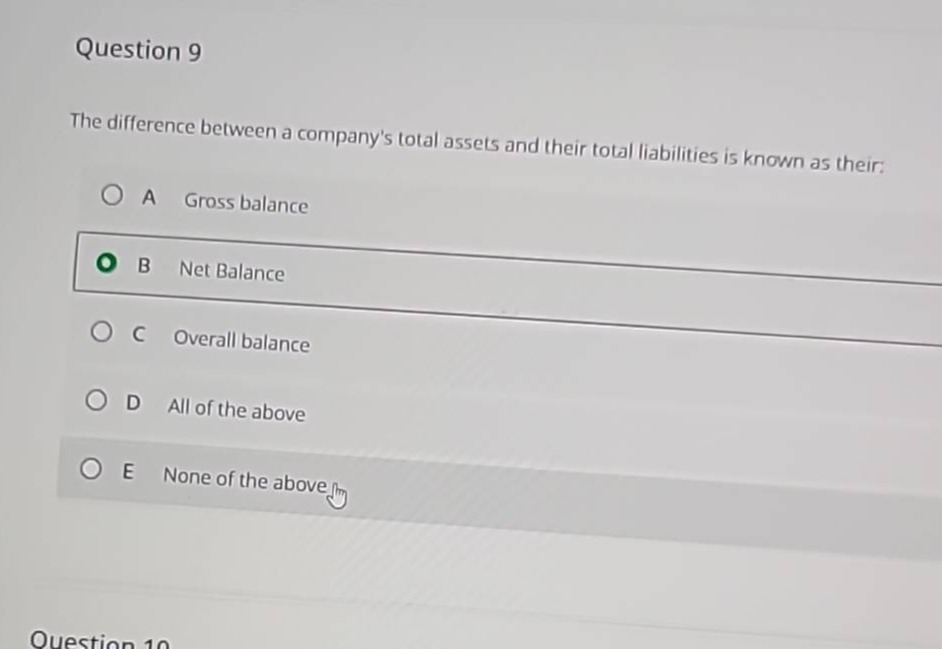
question 9
the difference between a companys total assets and their total liabilities is known as their:
a gross balance
b net balance
c overall balance
d all of the above
e none of the above
🆕 New Concept Discovered: The Accounting Equation
The relationship between what a business owns, owes, and is worth.
Step 1: Analyze the Accounting Equation
The fundamental accounting equation states:
$$ \text{Assets} = \text{Liabilities} + \text{Owner's Equity} $$
Where:
- Assets are what the company owns.
- Liabilities are what the company owes to external parties.
- Owner's Equity (or Net Worth/Net Assets) represents the owner's remaining claim on the assets after all debts are paid.
Step 2: Rearrange the Equation
To find the difference between total assets and total liabilities, we rearrange the equation:
$$ \text{Assets} - \text{Liabilities} = \text{Owner's Equity} $$
This difference is also commonly referred to as Net Worth, Net Assets, or Equity.
Step 3: Evaluate the Given Options
- A. Gross balance: This is not a standard accounting term for this difference.
- B. Net Balance: While "net" implies subtraction, "Net Balance" is not the standard technical term used in accounting for this difference.
- C. Overall balance: This is not a standard accounting term.
- D. All of the above: Incorrect.
- E. None of the above: Since the correct standard terms are Owner's Equity, Shareholders' Equity, or Net Assets (none of which are listed as options A, B, or C), this is the correct choice.

Snap & solve any problem in the app
Get step-by-step solutions on Sovi AI
Photo-based solutions with guided steps
Explore more problems and detailed explanations
E. None of the above