QUESTION IMAGE
Question
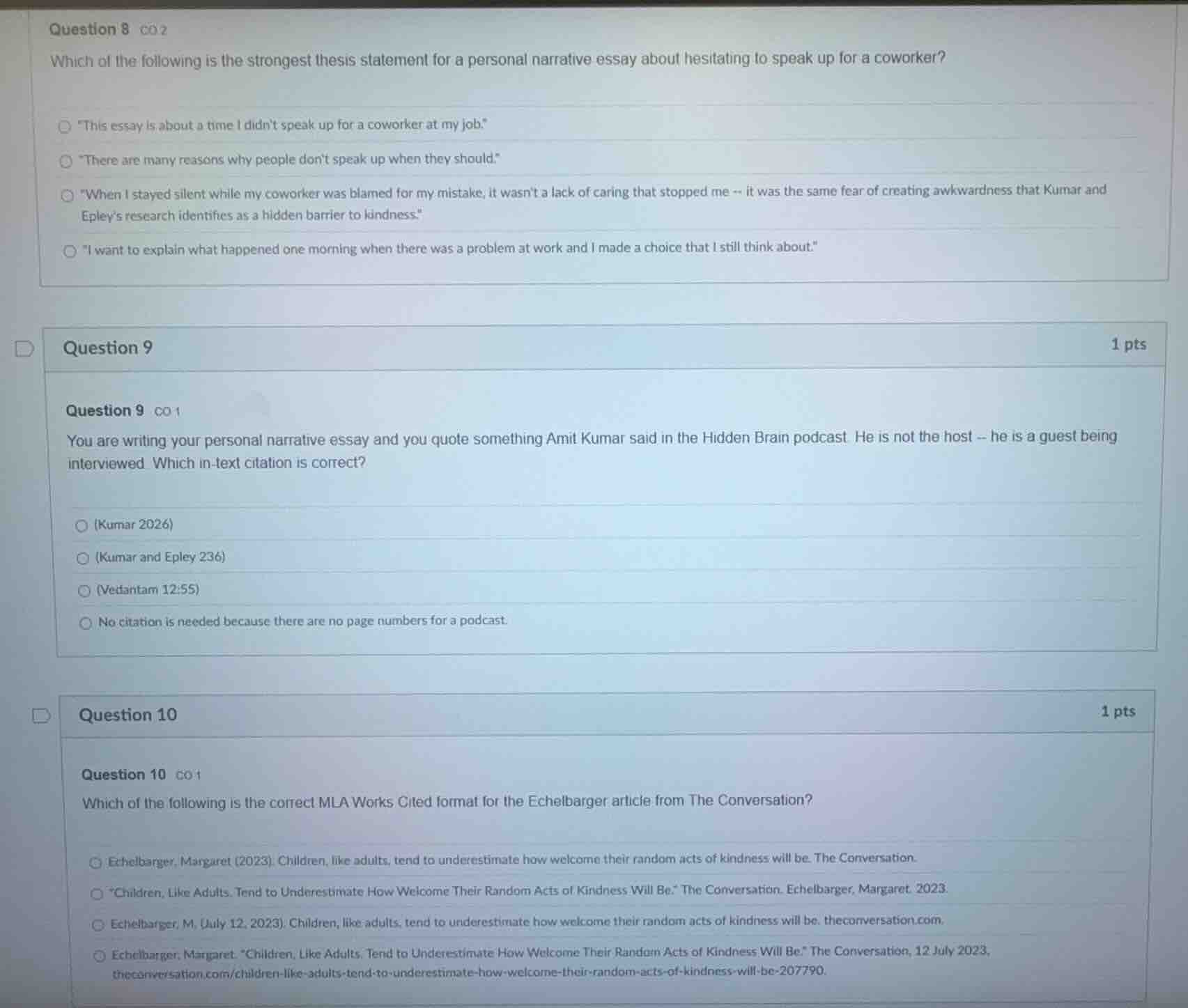
question 8 co 2
which of the following is the strongest thesis statement for a personal narrative essay about hesitating to speak up for a coworker?
- \this essay is about a time i didnt speak up for a coworker at my job.\
- \there are many reasons why people dont speak up when they should.\
- \when i stayed silent while my coworker was blamed for my mistake, it wasnt a lack of caring that stopped me -- it was the same fear of creating awkwardness that kumar and epleys research identifies as a hidden barrier to kindness.\
- \i want to explain what happened one morning when there was a problem at work and i made a choice that i still think about.\
question 9 co 1
you are writing your personal narrative essay and you quote something amit kumar said in the hidden brain podcast. he is not the host -- he is a guest being interviewed. which in-text citation is correct?
- (kumar 2026)
- (kumar and epley 236)
- (vedantam 12:55)
- no citation is needed because there are no page numbers for a podcast.
question 10 co 1
which of the following is the correct mla works cited format for the echelbarger article from the conversation?
- echelbarger, margaret (2023). children, like adults, tend to underestimate how welcome their random acts of kindness will be. the conversation.
- \children, like adults, tend to underestimate how welcome their random acts of kindness will be.\ the conversation. echelbarger, margaret. 2023.
- echelbarger, m. (july 12, 2023). children, like adults, tend to underestimate how welcome their random acts of kindness will be. theconversation.com.
- echelbarger, margaret. \children, like adults, tend to underestimate how welcome their random acts of kindness will be.\ the conversation, 12 july 2023, theconversation.com/children-like-adults-tend-to-underestimate-how-welcome-their-random-acts-of-kindness-will-be-207790.
Evaluate thesis statements for Question 8
We need to find the strongest thesis statement for a Personal Narrative Essay about hesitating to speak up for a coworker.
- Option 1: "This essay is about..." is a weak announcement rather than a thesis.
- Option 2: "There are many reasons why..." is too broad and lacks personal narrative focus.
- Option 3: "When I stayed silent while my coworker was blamed for my mistake, it wasn't a lack of caring that stopped me -- it was the same fear of creating awkwardness that Kumar and Epley's research identifies as a hidden barrier to kindness." This applies a strong Three-Part Thesis Formula structure by establishing the specific narrative event, the internal conflict, and connecting it to a broader conceptual insight.
- Option 4: "I want to explain..." is another weak announcement.
Analyze podcast in-text citation for Question 9
The prompt states you are quoting Amit Kumar (a guest) from the Hidden Brain podcast hosted by Shankar Vedantam.
- According to MLA guidelines for citing a podcast, if you focus on a particular guest's contribution, you can start the entry with the guest's name, or if citing the podcast as a whole, by the host/creator.
- For in-text citations of audio sources without page numbers, MLA style uses the author's/speaker's name and a timestamp (or range) if a specific moment is cited, or just the name.
- Let's look at the options:
(Kumar 2026)uses APA style (Author Year).(Kumar and Epley 236)refers to a print source with page numbers.(Vedantam 12:55)uses the host's name and a timestamp, which is the standard MLA format for an audio source when citing by the creator/host's name to point to a specific timestamp. Since Kumar is the guest on Vedantam's show, the overall source is typically listed under the host/creator (Vedantam) or the episode title, and the in-text citation points to the host's name and the timestamp of the quote:(Vedantam 12:55).
Determine MLA Works Cited format for Question 10
We need the correct MLA Works Cited format for an online article by Margaret Echelbarger from The Conversation.
- MLA 9th edition format for an online article:
Author (Last, First). "Title of Article." Title of Container (italicized), Publisher (if applicable), Date of Publication, URL.
- Let's evaluate the options:
- Option 1 uses APA style:
Echelbarger, Margaret (2023)... - Option 2 starts with the title in quotes, which is incorrect when the author is known.
- Option 3 uses APA style with initials and parenthetical date:
Echelbarger, M. (July 12, 2023)... - Option 4:
Echelbarger, Margaret. "Children, Like Adults, Tend to Underestimate How Welcome Their Random Acts of Kindness Will Be." The Conversation, 12 July 2023, theconversation.com/children-like-adults-tend-to-underestimate-how-welcome-their-random-acts-of-kindness-will-be-207790.This perfectly follows the MLA 9th edition template.

Snap & solve any problem in the app
Get step-by-step solutions on Sovi AI
Photo-based solutions with guided steps
Explore more problems and detailed explanations
Question 8
- (A) "This essay is about a time I didn't speak up for a coworker at my job."
- (B) "There are many reasons why people don't speak up when they should."</mcq-correct>
- (C) "When I stayed silent while my coworker was blamed for my mistake, it wasn't a lack of caring that stopped me -- it was the same fear of creating awkwardness that Kumar and Epley's research identifies as a hidden barrier to kindness." (Correct answer)
<mcq-option>(D) "I want to explain what happened one morning when there was a problem at work and I made a choice that I still think about."
Question 9
- (A) (Kumar 2026)
- (B) (Kumar and Epley 236)
- (C) (Vedantam 12:55) (Correct answer)
- (D) No citation is needed because there are no page numbers for a podcast.
Question 10
- (A) Echelbarger, Margaret (2023). Children, like adults, tend to underestimate how welcome their random acts of kindness will be. The Conversation.
- (B) "Children, Like Adults, Tend to Underestimate How Welcome Their Random Acts of Kindness Will Be." The Conversation. Echelbarger, Margaret. 2023.
- (C) Echelbarger, M. (July 12, 2023). Children, like adults, tend to underestimate how welcome their random acts of kindness will be. theconversation.com.
- (D) Echelbarger, Margaret. "Children, Like Adults, Tend to Underestimate How Welcome Their Random Acts of Kindness Will Be." The Conversation, 12 July 2023, theconversation.com/children-like-adults-tend-to-underestimate-how-welcome-their-random-acts-of-kindness-will-be-207790. (Correct answer)