Sovi.AI - AI Math Tutor

Scan to solve math questions

QUESTION IMAGE

question 3 both lipids and carbohydrates are important in animal cells …

Question

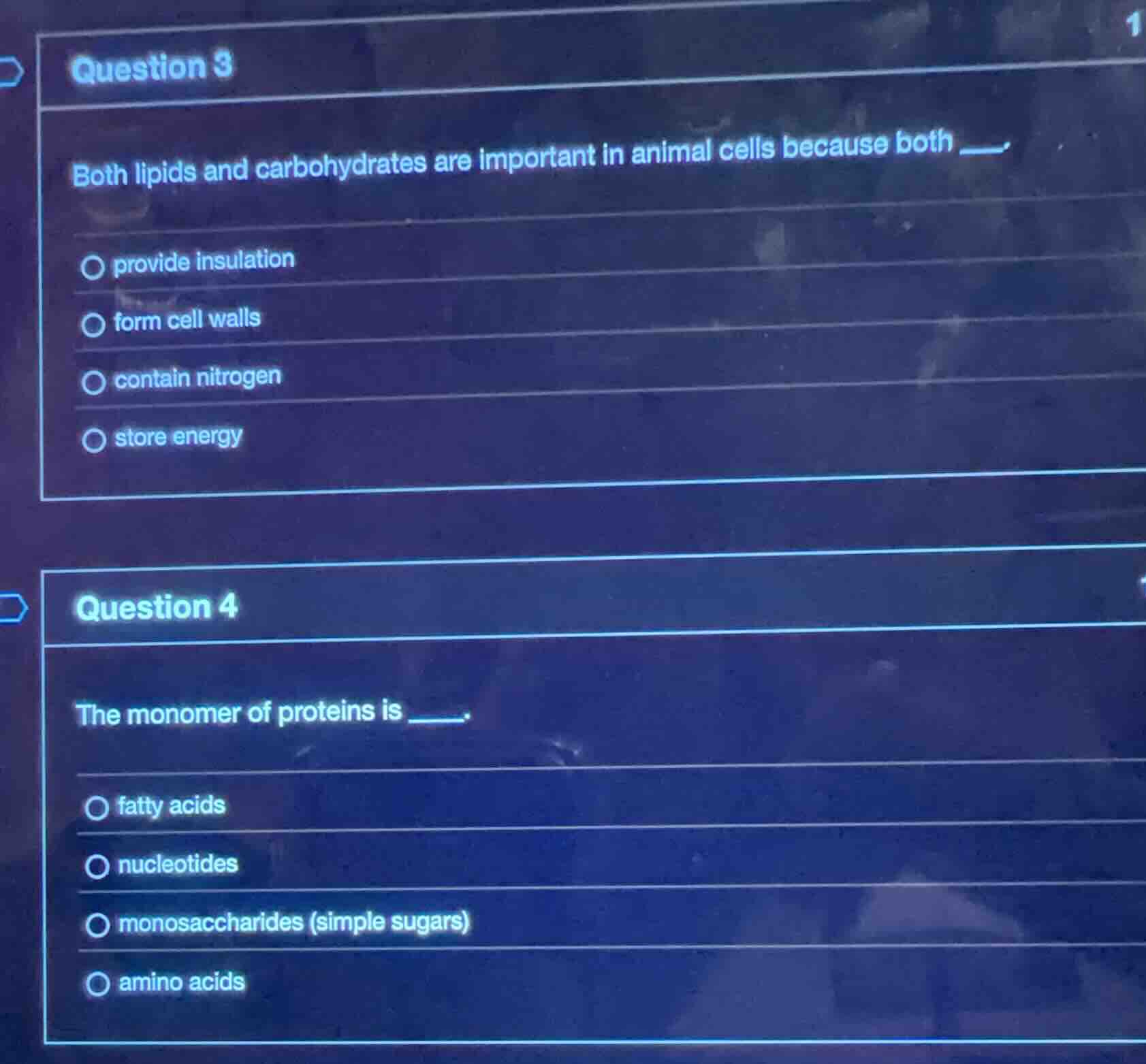
question 3
both lipids and carbohydrates are important in animal cells because both __.

  • provide insulation
  • form cell walls
  • contain nitrogen
  • store energy

question 4
the monomer of proteins is __.

  • fatty acids
  • nucleotides
  • monosaccharides (simple sugars)
  • amino acids

Explanation:

Response

<pre_analysis>
{
"quality": "clear",
"question_count": 2,
"skills_matched": [
"direct_cot",
"multiple_choice_formatter",
"explain_then_answer",
"tutor"
],
"needs_drawing": false,
"concepts_used": [
"Lipid Functions",
"Carbohydrate Functions",
"Protein Monomers"
],
"new_concepts": [],
"current_concepts": [
"Lipid Functions",
"Carbohydrate Functions",
"Protein Monomers",
"Biomolecules"
]
}
</pre_analysis>

<reasoning>

Analyze Question 3

This question asks for a shared function of lipids and carbohydrates in animal cells. Let's evaluate the options using our knowledge of Lipid Functions and Carbohydrate Functions:

  • "provide insulation": While lipids (fats) provide thermal insulation, carbohydrates do not serve this function.
  • "form cell walls": Animal cells do not have cell walls.
  • "contain nitrogen": Neither typical lipids nor simple carbohydrates contain nitrogen (they are composed of carbon, hydrogen, and oxygen).
  • "store energy": Both biomolecules are crucial for energy storage. Carbohydrates (like glycogen) provide short-term energy storage, while lipids (like triglycerides) provide long-term energy storage.

Analyze Question 4

This question asks for the building block of proteins. Let's evaluate the options using our knowledge of Protein Monomers:

  • "fatty acids": These are components of lipids.
  • "nucleotides": These are the monomers of nucleic acids (DNA and RNA).
  • "monosaccharides (simple sugars)": These are the monomers of carbohydrates.
  • "amino acids": These are the monomers that link together via peptide bonds to form proteins.

</reasoning>

<answer>

Question 3

<mcq-option>provide insulation</mcq-option>
<mcq-option>form cell walls</mcq-option>
<mcq-option>contain nitrogen</mcq-option>
<mcq-correct>store energy</mcq-correct>

Question 4

<mcq-option>fatty acids</mcq-option>
<mcq-option>nucleotides</mcq-option>
<mcq-option>monosaccharides (simple sugars)</mcq-option>
<mcq-correct>amino acids</mcq-correct>
</answer>

<post_analysis>
{
"subject": "Natural Science",
"question_type": "Multiple Choice",
"knowledge_point": [
"Natural Science",
"Biology",
"Biomolecules"
]
}
</post_analysis>

Answer:

<pre_analysis>
{
"quality": "clear",
"question_count": 2,
"skills_matched": [
"direct_cot",
"multiple_choice_formatter",
"explain_then_answer",
"tutor"
],
"needs_drawing": false,
"concepts_used": [
"Lipid Functions",
"Carbohydrate Functions",
"Protein Monomers"
],
"new_concepts": [],
"current_concepts": [
"Lipid Functions",
"Carbohydrate Functions",
"Protein Monomers",
"Biomolecules"
]
}
</pre_analysis>

<reasoning>

Analyze Question 3

This question asks for a shared function of lipids and carbohydrates in animal cells. Let's evaluate the options using our knowledge of Lipid Functions and Carbohydrate Functions:

  • "provide insulation": While lipids (fats) provide thermal insulation, carbohydrates do not serve this function.
  • "form cell walls": Animal cells do not have cell walls.
  • "contain nitrogen": Neither typical lipids nor simple carbohydrates contain nitrogen (they are composed of carbon, hydrogen, and oxygen).
  • "store energy": Both biomolecules are crucial for energy storage. Carbohydrates (like glycogen) provide short-term energy storage, while lipids (like triglycerides) provide long-term energy storage.

Analyze Question 4

This question asks for the building block of proteins. Let's evaluate the options using our knowledge of Protein Monomers:

  • "fatty acids": These are components of lipids.
  • "nucleotides": These are the monomers of nucleic acids (DNA and RNA).
  • "monosaccharides (simple sugars)": These are the monomers of carbohydrates.
  • "amino acids": These are the monomers that link together via peptide bonds to form proteins.

</reasoning>

<answer>

Question 3

<mcq-option>provide insulation</mcq-option>
<mcq-option>form cell walls</mcq-option>
<mcq-option>contain nitrogen</mcq-option>
<mcq-correct>store energy</mcq-correct>

Question 4

<mcq-option>fatty acids</mcq-option>
<mcq-option>nucleotides</mcq-option>
<mcq-option>monosaccharides (simple sugars)</mcq-option>
<mcq-correct>amino acids</mcq-correct>
</answer>

<post_analysis>
{
"subject": "Natural Science",
"question_type": "Multiple Choice",
"knowledge_point": [
"Natural Science",
"Biology",
"Biomolecules"
]
}
</post_analysis>