QUESTION IMAGE
Question
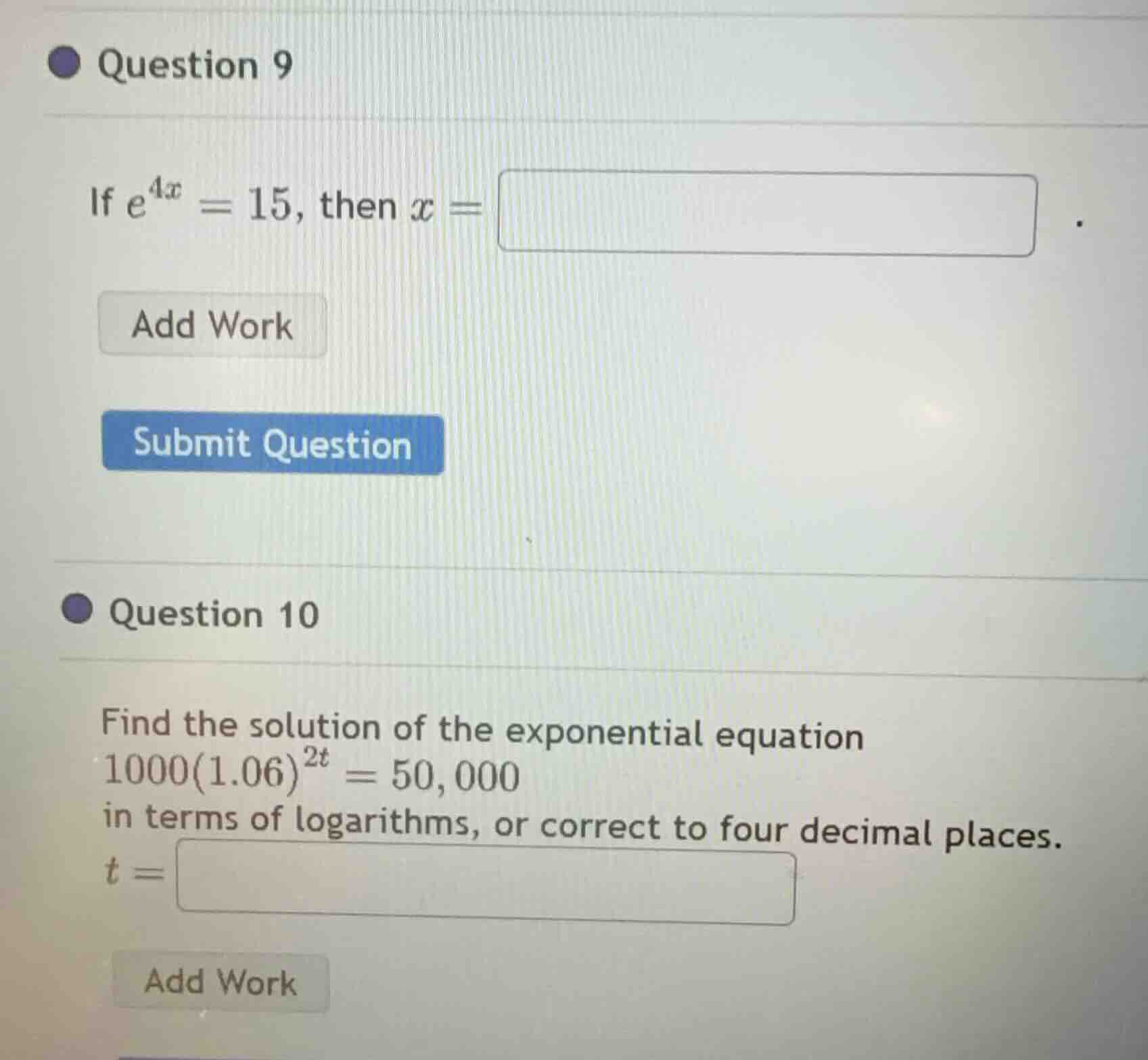
question 9
if (e^{4x} = 15), then (x = )
question 10
find the solution of the exponential equation
(1000(1.06)^{2t} = 50,000)
in terms of logarithms, or correct to four decimal places.
(t = )
⚡ Using what you learned: Solving Exponential Equations
Step 1: Solve Question 9
Take the natural logarithm (\(\ln\)) of both sides:
$$ \ln(e^{4x}) = \ln(15) $$
Apply the property \(\ln(e^u) = u\):
$$ 4x = \ln(15) $$
Divide by \(4\):
$$ x = \frac{\ln(15)}{4} $$
Step 2: Solve Question 10
Isolate the exponential term by dividing both sides by \(1000\):
$$ (1.06)^{2t} = 50 $$
Take the natural logarithm of both sides:
$$ \ln((1.06)^{2t}) = \ln(50) $$
Bring the exponent to the front:
$$ 2t \ln(1.06) = \ln(50) $$
Solve for \(t\):
$$ t = \frac{\ln(50)}{2 \ln(1.06)} $$
Calculate the decimal value:
$$ t \approx \frac{3.912023}{2 \times 0.0582689} \approx 33.5685 $$

Snap & solve any problem in the app
Get step-by-step solutions on Sovi AI
Photo-based solutions with guided steps
Explore more problems and detailed explanations
Question 9:
$$ x = \frac{\ln(15)}{4} \approx 0.6770 $$
Question 10:
$$ t = \frac{\ln(50)}{2\ln(1.06)} \approx 33.5685 $$