QUESTION IMAGE
Question
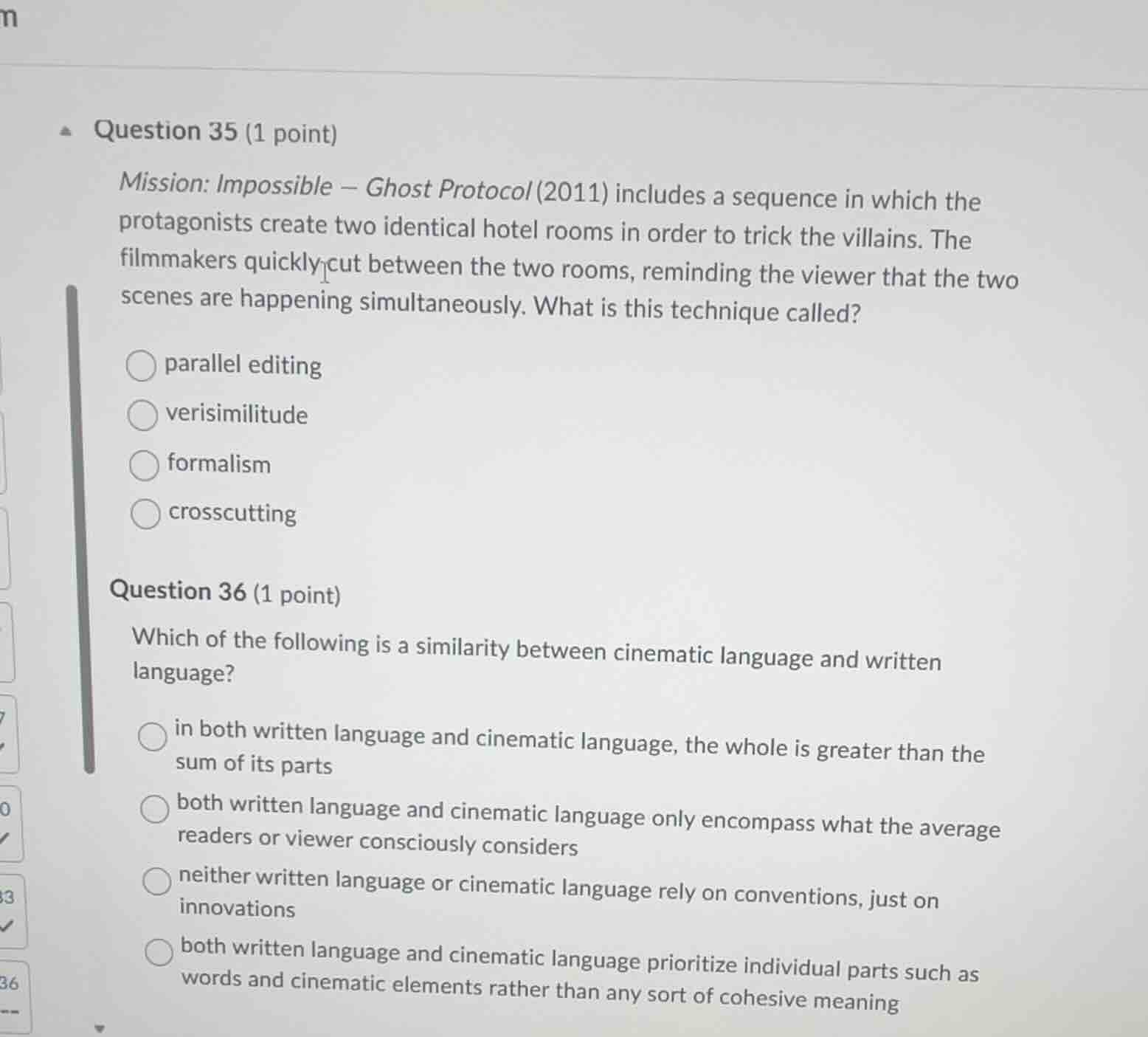
question 35 (1 point)
mission: impossible - ghost protocol (2011) includes a sequence in which the protagonists create two identical hotel rooms in order to trick the villains. the filmmakers quickly cut between the two rooms, reminding the viewer that the two scenes are happening simultaneously. what is this technique called?
parallel editing
verisimilitude
formalism
crosscutting
question 36 (1 point)
which of the following is a similarity between cinematic language and written language?
in both written language and cinematic language, the whole is greater than the sum of its parts
both written language and cinematic language only encompass what the average readers or viewer consciously considers
neither written language or cinematic language rely on conventions, just on innovations
both written language and cinematic language prioritize individual parts such as words and cinematic elements rather than any sort of cohesive meaning
Analyze Question 35
The prompt describes a sequence where filmmakers cut back and forth between two distinct locations (the two identical hotel rooms) to show actions occurring at the same time. This technique of alternating shots from two or more lines of action happening simultaneously in different places is known as crosscutting. While parallel editing is a closely related term, crosscutting specifically refers to editing that establishes simultaneous actions in different locations, which fits the description of cutting between the two rooms to show simultaneous events.
Analyze Question 36
We need to find a similarity between Cinematic Language and written language.
- Option 1: "in both written language and cinematic language, the whole is greater than the sum of its parts." This is a fundamental concept in film analysis and linguistics. Individual words or individual shots/cuts combine to create a deeper, cohesive meaning that exceeds the individual elements.
- Option 2: Both encompass far more than what is consciously considered (e.g., subconscious cues, grammar, lighting, framing).
- Option 3: Both rely heavily on conventions (grammar, genre tropes, continuity editing rules).
- Option 4: Both prioritize cohesive meaning over isolated individual parts.
Therefore, the first option is the correct similarity.

Snap & solve any problem in the app
Get step-by-step solutions on Sovi AI
Photo-based solutions with guided steps
Explore more problems and detailed explanations
Question 35
- parallel editing
- verisimilitude
- formalism
- crosscutting (Correct answer)
Question 36
- in both written language and cinematic language, the whole is greater than the sum of its parts (Correct answer)
- both written language and cinematic language only encompass what the average readers or viewer consciously considers
- neither written language or cinematic language rely on conventions, just on innovations
- both written language and cinematic language prioritize individual parts such as words and cinematic elements rather than any sort of cohesive meaning