QUESTION IMAGE
Question
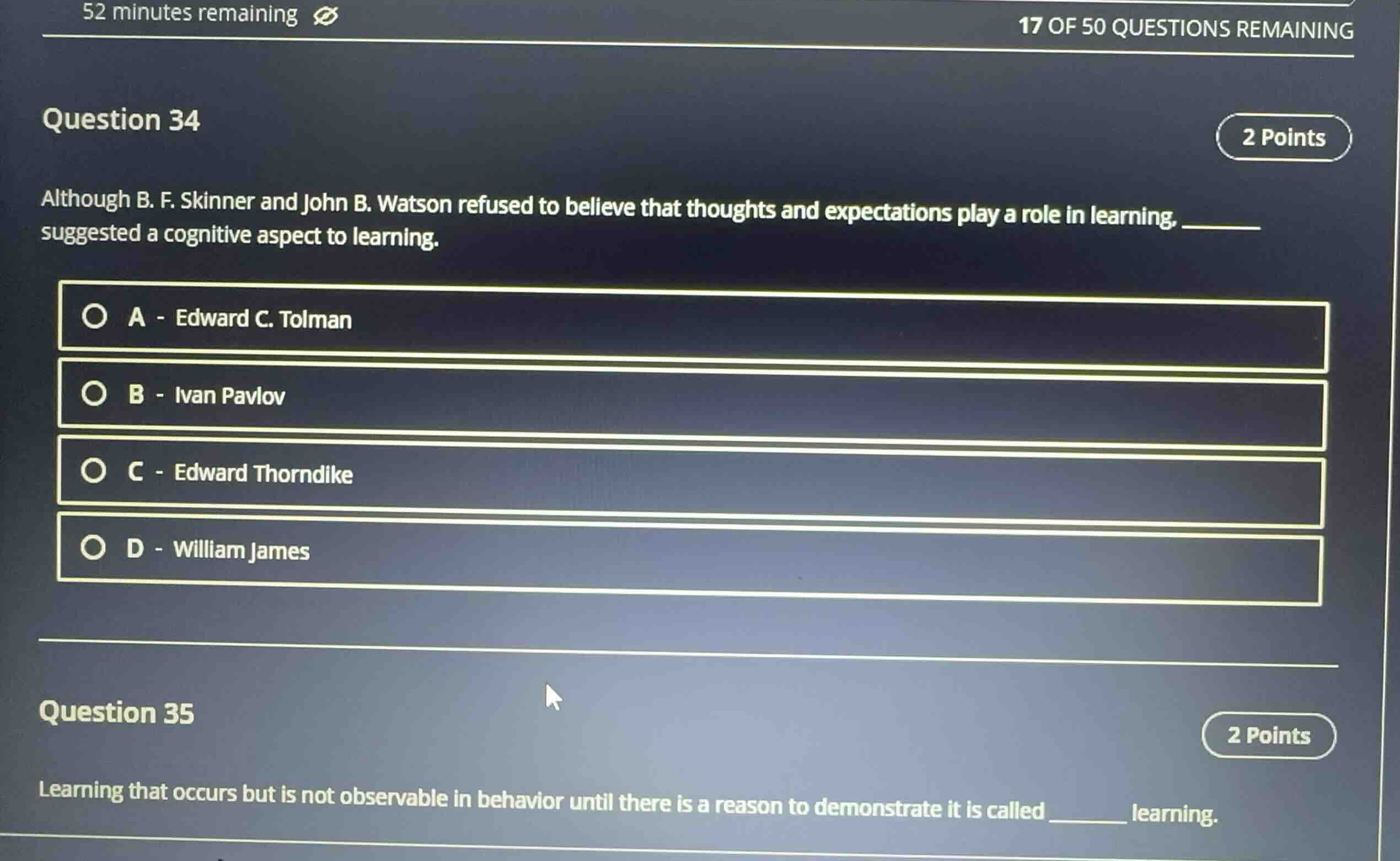
question 34
although b. f. skinner and john b. watson refused to believe that thoughts and expectations play a role in learning, ______ suggested a cognitive aspect to learning.
a - edward c. tolman
b - ivan pavlov
c - edward thorndike
d - william james
question 35
learning that occurs but is not observable in behavior until there is a reason to demonstrate it is called ______ learning.
Analyze Question 34
The question contrasts strict behaviorists like B. F. Skinner and John B. Watson with a researcher who proposed a cognitive aspect to learning.
- Skinner and Watson focused purely on observable behaviors, rejecting internal mental states.
- Edward C. Tolman introduced the concept of cognitive maps and latent learning, demonstrating that internal cognitive processes occur during learning.
- Ivan Pavlov and Edward Thorndike are classical behaviorists/connectionists. William James is associated with functionalism.
- Therefore, the correct researcher is Edward C. Tolman. This relates to Behavioral Psychology and Cognitive Learning.
Analyze Question 35
The question asks for the term describing learning that occurs without immediate reinforcement and is not demonstrated until there is an incentive to do so.
- This type of learning is known as latent learning.
- Edward Tolman demonstrated this with rats in mazes, showing they formed cognitive maps without rewards, only displaying their knowledge when food was introduced.
- This is a core concept of Cognitive Learning.

Snap & solve any problem in the app
Get step-by-step solutions on Sovi AI
Photo-based solutions with guided steps
Explore more problems and detailed explanations
Question 34
- A - Edward C. Tolman (Correct answer)
- B - Ivan Pavlov
- C - Edward Thorndike
- D - William James
Question 35
Learning that occurs but is not observable in behavior until there is a reason to demonstrate it is called <blank>latent</blank> learning.