QUESTION IMAGE
Question
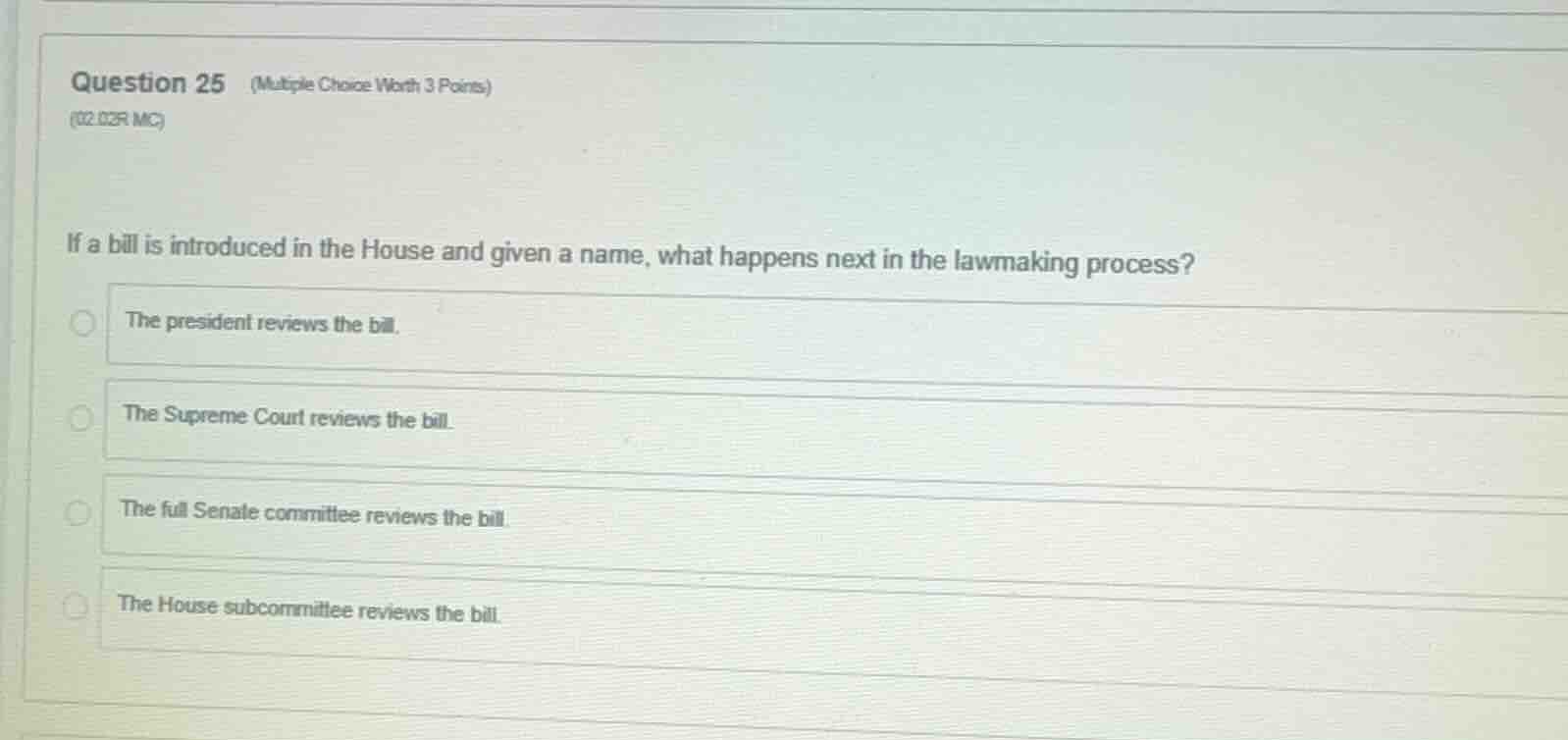
question 25 (multiple choice worth 3 points)
(02.02r mc)
if a bill is introduced in the house and given a name, what happens next in the lawmaking process?
- the president reviews the bill.
- the supreme court reviews the bill.
- the full senate committee reviews the bill.
- the house subcommittee reviews the bill.
Analyze the lawmaking process sequence
After a bill is introduced in either chamber of Congress (in this case, the House of Representatives) and assigned a designation/name (such as H.R. 1), it is referred to the appropriate standing committee. The committee then typically refers it to a specialized subcommittee for detailed study, hearings, and revisions.
Evaluate the given options
- The president reviews the bill: Incorrect. The president only reviews the bill at the very end of the legislative process after it has passed both the House and the Senate.
- The Supreme Court reviews the bill: Incorrect. The Supreme Court does not review bills during the legislative process; it only exercises judicial review on enacted laws if a case is brought before it.
- The full Senate committee reviews the bill: Incorrect. A bill introduced in the House must first go through the House committee system before it can ever reach the Senate.
- The House subcommittee reviews the bill: Correct. Referral to a House committee and its subsequent subcommittee is the immediate next step in the legislative process after introduction.

Snap & solve any problem in the app
Get step-by-step solutions on Sovi AI
Photo-based solutions with guided steps
Explore more problems and detailed explanations
- (A) The president reviews the bill.
- (B) The Supreme Court reviews the bill.
- (C) The full Senate committee reviews the bill.
- (D) The House subcommittee reviews the bill. (Correct answer)