QUESTION IMAGE
Question
question 22
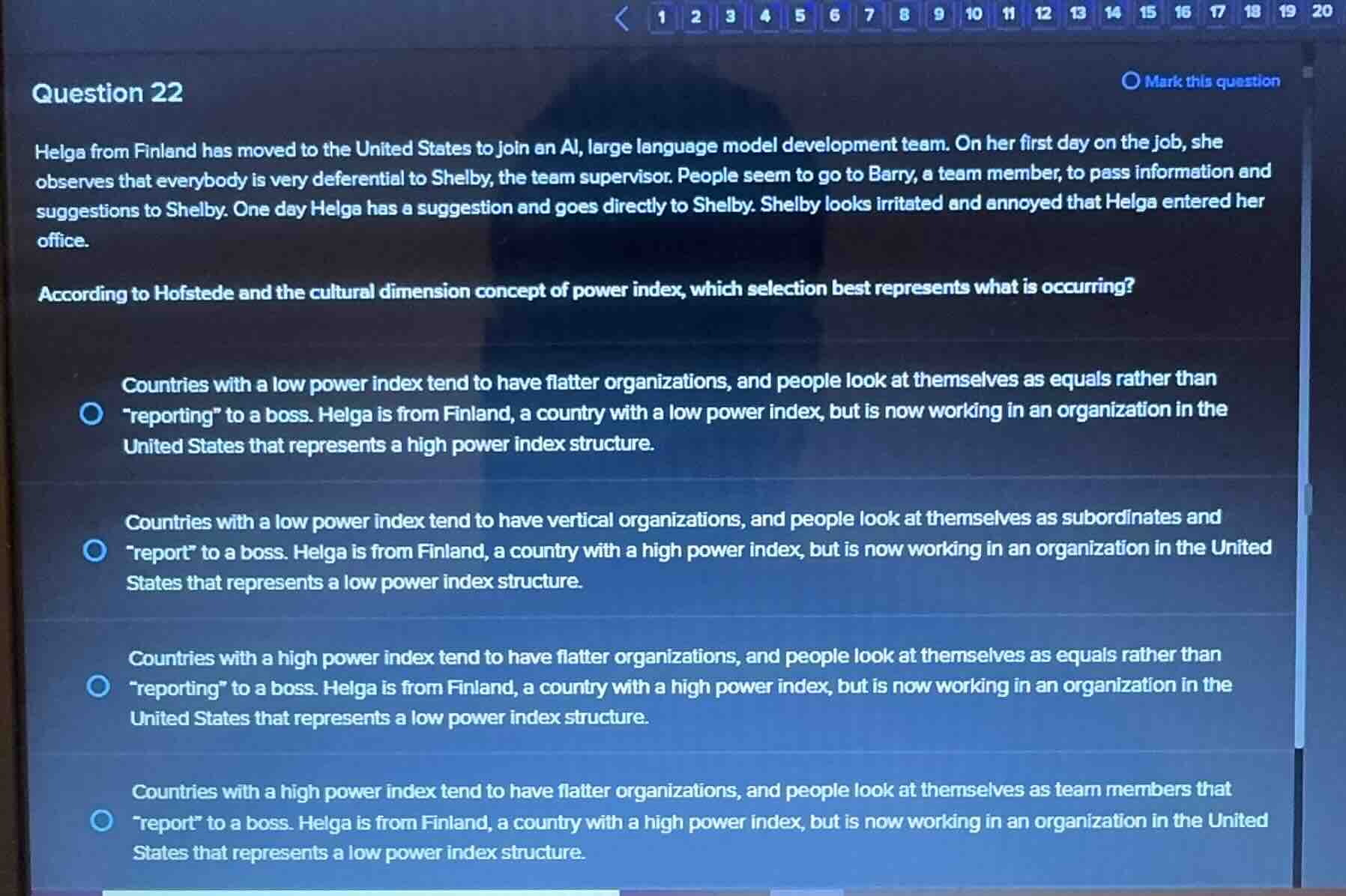
helga from finland has moved to the united states to join an ai, large language model development team. on her first day on the job, she observes that everybody is very deferential to shelby, the team supervisor. people seem to go to barry, a team member, to pass information and suggestions to shelby. one day helga has a suggestion and goes directly to shelby. shelby looks irritated and annoyed that helga entered her office.
according to hofstede and the cultural dimension concept of power index, which selection best represents what is occurring?
- countries with a low power index tend to have flatter organizations, and people look at themselves as equals rather than
eporting\ to a boss. helga is from finland, a country with a low power index, but is now working in an organization in the united states that represents a high power index structure.
- countries with a low power index tend to have vertical organizations, and people look at themselves as subordinates and
eport\ to a boss. helga is from finland, a country with a high power index, but is now working in an organization in the united states that represents a low power index structure.
- countries with a high power index tend to have flatter organizations, and people look at themselves as equals rather than
eporting\ to a boss. helga is from finland, a country with a high power index, but is now working in an organization in the united states that represents a low power index structure.
- countries with a high power index tend to have flatter organizations, and people look at themselves as team members that
eport\ to a boss. helga is from finland, a country with a high power index, but is now working in an organization in the united states that represents a low power index structure.
Analyze the cultural dimension of Power Distance Index (PDI)
The question asks us to apply Hofstede's cultural dimensions, specifically the power index (Power Distance Index or PDI), to Helga's situation.
- Low Power Distance (Low Power Index): Societies with a low power index prefer flatter organizational structures, decentralized authority, and minimal hierarchy. Employees and managers tend to view each other as equals, and direct communication across hierarchical levels is common and accepted. Finland is a classic example of a low power distance culture.
- High Power Distance (High Power Index): Societies or organizations with a high power index feature vertical, hierarchical structures. Authority is centralized, and subordinates expect to be told what to do. Communication follows a strict chain of command, and direct contact with high-level supervisors without going through intermediaries is often discouraged or viewed as disrespectful.
Evaluate the scenario details
- Helga's background: Helga is from Finland, which is characterized by a low power distance culture. She expects a flat structure where she can directly approach the supervisor, Shelby.
- The workplace environment: In her new US-based team, team members are highly deferential to Shelby and route all communication through Barry rather than approaching Shelby directly. When Helga bypasses this informal chain of command, Shelby becomes irritated. This behavior represents a high power distance (high power index) structure within this specific organizational context.
Compare with the given options
Let's evaluate the options based on our definitions:
- Option 1: "Countries with a low power index tend to have flatter organizations, and people look at themselves as equals rather than "reporting" to a boss. Helga is from Finland, a country with a low power index, but is now working in an organization in the United States that represents a high power index structure."
- This matches our analysis perfectly. Low power index = flatter organizations, viewing each other as equals. Finland = low power index. The new workplace = high power index structure.
- Option 2: Claims low power index countries have vertical organizations and that Finland has a high power index. This is incorrect.
- Option 3: Claims high power index countries have flatter organizations. This is incorrect.
- Option 4: Claims high power index countries have flatter organizations. This is incorrect.
Therefore, the first option is the correct representation of what is occurring.

Snap & solve any problem in the app
Get step-by-step solutions on Sovi AI
Photo-based solutions with guided steps
Explore more problems and detailed explanations
- (A) Countries with a low power index tend to have flatter organizations, and people look at themselves as equals rather than "reporting" to a boss. Helga is from Finland, a country with a low power index, but is now working in an organization in the United States that represents a high power index structure. (Correct answer)
- (B) Countries with a low power index tend to have vertical organizations, and people look at themselves as subordinates and "report" to a boss. Helga is from Finland, a country with a high power index, but is now working in an organization in the United States that represents a high power index structure.
- (C) Countries with a high power index tend to have flatter organizations, and people look at themselves as equals rather than "reporting" to a boss. Helga is from Finland, a country with a high power index, but is now working in an organization in the United States that represents a low power index structure.
- (D) Countries with a high power index tend to have flatter organizations, and people look at themselves as team members that "report" to a boss. Helga is from Finland, a country with a high power index, but is now working in an organization in the United States that represents a low power index structure.