QUESTION IMAGE
Question
question 6 of 20
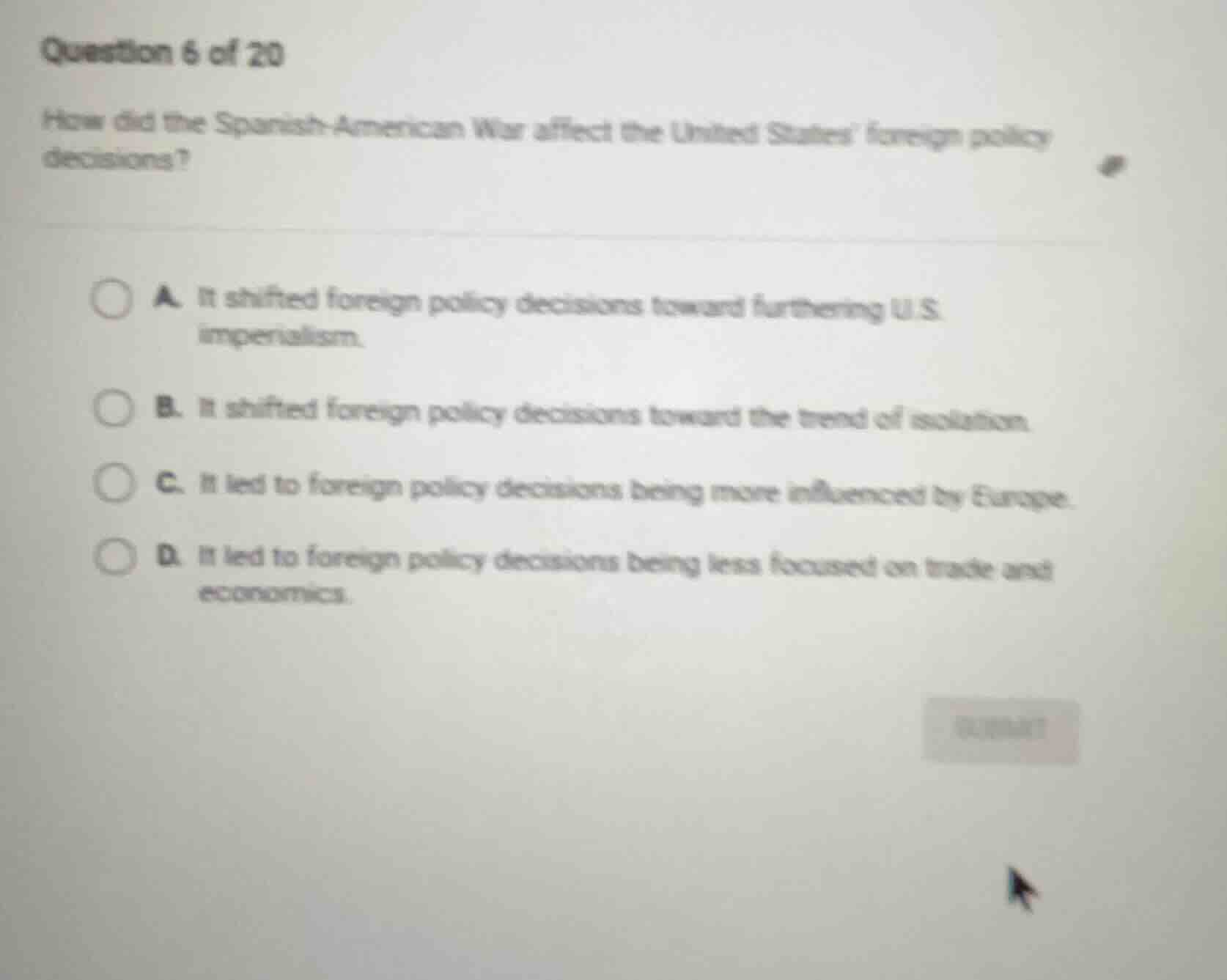
how did the spanish-american war affect the united states foreign policy decisions?
a. it shifted foreign policy decisions toward furthering u.s. imperialism.
b. it shifted foreign policy decisions toward the trend of isolation.
c. it led to foreign policy decisions being more influenced by europe.
d. it led to foreign policy decisions being less focused on trade and economics.
Analyze the historical context of the Spanish-American War
The Spanish-American War (1898) marked a critical turning point in United States foreign policy. Prior to the war, the U.S. largely adhered to a policy of non-intervention in European affairs and focused on continental expansion. The decisive victory over Spain resulted in the acquisition of overseas territories, including the Philippines, Guam, and Puerto Rico, while establishing a protectorate over Cuba.
Evaluate the impact on foreign policy decisions
Acquiring these overseas territories thrust the United States into the role of a global colonial power. This shift directly aligned with and accelerated the trend of US Imperialism, as the nation sought to expand its economic, military, and political influence globally, particularly in East Asia and the Caribbean.
Assess the given multiple-choice options
- Option A correctly identifies that the war shifted foreign policy toward furthering imperialism.
- Option B is incorrect because the war moved the U.S. away from isolationism, not toward it.
- Option C is incorrect because U.S. foreign policy became more independent and assertive globally, rather than being more influenced by Europe.
- Option D is incorrect because foreign policy became much more focused on securing international trade routes and economic markets (such as the Open Door Policy in China).

Snap & solve any problem in the app
Get step-by-step solutions on Sovi AI
Photo-based solutions with guided steps
Explore more problems and detailed explanations
- (A) It shifted foreign policy decisions toward furthering U.S. imperialism. (Correct answer)
- (B) It shifted foreign policy decisions toward the trend of isolation.
- (C) It led to foreign policy decisions being more influenced by Europe.
- (D) It led to foreign policy decisions being less focused on trade and economics.