QUESTION IMAGE
Question
question 20 of 25
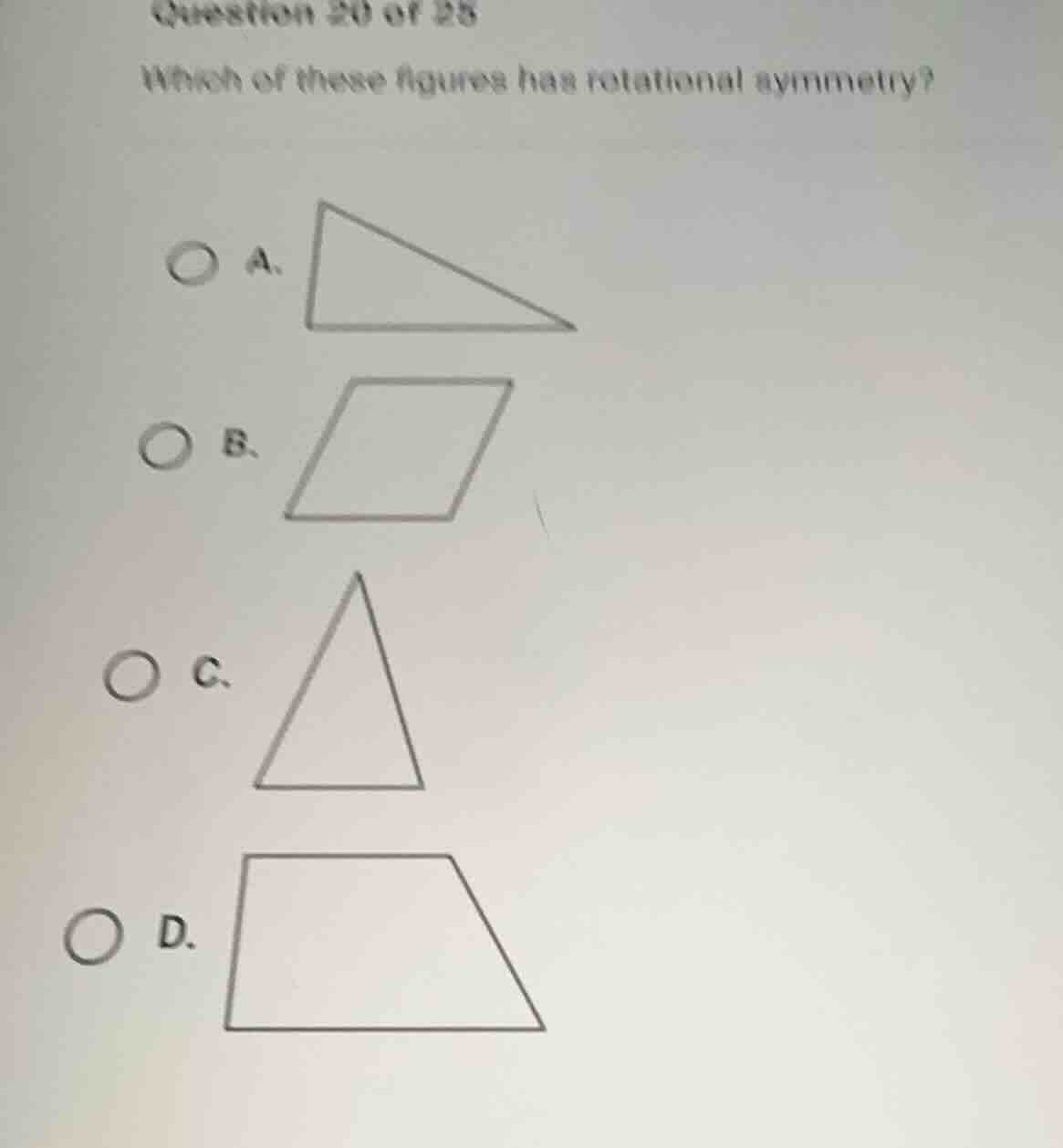
which of these figures has rotational symmetry?
a.
b.
c.
d.
Define rotational symmetry
Using the Rotational Symmetry Definition knowledge point
A figure has rotational symmetry if it can be rotated about a central point by an angle of more than \(0^\circ\) and less than \(360^\circ\) so that the image maps exactly onto the original figure.
Analyze each option
- Figure A (Scalene Right Triangle): Rotating this figure by any angle less than \(360^\circ\) will not result in the same orientation. It only maps onto itself after a full \(360^\circ\) rotation.
- Figure B (Parallelogram): A parallelogram has rotational symmetry of order 2. Rotating it by \(180^\circ\) about its center maps the figure exactly onto itself.
- Figure C (Isosceles Triangle): An isosceles triangle only has reflectional symmetry across its vertical altitude. It does not map onto itself for any rotation less than \(360^\circ\).
- Figure D (Trapezoid): A general trapezoid has no rotational symmetry, as rotating it by any angle less than \(360^\circ\) changes its orientation.

Snap & solve any problem in the app
Get step-by-step solutions on Sovi AI
Photo-based solutions with guided steps
Explore more problems and detailed explanations
- (A) Scalene right triangle
- (B) Parallelogram (Correct answer)
- (C) Isosceles triangle
- (D) Trapezoid