QUESTION IMAGE
Question
question 19 of 25
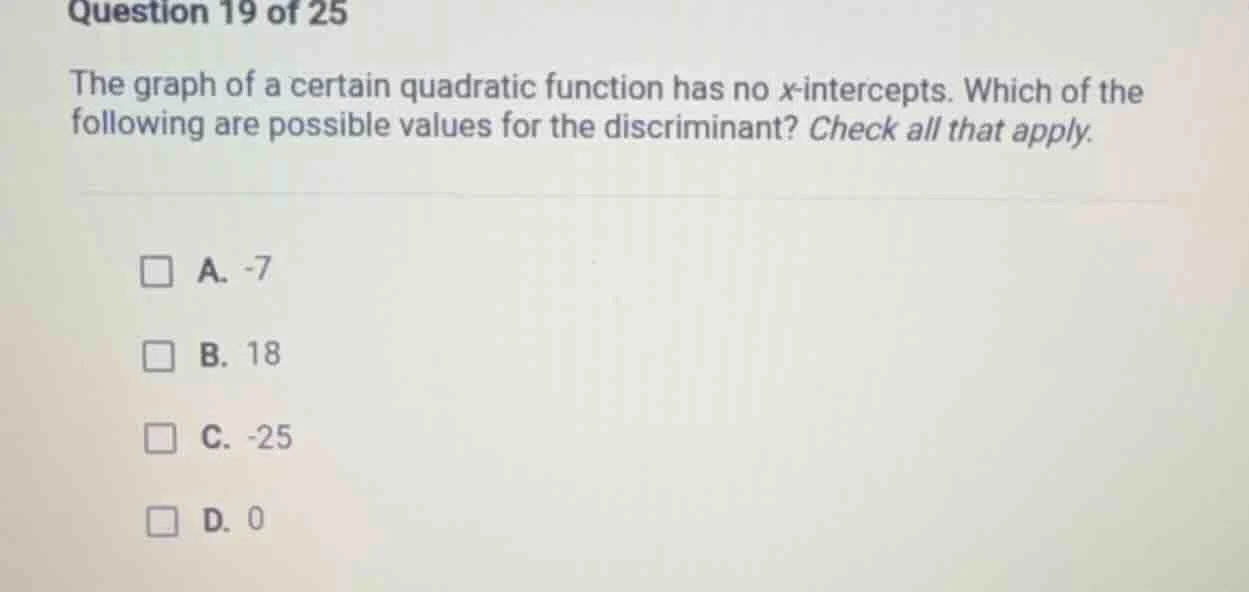
the graph of a certain quadratic function has no x-intercepts. which of the following are possible values for the discriminant? check all that apply.
a. -7
b. 18
c. -25
d. 0
Step1: Recall discriminant rules
For a quadratic function \(y = ax^2 + bx + c\), the discriminant is \(D = b^2 - 4ac\). The number of \(x\)-intercepts is determined by:
- If \(D>0\), two distinct \(x\)-intercepts.
- If \(D = 0\), one \(x\)-intercept.
- If \(D<0\), no \(x\)-intercepts.
Step2: Analyze each option
- Option A: \(-7<0\), so discriminant \(-7\) means no \(x\)-intercepts.
- Option B: \(18>0\), so two \(x\)-intercepts.
- Option C: \(-25<0\), so discriminant \(-25\) means no \(x\)-intercepts.
- Option D: \(0\) means one \(x\)-intercept.

Snap & solve any problem in the app
Get step-by-step solutions on Sovi AI
Photo-based solutions with guided steps
Explore more problems and detailed explanations
A. -7, C. -25