QUESTION IMAGE
Question
question #18
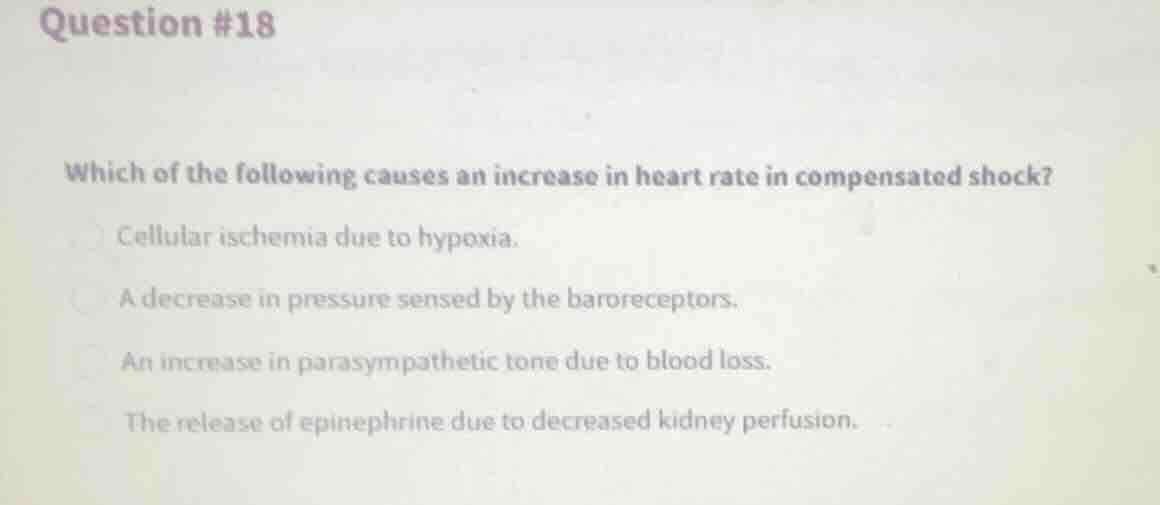
which of the following causes an increase in heart rate in compensated shock?
cellular ischemia due to hypoxia.
a decrease in pressure sensed by the baroreceptors.
an increase in parasympathetic tone due to blood loss.
the release of epinephrine due to decreased kidney perfusion.
<pre_analysis>
{
"quality": "clear",
"question_count": 1,
"skills_matched": [
"direct_cot",
"multiple_choice_formatter",
"explain_then_answer",
"tutor",
"mastery_adaptive_brevity"
],
"needs_drawing": false,
"concepts_used": [
"Shock Stages",
"Autonomic Nervous System Regulation"
],
"new_concepts": [
"Baroreceptor Reflex",
"Compensatory Shock Mechanisms"
],
"current_concepts": [
"Shock Stages",
"Autonomic Nervous System Regulation",
"Baroreceptor Reflex",
"Compensatory Shock Mechanisms"
]
}
</pre_analysis>
<reasoning>
Identify the physiological trigger in early shock
Using the Shock Stages knowledge point
In the early stage of shock (compensated shock), a decrease in circulating blood volume or cardiac output leads to a drop in arterial blood pressure.
Analyze the baroreceptor reflex response
Using the Autonomic Nervous System Regulation knowledge point
Specialized stretch receptors called baroreceptors, located in the carotid sinuses and aortic arch, detect this drop in arterial pressure. A decrease in pressure sensed by these baroreceptors reduces their firing rate to the cardioregulatory center in the brainstem.
Determine the autonomic nervous system output
Using the Autonomic Nervous System Regulation and Shock Stages knowledge points
The reduction in baroreceptor firing triggers a compensatory reflex: it decreases parasympathetic (vagal) tone and increases sympathetic nervous system activity. This sympathetic surge releases norepinephrine and epinephrine, which act on the heart to increase heart rate (tachycardia) and myocardial contractility, helping to maintain cardiac output and blood pressure.
Evaluate the given options
- Cellular ischemia due to hypoxia: This is a cellular consequence of hypoperfusion, not the primary systemic reflex trigger that increases heart rate.
- A decrease in pressure sensed by the baroreceptors: This is the direct physiological trigger that initiates the compensatory reflex to increase heart rate.
- An increase in parasympathetic tone due to blood loss: Blood loss triggers an increase in sympathetic tone, while parasympathetic tone is decreased.
- The release of epinephrine due to decreased kidney perfusion: Decreased kidney perfusion triggers the renin-angiotensin-aldosterone system (RAAS), not the immediate release of epinephrine (which is released from the adrenal medulla via direct sympathetic stimulation).
</reasoning>
<answer>
<mcq-option>Cellular ischemia due to hypoxia.</mcq-option>
<mcq-correct>A decrease in pressure sensed by the baroreceptors.</mcq-correct>
<mcq-option>An increase in parasympathetic tone due to blood loss.</mcq-option>
<mcq-option>The release of epinephrine due to decreased kidney perfusion.</mcq-option>
</answer>
<post_analysis>
{
"subject": "Natural Science",
"question_type": "Multiple Choice",
"knowledge_point": [
"Natural Science",
"Medicine and Health",
"Pathophysiology of Shock"
]
}
</post_analysis>
Snap & solve any problem in the app
Get step-by-step solutions on Sovi AI
Photo-based solutions with guided steps
Explore more problems and detailed explanations
<pre_analysis>
{
"quality": "clear",
"question_count": 1,
"skills_matched": [
"direct_cot",
"multiple_choice_formatter",
"explain_then_answer",
"tutor",
"mastery_adaptive_brevity"
],
"needs_drawing": false,
"concepts_used": [
"Shock Stages",
"Autonomic Nervous System Regulation"
],
"new_concepts": [
"Baroreceptor Reflex",
"Compensatory Shock Mechanisms"
],
"current_concepts": [
"Shock Stages",
"Autonomic Nervous System Regulation",
"Baroreceptor Reflex",
"Compensatory Shock Mechanisms"
]
}
</pre_analysis>
<reasoning>
Identify the physiological trigger in early shock
Using the Shock Stages knowledge point
In the early stage of shock (compensated shock), a decrease in circulating blood volume or cardiac output leads to a drop in arterial blood pressure.
Analyze the baroreceptor reflex response
Using the Autonomic Nervous System Regulation knowledge point
Specialized stretch receptors called baroreceptors, located in the carotid sinuses and aortic arch, detect this drop in arterial pressure. A decrease in pressure sensed by these baroreceptors reduces their firing rate to the cardioregulatory center in the brainstem.
Determine the autonomic nervous system output
Using the Autonomic Nervous System Regulation and Shock Stages knowledge points
The reduction in baroreceptor firing triggers a compensatory reflex: it decreases parasympathetic (vagal) tone and increases sympathetic nervous system activity. This sympathetic surge releases norepinephrine and epinephrine, which act on the heart to increase heart rate (tachycardia) and myocardial contractility, helping to maintain cardiac output and blood pressure.
Evaluate the given options
- Cellular ischemia due to hypoxia: This is a cellular consequence of hypoperfusion, not the primary systemic reflex trigger that increases heart rate.
- A decrease in pressure sensed by the baroreceptors: This is the direct physiological trigger that initiates the compensatory reflex to increase heart rate.
- An increase in parasympathetic tone due to blood loss: Blood loss triggers an increase in sympathetic tone, while parasympathetic tone is decreased.
- The release of epinephrine due to decreased kidney perfusion: Decreased kidney perfusion triggers the renin-angiotensin-aldosterone system (RAAS), not the immediate release of epinephrine (which is released from the adrenal medulla via direct sympathetic stimulation).
</reasoning>
<answer>
<mcq-option>Cellular ischemia due to hypoxia.</mcq-option>
<mcq-correct>A decrease in pressure sensed by the baroreceptors.</mcq-correct>
<mcq-option>An increase in parasympathetic tone due to blood loss.</mcq-option>
<mcq-option>The release of epinephrine due to decreased kidney perfusion.</mcq-option>
</answer>
<post_analysis>
{
"subject": "Natural Science",
"question_type": "Multiple Choice",
"knowledge_point": [
"Natural Science",
"Medicine and Health",
"Pathophysiology of Shock"
]
}
</post_analysis>