QUESTION IMAGE
Question
question 18
1 pts
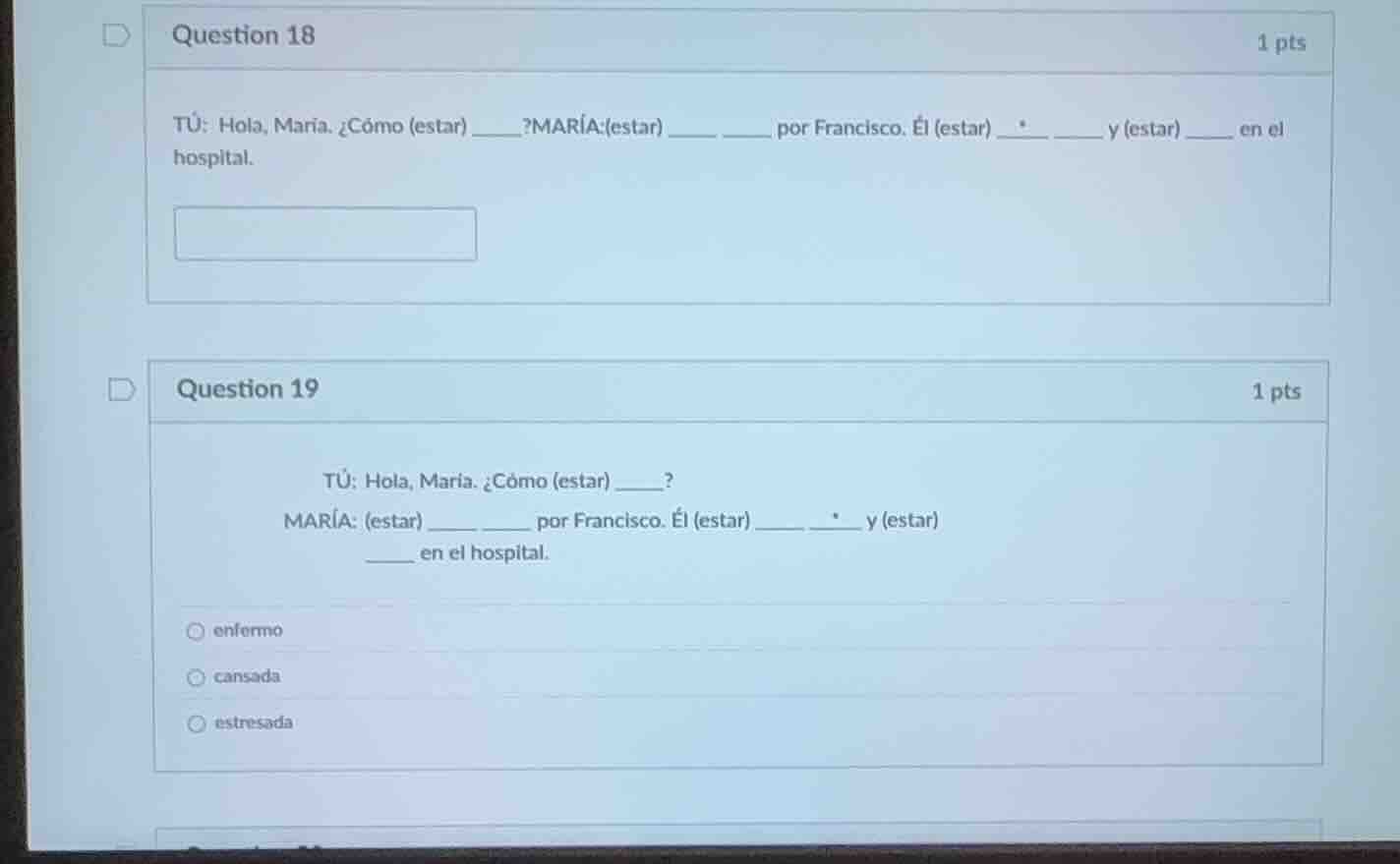
tú: hola, maría. ¿cómo (estar) __? maría: (estar) por francisco. él (estar) * y (estar) __ en el hospital.
question 19
1 pts
tú: hola, maría. ¿cómo (estar) ____?
maría: (estar) __ por francisco. él (estar) * y (estar) __ en el hospital.
enfermo
cansada
estresada
Analyze Question 18
The prompt asks to fill in the correct conjugations of the verb estar in the dialogue:
- TÚ: Hola, María. ¿Cómo (estar) \_\_\_\_\_?
- The subject is "tú" (informal "you"). The conjugation of estar for "tú" is estás.
- MARÍA: (estar) \_\_\_\_\_ por Francisco.
- María is speaking about herself ("yo"). The conjugation of estar for "yo" is estoy.
- Él (estar) \_\_\_\_\_\* y (estar) \_\_\_\_\_ en el hospital.
- The subject is "él" (he). The conjugation of estar for "él" is está. Both blanks refer to "él", so both conjugations are está.
Thus, the four conjugations in order are: estás, estoy, está, está.
Analyze Question 19
The prompt asks to select the word that fits the blank marked with an asterisk (\*) in the sentence:
"Él (estar) \_\_\_\_\_\* y (estar) \_\_\_\_\_ en el hospital."
- The subject is "él" (he), which is masculine singular.
- The adjective must agree in gender and number with "él" (Spanish Adjective Agreement).
- Let's look at the options:
- enfermo (masculine singular)
- cansada (feminine singular)
- estresada (feminine singular)
- Since "él" is masculine, the correct adjective is enfermo.

Snap & solve any problem in the app
Get step-by-step solutions on Sovi AI
Photo-based solutions with guided steps
Explore more problems and detailed explanations
Question 18
TÚ: Hola, María. ¿Cómo (estar) <blank>estás</blank>? MARÍA:(estar) <blank>estoy</blank> por Francisco. Él (estar) <blank>está</blank> y (estar) <blank>está</blank> en el hospital.
Question 19
- enfermo (Correct answer)
- cansada
- estresada