QUESTION IMAGE
Question
question 18
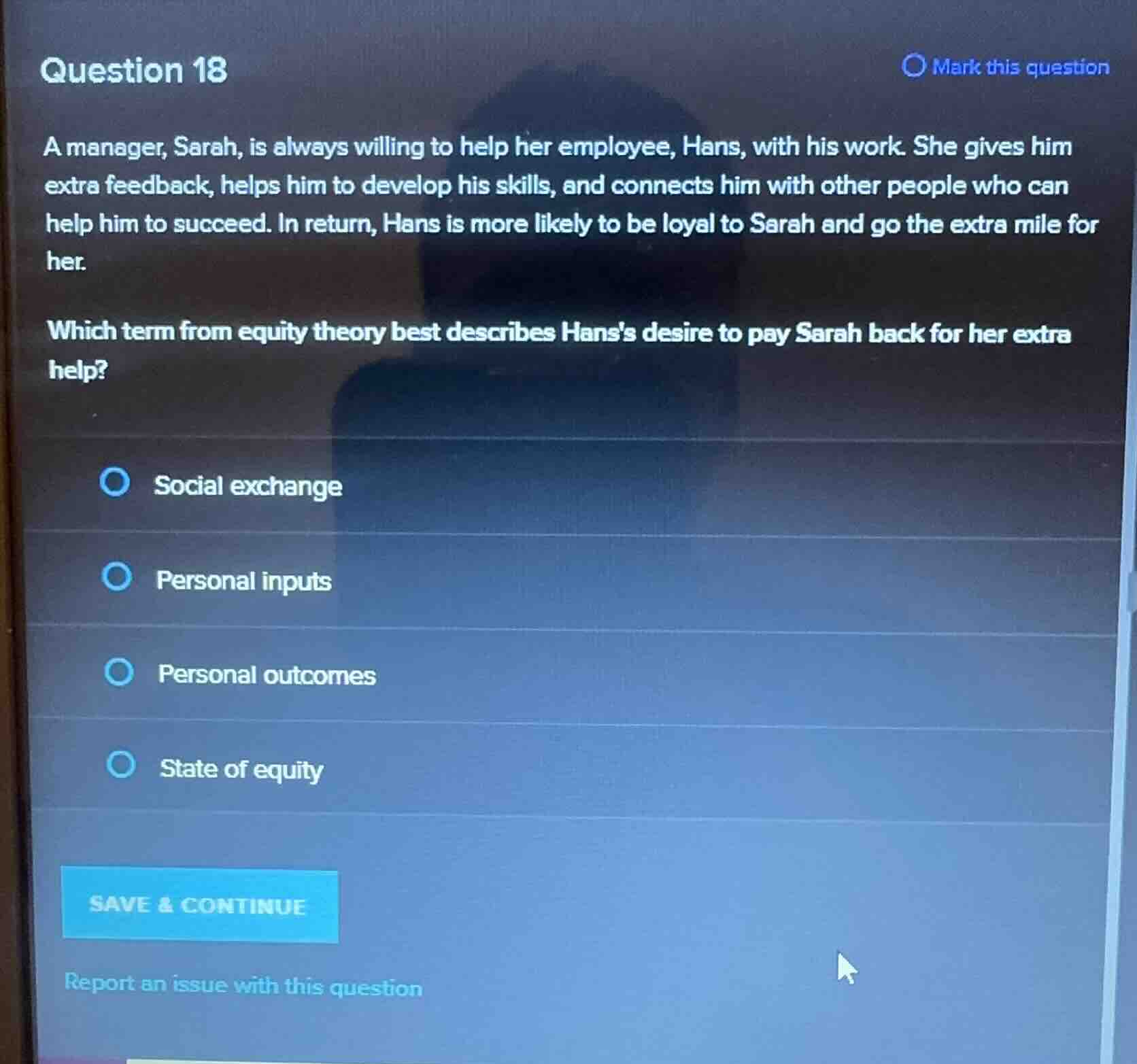
a manager, sarah, is always willing to help her employee, hans, with his work. she gives him extra feedback, helps him to develop his skills, and connects him with other people who can help him to succeed. in return, hans is more likely to be loyal to sarah and go the extra mile for her.
which term from equity theory best describes hanss desire to pay sarah back for her extra help?
social exchange
personal inputs
personal outcomes
state of equity
Analyze the scenario and question
Using the Equity Theory knowledge point
The scenario describes a reciprocal relationship where a manager (Sarah) provides extra support, feedback, and development to her employee (Hans). In return, Hans feels motivated to pay her back with loyalty and extra effort. The question asks which term from equity theory best describes Hans's desire to pay Sarah back for her extra help.
Evaluate the options
Using the Equity Theory knowledge point
- Social exchange: Equity theory is built on the concept of social exchange theory, where individuals view organizational relationships as a series of reciprocal transactions. When a manager provides high-quality inputs (support, mentoring), the employee feels a strong obligation to reciprocate with positive work behaviors (loyalty, extra effort) to maintain a balanced, fair exchange.
- Personal inputs: These are the contributions an individual brings to the job (e.g., effort, time, skills). While Hans's extra effort is an input, the desire to pay her back describes the underlying reciprocal relationship dynamic rather than just the input itself.
- Personal outcomes: These are the rewards an individual receives (e.g., pay, recognition, support). Sarah's help is an outcome for Hans, but the desire to reciprocate is not itself a personal outcome.
- State of equity: This is the cognitive state where an employee perceives their input-to-outcome ratio to be equal to a comparison other's ratio. The specific drive to reciprocate favorable treatment is best captured by the social exchange dynamic within the theory.
Therefore, the term that best describes this reciprocal desire to balance the relationship is social exchange.

Snap & solve any problem in the app
Get step-by-step solutions on Sovi AI
Photo-based solutions with guided steps
Explore more problems and detailed explanations
- (A) Social exchange (Correct answer)
- (B) Personal inputs
- (C) Personal outcomes
- (D) State of equity